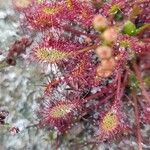
Drosera anglica
Great sundew · English sundew · Narrow-leaf sundew
Description
Source: leafsnapDrosera anglica, commonly known as the English sundew or great sundew, is a carnivorous flowering plant species belonging to the sundew family Droseraceae. It is a temperate species with a circumboreal range, although it does occur as far south as Japan, southern Europe, and the island of Kauai in Hawaii, where it grows as a tropical sundew. It is thought to originate from an amphidiploid hybrid of D. rotundifolia and D. linearis, meaning that a sterile hybrid between these two species doubled its chromosomes to produce fertile progeny which stabilized into the current D. anglica.
Care Guide
💧 Water 2-3 times a month
The English sundew flourishes in humid environments and prefers consistently moist conditions, typically needing watering twice a week. This perennial carnivorous plant thrives best outdoors, where it can effectively capture dew and insects. Its growth cycle is heavily influenced by the availability of water.
What is the most effective way to water your English sundew plant?
To adequately moisten your English sundew, grow it in a pot with good drainage holes and place a plastic dish or tray underneath. Fill the dish with about a third to half an inch of water, which will naturally be drawn up by the roots as the soil dries. Avoid letting the dish completely dry out and adjust the amount of water based on how quickly the plant absorbs it. Avoid using terra cotta pots for growing English sundews unless you place the pot inside a larger one. This is because water can seep through the clay and filter out dissolved solids. Only put water in the outer pot. The mineral content of the water used is crucial for watering English sundews adequately. If possible, collect rainwater for your English sundew as it is the safest option. Alternatively, distilled water or water from a reverse osmosis system are good alternatives. Purified water works as well, but may contain some minerals within the tolerable range for English sundews. Tap water with less than 50 parts per million of total dissolved solids is considered safe. You can purchase a meter to measure this at a reasonable cost. Remember to fill your watering device 24 hours in advance to allow chlorine to dissipate from the water before use.
If I give English sundew too much or too little water, what should I do?
Symptoms of an overwatered English sundew include brown spots on the undersides of leaves, white mold in the soil, and a wilted appearance. The wilted look is due to the plant's inability to draw water into its stem. Overwatering can lead to root rot, which can be identified by a bad smell. If root rot is present, it is important to remove the plant from its soil, rinse it with distilled water, cut away the rotted roots and affected leaves, rinse again with distilled water, and replant in new soil. On the other hand, an underwatered English sundew will have brittle leaves. In this case, it is necessary to cut away the affected leaves, ensure the soil is damp, and mist the leaves. To help the underwatered plant recover, it is important to resume watering as soon as possible. However, due to root damage, yellow leaves may dry out in the short term.
How frequently should I water my English sundew?
Insectivorous plants, like the English sundew, are commonly watered using the tray method. To do this, pot the sundew in a container with multiple drainage holes and place it in a tray filled about one-third with water. As the soil dries, the plant will naturally draw up water. It's important to add water promptly after the water level drops and avoid letting the tray dry out completely. This will help you gauge how often the plants need to be watered. Since English sundews are native to humid environments, finding the right balance between watering and letting the soil dry out is crucial. In the active seasons (spring to autumn), avoid letting the soil dry out completely. Water the English sundew 2-3 times per week in spring and fall, and increase the frequency of watering in the summer to keep the soil moist. However, during the winter and early spring when the sundew goes dormant, adjustments need to be made. Care for the plant by reducing the amount of water you give it. Allow the soil and water level in the tray to dry out for a few days before adding more. If you live in a naturally dry area, misting the English sundew may be necessary to replicate its humid growing conditions. This can be done in the morning. Proper water spraying is particularly important in dry environments.
How much water does my English sundew plant require?
English sundew is a type of carnivorous plant that is often kept as a houseplant. To successfully care for an English sundew, it is important to recreate its natural growing conditions, which include high humidity. These plants prefer environments that are humid and low in nutrients. If you live in a naturally humid area, you can grow them outside in a bog garden, which is a special type of garden designed for plants that require high humidity. However, most people choose to grow them as houseplants. When choosing a pot for your English sundew, it is best to use one that retains moisture, such as plastic or a self-watering pot. The tray method is the most effective way to water these insectivorous plants. Make sure the water level in the tray pots covers the small hole at the bottom, and add water as needed to keep the trays from drying out. By providing the right amount of water, you can ensure that your English sundew thrives.
Do I need to water English sundew differently when I plant it inside instead of outside?
English sundew plants grown indoors generally require less water due to receiving less sunlight. The amount of water needed for growth increases with the amount of light received. It is essential to provide sufficient light and water for the plant's health. Additionally, maintaining a humid environment is important for indoor plants. One effective way to do this is by growing them in a terrarium or as part of a plant display in an aquarium, as the enclosed sides prevent humid air from escaping. However, it is crucial to ensure proper air circulation.
☀️ Light Full sun
The English sundew prefers low-light conditions, mirroring its native habitat where sunlight is usually weaker. Although the plant can survive without light, it still needs some because light is vital for healthy growth. Both excessive and insufficient sunlight can stress the plant, limiting its growth and overall health.
What are the sunlight requirements for the English Sundew?
The English Sundew requires less than 3 hours of sunlight, thriving in full shade conditions. It's important to observe the movement of sunlight through your garden to pick spots providing a balance of light and shade, ensuring the plants' wellbeing. While it can survive with minimal light, some exposure is necessary for healthy growth. Excessive sunlight or a complete lack of it can stress the plant, affecting its growth and health.
How can artificial lighting support the English Sundew's growth?
Artificial lighting is crucial for the growth of indoor English Sundew plants, especially when natural sunlight is insufficient. LED lights are recommended because they can be customized to provide the specific wavelengths of light needed by the plants. The intensity of artificial light should be adjusted based on the plant's natural sunlight requirements: 30-50W/sq ft for full sun plants, 20-30W/sq ft for partial sun plants, and 10-20W/sq ft for full shade plants. The light source should be placed 12-36 inches above the plant to mimic natural sunlight, ensuring the plant receives 8-12 hours of light per day.
What are the symptoms of light deficiency in the English Sundew?
Symptoms of light deficiency in the English Sundew include smaller new leaves, leggy or sparse growth, faster leaf drop, slower or no new growth, lighter-colored new leaves, chlorosis, sunscald, leaf curling, wilting, and leaf scorching. These symptoms hinder the plant's growth by affecting its ability to photosynthesize and maintain health.
What solutions exist for light-related issues in the English Sundew?
To address light-related issues in the English Sundew, move indoor plants closer to windows for optimal natural light or use artificial lights for at least 8 hours daily. Outdoor plants should be gradually moved to sunnier locations to avoid sudden changes and potential sunburn. For ground plants, reduce obstructions by pruning or transplanting during the dormant period to ensure adequate sunlight and good drainage. It's crucial to note that affected parts may not recover, but new growth post-adjustment will be healthy.
🌡️ Temperature 20–35°C
The English sundew is native to temperate regions and thrives best in temperatures of 68 to 95 °F (20 to 35 ℃). In high heat or cold seasons, adjust the temperature to match its preferred range to ensure optimal growth.
What is the native region and ideal temperature range for the English sundew?
The English sundew, or Drosera anglica, is native to temperate regions. It thrives best in temperatures ranging from 68 to 95 °F (20 to 35 °C). To ensure optimal growth, it is crucial to adjust the environmental temperature to fit its preferences, especially during high heat or cold seasons. Maintaining temperatures above 20°C during the winter cultivation is beneficial for the plant's growth, with the minimum temperature kept above the freezing point to prevent freezing damage. When outdoor temperatures approach -5°C (25°F) during winter, bringing the English sundew indoors or providing protection with a temporary greenhouse or wrapping materials such as plastic film or fabric is advisable.
How does the English sundew respond to low temperatures, and what measures should be taken?
The English sundew has a moderate tolerance to low temperatures, performing best when the temperature is between 20°C and 35°C. During winter, it is important to keep the temperature above 0°C. Exposure to temperatures below -5°C can cause the leaves to darken, and in severe cases, lead to water-soaked necrosis, wilting, drooping, and a gradual browning of the leaves. To protect the plant in such conditions, frost-damaged parts should be trimmed away, and the plant should be moved indoors to a warm environment or housed within a makeshift greenhouse. If placed indoors, positioning the plant near a south-facing window ensures it receives ample sunlight. In the event of insufficient light, supplemental lighting may be used.
What are the effects of high temperatures on the English sundew, and how can they be mitigated?
During summer, it is crucial to keep the English sundew’s environment below 35°C. Temperatures exceeding 38°C can slow down its growth, lighten the color of its leaves, and increase susceptibility to sunburn. To counteract these effects, sunburned and dried-up parts of the plant should be trimmed away. Moving the plant to a location that provides afternoon shade can protect it from the harsh sun. Additionally, watering the plant in the morning and evening helps keep the soil moist and supports the plant's well-being in high-temperature conditions.
💨 Humidity
🪴 Soil 5-6
🌱 Fertilizer
Drosera does not require fertilizer but when it's planted indoors it's good to use the fertilizer in small amounts. Maxsea can be applied once in a month, ¼ of the fertilizer can be mixed with a gallon of water and sprayed on the plants
🪴 Pot & Repot 2-3 years
When repotting an English sundew, pick a pot 1-2 inches (2.5–5.1 cm) larger that has ample drainage. Use a well-draining potting mix. Repot in spring or fall, making sure the root ball sits slightly below the rim of the flower pot. Water thoroughly after repotting and place the plant in a warm spot with indirect sunlight.
✂️ Pruning
The English sundew is a carnivorous plant that uses its sticky leaves to trap insects. To encourage growth and prevent disease, prune any dead leaves from early to late spring. Make sure to use clean tools to avoid infection, and consult reliable sources for additional care tips.
🌿 Propagating
🐛 Diseases & pets
☠️ Toxicity
Drosera is not toxic, and it's considered safe to human and pets, in fact some people use Drosera as homeopathic medicine
Characteristics
- Plant Type
- Herb
- Life Cycle
- Perennial
- Genus
- Drosera
- Family
- Droseraceae
- Hardiness Zone
- 9
- Mature Height
- 2 cm
- Mature Spread
- 5 cm
- Leaf Color
- Green, Red
- Leaf Type
- Deciduous
- Flower Color
- White
- Flower Size
- 0.76 cm
- Bloom Time
- Summer
- Planting Time
- Spring, Summer
- Harvest Time
- Late summer, Early fall, Mid fall