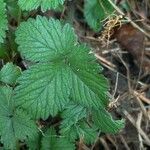
Duchesnea indica
Indian strawberry · Mock Strawberry · Yellow-flowered Strawberry · India mockstrawberry · False strawberry
Description
Source: leafsnapDuchesnea indica, commonly known as Indian strawberry or mock strawberry, is a perennial herbaceous plant belonging to the Rosaceae family. Native to Asia, it can be found in various parts of the world, including North America and Europe. The plant grows up to 30 cm in height and features trifoliate leaves that are green on top and pale underneath. The flowers are yellow with five petals, and the fruit resembles a small red strawberry, though it lacks flavor. Duchesnea indica has been used in traditional Chinese medicine for centuries due to its perceived medicinal properties. It is believed to have anti-inflammatory effects that can help alleviate pain caused by arthritis and other inflammatory conditions. Additionally, it has been used as a diuretic and laxative. The plant prefers moist soil conditions but can tolerate drought once established. It spreads through runners or stolons that root at nodes along their length, allowing it to form dense mats of vegetation over time. While Duchesnea indica may be considered an invasive species in some areas due to its ability to spread rapidly through runners and stolons, it also serves as an important food source for wildlife such as birds, which feed on its fruit during winter months when other food sources are scarce. Overall, Duchesnea indica is a fascinating herbaceous perennial with medicinal properties. It serves important ecological functions within its native range but can be considered invasive elsewhere primarily due to its rapid, stoloniferous growth habit.
🌳 Mock strawberry, which is frequently misidentified as the strawberry, fulfills a distinct ecological function. These plants usually do well in disturbed environments and are therefore often used to help control soil erosion. Their thick mats of leaves can hold soil in place, offering an ecological benefit in erosion-prone locations. In addition, their flowers supply nectar to pollinators, thereby making an important contribution to the survival of several bee species.
🎭 Good luck
Care Guide
💧 Water Every 7 days
Mock Strawberry will appreciate regular watering but are quite drought-tolerant.
☀️ Light Partial sun
Mock strawberry performs best in spots that receive sufficient sunlight for half of the day. It can, however, tolerate full sun or full shade. Too much light can reduce its overall robustness, while low light can inhibit its growth. It originated in environments with fluctuating light levels, which fosters its adaptability.
🌡️ Temperature 5–35°C
Mock strawberry is a plant that grows best in its native temperature range of 68 to 95 °F (20 to 35 ℃). It favors mild climates but can tolerate colder or hotter seasons. To promote its growth, adjust the temperature as needed.
💨 Humidity
🪴 Soil 5-7
🌱 Fertilizer
A single fertilizer application in spring is generally sufficient for Mock strawberry, though several feedings can boost growth. Feed about once every month to a month and a half. Fertilizing improves leaf appearance and function, helping maintain even color and a healthy texture. It also encourages root development and better nutrient uptake for long-term plant health.
🪴 Pot & Repot 2-3 years
When repotting Mock strawberry, select a pot 1-2 inches (2.5–5.1 cm) larger that has ample drainage. Use a well-draining potting mix. Repot in spring or fall, making sure the root ball sits slightly lower than the rim of the flower pot. Water thoroughly after repotting and place in a warm spot with indirect sunlight.
✂️ Pruning
Mock Strawberries do not require pruning to encourage healthy growth. You may deadhead blooms and remove dead or unsightly foliage after the flowering period ends.
🌿 Propagating
🐛 Diseases & pets
☠️ Toxicity
Mock Strawberry fruit is not poisonous, but as mentioned above, it is not considered to be very tasty. While Potentilla indica is not poisonous, exercise caution when foraging because many other berries in the wild can be toxic to humans.
Characteristics
- Plant Type
- Herb
- Life Cycle
- Perennial, Annual
- Genus
- Duchesnea
- Family
- Rosaceae
- Hardiness Zone
- 5-9
- Mature Height
- 30 cm to 91 cm
- Mature Spread
- 76 cm
- Leaf Color
- Green
- Leaf Type
- Deciduous
- Flower Color
- White, Yellow
- Flower Size
- 1.52 cm to 2.54 cm
- Bloom Time
- Late spring, Early summer, Mid summer
- Planting Time
- Autumn, Winter, Spring
- Harvest Time
- Early summer, Mid summer
- Native Area
- Nepal, Sri Lanka, Tajikistan, Turkey, India, Philippines, Bangladesh, Pakistan, Laos, China, Afghanistan, Indonesia, Vietnam, Myanmar, Japan, Koppen, Bhutan, South Korea, Thailand