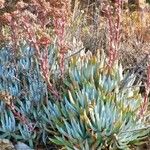
Dudleya virens
Bright green dudleya · Green liveforever
Description
Source: leafsnapDudleya virens, the green liveforever or bright green dudleya, is an uncommon species of perennial, succulent plant in the family Crassulaceae, native to several coastal southern California and Baja California locations.
Care Guide
💧 Water
Bright green dudleya, native to coastal California, thrives in arid environments with minimal water. This drought-tolerant succulent adapts well to xeric landscapes, making use of dew and fog as sources of moisture in addition to needing just weekly watering. It stores moisture in its fleshy leaves, allowing it to withstand infrequent rainfall.
☀️ Light Full sun
Bright green dudleya performs best in spots where it can take in a generous amount of sunlight for growth and well-being. Excessive exposure may damage the plant, while too little light can impede its development. It can cope in environments that have less sun than its original growing habitat.
What are the sunlight requirements for Bright Green Dudleya?
Bright Green Dudleya thrives best in full sunlight, requiring more than 6 hours of sunlight per day, though it can also tolerate partial sun, which is about 3-6 hours of sunlight. It's essential to observe how sunlight moves through your garden to find spots that offer the right balance of light and shade, ensuring the plant's happiness and health. However, excessive exposure to sunlight can harm the plant, while insufficient sunlight may hinder its growth.
How important is artificial lighting for indoor Bright Green Dudleya plants?
Artificial lighting plays a crucial role for indoor Bright Green Dudleya plants, especially when natural sunlight is insufficient, such as in winter or in areas that receive less sun. It promotes healthier, faster growth by supplementing the lack of natural sunlight. LED lights are recommended due to their ability to provide specific wavelengths needed for plant growth. Full sun plants require 30-50W/sq ft, partial sun plants need 20-30W/sq ft, and full shade plants need 10-20W/sq ft of artificial light. The proper distance (12-36 inches above the plant) and duration (8-12 hours per day) of light exposure are crucial for mimicking natural sunlight conditions.
What are the symptoms of inadequate lighting for Bright Green Dudleya?
When Bright Green Dudleya doesn't receive enough light, several symptoms can appear, including smaller new leaves, leggy or sparse growth, early leaf drop, halted growth, lighter-colored new leaves, chlorosis, sunscald, leaf curling, wilting, and leaf scorching. These symptoms indicate either too little or too much sunlight exposure, affecting the plant's ability to photosynthesize, maintain health, and grow properly.
What solutions can help Bright Green Dudleya receive adequate light?
To ensure Bright Green Dudleya receives adequate light, gradually move the plants to sunnier locations until they get at least 6 hours of direct sunlight daily. For indoor plants, consider using artificial light sources like desk or ceiling lamps, or professional plant grow lights, if moving them isn't feasible. Outdoors, adapt plants to brighter conditions by moving them weekly to prevent sunburn. Minimize obstructions to sunlight by pruning or relocating smaller plants to sunnier spots. Although parts of the plant damaged by incorrect light exposure may not recover, new growth will be healthy with proper care.
🌡️ Temperature 20–37.8°C
Although Bright green dudleya tolerates some heat, it mainly thrives and grows in the cooler seasons and goes dormant in summer. In hot summer conditions, provide shade to avoid scorching from intense sunlight. Watering should be reduced or stopped during the hottest part of the year to prevent root rot. Bright green dudleya shows vigorous growth in winter and spring, and as long as temperatures don’t fall too low, it will continue to grow steadily.
What is the name of the plant?
The plant is called Bright green dudleya, and its botanical name is Dudleya virens.
💨 Humidity
🪴 Soil 6-7
🌱 Fertilizer
For Bright green dudleya, small amounts of fertilizer once or twice a year during the growing season are enough. Do not fertilize in winter or in summer when the plant is dormant. Cut back on fertilizer for plants that have been repotted, and wait a couple of months after repotting before applying fertilizer. Fertilizing helps maintain healthy growth and promotes flowering.
🪴 Pot & Repot Every 3 years
✂️ Pruning
Bright green dudleya is a succulent that thrives in well-drained soil. To encourage healthy growth and maintain its shape, it's best to prune the plant from early to late spring. Be sure to use sterilized tools to prevent the spread of disease. When pruning, limit the amount you cut to preserve the water-storing leaves, which are vital for the plant. This careful pruning will also improve air circulation and decrease the risk of rot.
🌿 Propagating
🐛 Diseases & pets
☠️ Toxicity
Characteristics
- Plant Type
- Herb
- Life Cycle
- Perennial
- Genus
- Dudleya
- Family
- Crassulaceae
- Hardiness Zone
- 9-11
- Mature Height
- 10 cm to 20 cm
- Mature Spread
- 10 cm to 49 cm
- Leaf Color
- Green
- Leaf Type
- Evergreen
- Flower Color
- Yellow
- Flower Size
- 2.54 cm
- Bloom Time
- Mid spring, Late spring, Early summer
- Planting Time
- Spring, Summer
- Harvest Time
- Mid summer, Late summer, Early fall