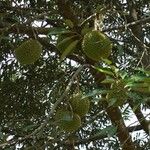
Durio zibethinus
Durian · Dhurin · 榴槤
Description
Source: leafsnapDurio zibethinus, commonly known as durian, is a tropical fruit tree native to Southeast Asia. Belonging to the Malvaceae family, this tree can grow up to 50 meters tall. Durian trees produce large, spiky fruits that are highly valued for their unique flavor and aroma. The durian fruit is renowned for its strong odor, often described as a mix of sweet custard and pungent cheese. The flesh of the fruit is creamy yellow and contains large seeds at its center. It is rich in nutrients such as vitamin C, potassium, fiber, and antioxidants. Durian trees require warm temperatures and high humidity levels for optimal growth. They are typically cultivated in tropical regions like Thailand, Malaysia, and Indonesia, where they are an important crop for local farmers. Beyond its culinary uses, durian has been employed medicinally by traditional healers in Southeast Asia for centuries. It has been used to treat various ailments, including fever, diarrhea, and high blood pressure. Despite its popularity among enthusiasts who enjoy its unique flavor, some people find the smell of durians unpleasant or even offensive. In some countries, such as Singapore, the fruit is banned from public transportation due to its strong odor.
🌳 Surprisingly, the strong scent of durian, often seen as overpowering, is used by perfumers to craft captivating fragrances. Moreover, the usually discarded durian rind is being turned into an energy source, cleverly repurposed as supercapacitors for electronics.
Care Guide
💧 Water Every 7 days
Originating from Southeast Asia, durian thrives in the humid conditions of tropical rainforests. It needs consistent humidity and should be watered every 2 to 3 weeks. Typically grown outdoors, durian benefits from the natural rainfall that supports its growth and development.
How should I water my Durian?
Your Durian isn't fussy when it comes to watering methods. You can use any common watering tool, like watering cans, hoses, or even cups, to keep the soil moist. Make sure to water directly onto the soil and water all areas evenly to ensure the entire root system gets enough water. Using filtered water is a good idea since tap water may have harmful particles. It's also best to use water that is at or slightly above room temperature to avoid shocking the Durian. However, the Durian generally does well with any type of water.
What should I do if I give my Durian plant too much or too little water?
Outdoor plants, particularly newly planted ones or seedlings, are at risk of not getting enough water. It's important to consistently water them for several months while the tree is small or just planted. Once the roots are established, the Durian can rely on rain for most of its water needs. When you have Durian plants in pots, overwatering is a common issue. If you accidentally overwater your Durian, take immediate action to address the situation. Stop watering the plant right away to minimize the impact of overwatering. Then, remove the Durian from its pot to inspect the roots. If there are no signs of root rot, you can put the plant back in its container. However, if you find any roots affected by rot, trim them away and consider using a fungicide to prevent further damage. Finally, repot the Durian in well-draining soil. In the case of underwatered Durian plants, simply increase the frequency of watering. Underwatering is usually an easy problem to solve. When a plant is underwatered, its leaves may droop, dry out, and fall off. However, the leaves will recover quickly and regain their fullness once sufficiently watered. It's important to adjust your watering schedule as soon as you notice underwatering.
How many times should I give water to my Durian?
Most outdoor plants can grow naturally with rainfall. However, if your area doesn't receive much rain, you'll need to water your plants every two weeks in the spring and fall. In the summer, when it's hot, you'll need to water them more often. During the slower growth period in winter, you can water less or not at all. If you have a young or newly planted Durian tree, you should water it more frequently to help it establish and grow. This will make it more adaptable and drought tolerant as it matures. For potted plants, there are two ways to determine how often to water your Durian. The first is to set a regular watering schedule, such as once a week or once every two weeks. However, this may not work well because it doesn't consider the specific conditions of your Durian's growing environment. The second option is to base your watering frequency on the moisture level of the soil. It's best to wait until the top two to four inches of soil, about a third to a half of the pot's depth, are completely dried out before watering again. This approach may require adjusting during seasons when the Durian tree's water needs are highest, such as in the summer.
How much water does my Durian fruit require?
When watering your Durian, you might be surprised to learn that it doesn't always require a lot of water. If only a few inches of soil have dried since the last watering, you can promote healthy growth by giving it about five to ten ounces of water each time. You can adjust the amount based on how dry the soil is. To ensure your Durian gets the necessary moisture, water enough to dampen all the layers of soil that have dried since the last watering. If more than half of the soil is dry, consider giving more water, making sure there is excess water draining from the pot's holes. If the Durian is planted in a rainy outdoor area, additional watering may not be needed. For young or newly established Durians, aim for 1-2 inches of rain per week. As it grows, it can rely on rainwater, except during hot weather with no rainfall for 2-3 weeks, in which case a full watering is necessary to prevent stress.
How can I know if I'm giving enough water to my Durian?
The Durian plant is more commonly affected by overwatering, which can be identified by yellowing leaves, leaf drop, shriveling of the plant structure, and potential root rot. Conversely, an underwatered Durian will start to wilt and exhibit brown or brittle leaves. Regardless of whether you observe signs of overwatering or underwatering, it is important to intervene promptly to restore the health of your Durian.
☀️ Light Full sun
Durian does best with consistent sunlight. It comes from areas where sunlight is abundant year-round, so both excessive and insufficient sun can cause problems. Its light needs don't change much across growth stages. Too little sunlight can slow its growth, while too much can produce sun‑scald damage.
What are the sunlight requirements for Durian plants?
Durian plants thrive best with continuous exposure to sunlight, requiring more than 6 hours of sunlight each day. These plants are native to regions where sunlight is abundant throughout the year, and they do not significantly alter their sun preference at different growth stages. It is important to watch the sunlight movement in your garden to find spots that offer a good balance of light and shade, ensuring the plants' well-being. Insufficient sunlight may lead to slower growth, while excessive sunlight can cause sun-scald damage to the plants.
How can artificial lighting benefit Durian plants indoors?
When natural sunlight is insufficient, especially during winter or in less sunny locations, artificial lighting can be a crucial supplement for Durian plants' growth. For optimal growth indoors, aim for 30-50W/sq ft of artificial light for full sun plants, 20-30W/sq ft for partial sun plants, and 10-20W/sq ft for full shade plants. LED lights are recommended because they can be customized to provide specific wavelengths of light needed by plants. The artificial light source should be positioned 12-36 inches above the plant to mimic natural sunlight and kept on for 8-12 hours per day to simulate the natural daylight hours.
What are the symptoms of inadequate sunlight in Durian plants?
Durian plants may exhibit several symptoms when they don't receive enough sunlight, including smaller new leaves, leggy or sparse growth, premature leaf drop, and halted growth, indicating the plant has entered a survival mode. Leaves may also develop irregular color patterns or turn pale, a condition known as chlorosis, where the leaves lose their green color and turn yellow due to a breakdown of chlorophyll. Intense sunlight exposure, on the other hand, can cause sunscald, leaf curling as a defense against excessive sunlight, wilting from rapid water loss, and leaf scorching, where the leaf edges turn brown, dry, and crispy.
How can you accommodate Durian plants' sunlight needs both indoors and outdoors?
To ensure Durian plants receive adequate sunlight indoors, gradually move them to sunnier locations until they get at least 6 hours of direct sunlight daily, using south-facing windows for maximum exposure. If the plant is large or not easily movable, consider supplemental artificial lighting, keeping lamps on for at least 8 hours a day. Outdoors, gradually move plants to sunnier spots weekly to prevent sunburn. If plants are blocked from sunlight, identify and minimize obstructions. For smaller plants, consider transplanting during their dormant period to a well-lit location with good drainage. Note that parts of the plant previously affected by insufficient light may not recover, but new growth should be healthy with improved lighting.
🌡️ Temperature 20–37.8°C
Durian is a plant that grows well in its native tropical environment, favoring temperatures between 68 and 100 °F (20 to 38 °C). Its growth may be harmed if conditions fall outside this range. Because it comes from the tropics, seasonal adjustments are typically not necessary.
What are the ideal growing conditions for Durian?
Durian, scientifically known as Durio zibethinus, flourishes in its native tropical climate, thriving best in temperatures ranging from 68 to 100 °F (20 to 38 °C). It requires a consistently warm environment to grow properly, making seasonal adjustments typically unnecessary due to its tropical origins. It's crucial to protect the plant from cold, with a preference for keeping the environment above 20°C. During winter or in colder climates, it is advised to bring outdoor-grown Durian plants indoors, placing them near a bright window but away from direct heat sources to maintain optimal growth conditions.
How does low temperature affect Durian plants, and what can be done?
Durian plants are particularly sensitive to low temperatures, thriving best when the temperature is maintained above 20°C. Exposure to temperatures below 5°C can be harmful, and going below 1°C may cause the leaves to lighten in color. Such cold exposure can lead to symptoms like wilting and drooping, and in the aftermath of frost damage, the foliage may turn brown or black. To mitigate frost damage, affected parts should be trimmed off, and the plant should be moved indoors to a warmer setting. A south-facing window is ideal for ensuring sufficient sunlight, while caution should be taken to avoid placing the plant too close to heaters or air conditioners to prevent air dryness.
What should be done if a Durian plant experiences high temperatures?
High temperatures pose a risk to Durian plants, particularly during summer when temperatures should ideally be kept below 38°C to prevent stress. Exposure to temperatures above 43°C can cause leaf discoloration and increase susceptibility to sunburn. If a plant shows signs of sunburn or dried-up parts, those affected areas should be trimmed away. To protect the plant from excessive heat, it should be moved to a shaded area, especially away from the harsh midday and afternoon sun. Ensuring the soil remains moist through watering in the morning and evening will also help mitigate the effects of high temperatures.
💨 Humidity high (>60%)
This plant needs special care because it loves high humidity levels of 60-80% or more. The best way to achieve this is by placing a humidifier near the plant. Daily misting is also essential! Make sure the room has good ventilation.
🪴 Soil 6-7
🌱 Fertilizer
Choose organic fertilizers (e.g., fish emulsion, compost) instead of chemical fertilizers for Durian. Apply higher levels of nitrogen and phosphorus to young plants in spring. Incorporate compost or fertilizer before or after planting. For mature plants, supplement in spring with a balanced fertilizer or one targeted to specific deficiencies. Nutrient deficiency causes small leaves, short branches, yellow or bronze leaves, acidic fruits, premature fruit fall, and splitting.
🪴 Pot & Repot Every 12 months
✂️ Pruning
Pruning durian trees from early to late spring can enhance their growth and increase fruit yield. To achieve this, focus on removing dead branches and shaping the canopy to improve airflow and light penetration. Always use clean, sharp tools to prevent the spread of disease, and be careful not to over-prune, respecting the tree's natural structure.
🌿 Propagating
🐛 Diseases & pets
☠️ Toxicity
Characteristics
- Plant Type
- Tree
- Life Cycle
- Perennial
- Genus
- Durio
- Family
- Malvaceae
- Hardiness Zone
- 10-12
- Mature Height
- 14.94 m to 39.93 m
- Mature Spread
- 1.22 m
- Leaf Color
- Green
- Leaf Type
- Evergreen
- Flower Color
- White, Cream
- Flower Size
- 2.03 cm
- Bloom Time
- Late spring, Early summer, Mid summer
- Planting Time
- Spring, Summer, Autumn
- Harvest Time
- Mid summer, Late summer, Early fall
- Native Area
- Indonesia, Vietnam, Brunei, Malaysia