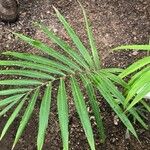
Dypsis cabadae
Cabada palm
Care Guide
💧 Water
☀️ Light Partial sun
The Cabada palm organically thrives in surroundings like forest understories or rocky terrains, where it naturally encounters shade. It predominantly prefers conditions with partial sunlight, however, it can acclimate to situations of full sunlight or complete shadow, thus showcasing its adaptable and robust characteristics.
🌡️ Temperature 20–37.8°C
The Cabada palm is native to tropical areas characterized by hot and moist climates. Consequently, it is acclimatized to endure heat and humidity. It does not deal well with abrupt changes in temperature and favors a consistent thermal climate, hence the need to prevent noticeable temperature variations in indoor settings. The plant generally is not resilient to cold climates and necessitates warmer conditions to thrive. Should the ambient temperature plummet significantly, this might culminate in the stunting of its growth, or even worse, the death of the plant.
💨 Humidity
🪴 Soil 6-7
🌱 Fertilizer
Encourage healthy development by applying fertilizer to your Cabada palm at the start of spring. Consistent fertilization boosts the overall wellbeing, leading to robust growth, increased resilience against harsh environments, and better resistance to diseases and pests. Stick to a particular fertilization routine for your Cabada palm to guarantee bright, colourful leaves and a dense look.
🪴 Pot & Repot
✂️ Pruning
🌿 Propagating
🐛 Diseases & pets
☠️ Toxicity
Characteristics
- Plant Type
- Palm
- Life Cycle
- Perennial
- Genus
- Dypsis
- Family
- Arecaceae
- Hardiness Zone
- 10-12
- Mature Height
- 6.1 m to 11.89 m
- Mature Spread
- 3.05 m to 4.88 m
- Leaf Color
- Green, Dark Green
- Leaf Type
- Evergreen
- Flower Color
- Yellow
- Flower Size
- 0.51 cm to 1.02 cm
- Bloom Time
- All year round
- Planting Time
- Summer, Autumn
- Harvest Time
- All year round
- Native Area
- Madagascar