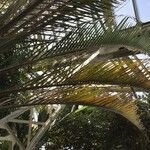
Dypsis decaryi
Triangle palm
Description
Source: leafsnapDypsis decaryi, commonly known as the Triangle Palm, is a striking and unique palm tree native to Madagascar. This slow-growing palm can reach heights of up to 20 feet and is notable for its distinctive triangular shape, with three distinct trunks emerging from the base. The leaves of the Triangle Palm are pinnate, or feather-like, and can extend up to 10 feet in length. The leaflets are arranged in an upward-facing V-shape along each leaf's stem. The Triangle Palm thrives in full sun or partial shade and requires well-draining soil. Although it is drought-tolerant once established, it benefits from regular watering during dry spells. This palm is hardy in USDA zones 10-11 but can also be grown indoors as a houseplant. The unique shape of Dypsis decaryi makes it an excellent choice for adding visual interest to both landscapes and indoor spaces. Its striking appearance has made it popular among landscapers and gardeners for use as an accent plant or focal point in tropical-themed gardens. Overall, Dypsis decaryi is an attractive plant with distinctive features that make it stand out among other palm species. Its unique beauty makes it highly sought after by gardeners seeking something different and visually appealing.
Care Guide
💧 Water Every 7 days
The Triangle Palm thrives in arid conditions due to its high drought tolerance, needing water only every two weeks. It grows best in a balance of humidity and dryness and requires well-drained soil. Typically, this palm is cultivated as an evergreen plant outdoors.
☀️ Light Partial sun
Triangle palm naturally occurs in places like forest understories or rocky areas where it grows in natural shade. It prefers partial sun but can adapt to full sun or full shade, showing its hardy and adaptable nature.
What are the sunlight requirements for a Triangle Palm (Dypsis decaryi)?
The Triangle Palm, or Dypsis decaryi, thrives in various sunlight conditions. For full sun exposure, it requires above 6 hours of sunlight daily, which is essential for its optimal growth and health. Alternatively, it can also grow in partial sun, needing about 3-6 hours of sunlight each day. It's important to observe how sunlight moves through your garden throughout the day. This observation will help you choose spots that offer a perfect balance between light and shade, ensuring that your Triangle Palm grows happily and healthily.
🌡️ Temperature 20–37.8°C
Triangle palm originates in tropical areas, where the climate is generally warm and humid. As a result, it is adapted to high temperatures and humidity. It does not tolerate sudden temperature changes and prefers a steady thermal environment, so it is important to avoid temperature fluctuations indoors. It usually cannot withstand cold and needs higher temperatures to grow. If the surrounding temperature falls too low, the plant may stop growing or even die.
💨 Humidity
🪴 Soil 6-7
🌱 Fertilizer
Fertilize your Triangle palm in early spring to encourage healthy growth. Regular feeding boosts overall health, leading to strong growth, increased tolerance of harsh conditions, and enhanced resistance to pests and diseases. Keep to a specific fertilization schedule for your Triangle palm to maintain vibrant, deeply colored foliage and a lush appearance.
🪴 Pot & Repot 1-2 years
The triangle palm has a distinct triangular crown and thrives when repotted every 1-2 years, ideally in early spring. Use a large container to accommodate its strong roots. After repotting, be sure to water it regularly and keep it out of direct sunlight for optimal growth.
✂️ Pruning
The Triangle Palm has a distinct triangular frond arrangement and requires very little pruning. To maintain its health and appearance, remove any dead or damaged fronds in early spring. Use clean, sharp tools to prevent disease and ensure precise cuts. This approach will enhance air circulation and promote growth without causing the plant any stress.
🌿 Propagating
🐛 Diseases & pets
☠️ Toxicity
Seed is poisonous if ingested. Parts of plants are poisonous if ingested. It causes severe gastrointestinal disorders.
Characteristics
- Plant Type
- Palm
- Life Cycle
- Perennial
- Genus
- Dypsis
- Family
- Arecaceae
- Hardiness Zone
- 10-12
- Mature Height
- 10.06 m
- Mature Spread
- 4.88 m
- Leaf Color
- Green, Yellow Green
- Leaf Type
- Evergreen
- Flower Size
- 0.51 cm to 0.76 cm
- Bloom Time
- Late spring, Summer, Early fall, Mid fall
- Planting Time
- Summer
- Harvest Time
- Late summer, Fall, Early winter, Mid winter
- Native Area
- Madagascar