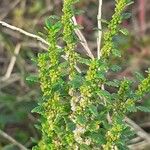
Dysphania pumilio
Clammy goosefoot · Small Crumbweed · Australian Goosefoot · Ridged Goosefoot
Description
Source: leafsnapDysphania pumilio, commonly known as dwarf goosefoot or pygmy goosefoot, is a small annual herbaceous plant in the Amaranthaceae family. Native to North America, it thrives in diverse habitats such as fields, meadows, and disturbed areas. The plant typically grows up to 20 cm in height and features a branching stem with small, oval, or lance-shaped green leaves. Its tiny, greenish-white flowers lack petals but are adorned with bracts that resemble petals. Dysphania pumilio serves as an important food source for various wildlife species, including birds and rodents. Additionally, it possesses medicinal properties and can be used to treat digestive disorders. The plant's adaptability to different environmental conditions has led to its classification as an invasive species in some regions, where it competes with native plants for resources. Despite its small size, Dysphania pumilio plays a significant role in its ecosystem and offers practical benefits for humans.
🌳 Clammy Goosefoot's robust stems and leaves offer considerable promise for material crafting, especially in producing eco-friendly textiles. Although it is not widely known for this use, the plant's fibers could serve as an environmentally conscious substitute for conventional fabrics. Its usefulness is not limited to textiles; it might also be suitable for paper manufacture, supplying a sustainable resource that could help lessen the impact of deforestation.
Care Guide
💧 Water Every 7 days
Originating from arid environments, clammy goosefoot is highly drought-tolerant and requires minimal watering, typically just once a week. Its hardy nature makes it ideal for outdoor settings and xeriscaping, allowing for landscaping that minimizes the need for additional water.
How should I water my Clammy Goosefoot?
To water Clammy Goosefoot, you have several options. You can use a garden hose with a spray nozzle, a watering can, or any other common watering tool. Clammy Goosefoot is not too picky about the type of water it receives and can thrive with rainwater, tap water, or filtered water. However, it's generally best to avoid watering this plant from overhead to prevent leaf and flower damage and minimize the risk of disease. For optimal watering, setting up a drip irrigation system is recommended as it evenly applies water directly to the soil. If you have a container-grown Clammy Goosefoot, you can follow a similar approach but use a cup, watering can, or tap to water the plant directly into the soil.
What should I do if I give too much or too little water to my Clammy Goosefoot?
To fix underwatering issues with Clammy Goosefoot, simply water it more regularly when you notice it lacks moisture. Overwatering, on the other hand, can lead to serious problems like diseases and the plant's decline. To prevent this, choose a growing location that gets plenty of sunlight, has good drainage, and avoids water logging in the soil. If you overwater a potted Clammy Goosefoot, consider changing to a new pot with proper drainage and loose soil.
How frequently should I water my Clammy Goosefoot plant?
Clammy Goosefoot needs regular watering throughout the growing season. In the spring, water it once a week. As the season progresses and becomes warmer, increase watering to two to three times a week. Overwatering can be harmful, so it's important to keep the soil moist but not wet. Watering Clammy Goosefoot in a pot is different. Potted plants tend to dry out faster, so you'll need to water them more frequently. Typically, watering a container-grown Clammy Goosefoot a few times a week is recommended, compared to just once a week for plants in the ground.
How much water does my Clammy Goosefoot plant need?
There are a few different ways to determine how much water to give your Clammy Goosefoot. Some gardeners choose to feel the soil for moisture and water until the first six inches are moist. Another option is to use a set measurement, like giving about two gallons per week depending on heat and soil dryness. However, following strict guidelines can lead to overwatering if your plant needs less. For container-grown Clammy Goosefoot, you should moisten all dry layers of soil and check for moisture by sticking your finger in the soil or noticing a slight trickle of excess water from drainage holes.
How can I know if I'm giving enough water to my Clammy Goosefoot?
Keeping your Clammy Goosefoot properly watered can be a bit tricky. On one hand, these plants have deep roots that need to be moistened weekly. However, Clammy Goosefoot is very prone to root rot, which can cause browning. Underwatering is not as much of a concern since these plants can survive without extra watering for some time. But if you wait too long, your Clammy Goosefoot might start wilting and develop dry leaves.
☀️ Light Full sun
Clammy Goosefoot comes from bright, open habitats and does best in full sun. It will tolerate partial sun but favors direct sunlight for optimal growth. This plant, which can be annual or biennial, is known for its sun-loving nature.
What are the sunlight requirements for Clammy Goosefoot?
Clammy Goosefoot thrives in full sun, requiring more than 6 hours of sunlight daily for optimal growth. It can also tolerate partial sun, which means about 3-6 hours of sunlight. It's important to monitor the sunlight patterns in your garden to ensure that Clammy Goosefoot is planted in a location that meets its sunlight needs, striking a healthy balance between light and shade.
How does artificial lighting support Clammy Goosefoot indoors?
For indoor Clammy Goosefoot plants or when natural sunlight is insufficient, artificial lighting is a beneficial alternative. LED lights are especially recommended because they can be adjusted to provide specific wavelengths needed for plant growth. Full sun plants should have 30-50W/sq ft of light, partial sun plants 20-30W/sq ft, and shade plants 10-20W/sq ft. The light source should be positioned 12-36 inches above the plants to simulate natural sunlight, and plants typically require 8-12 hours of light per day.
What are the symptoms of inadequate light for Clammy Goosefoot?
Indications of insufficient light in Clammy Goosefoot include smaller new leaves, leggy or sparse growth, premature leaf drop, halted growth, paler new leaves, and chlorosis, which is the yellowing of leaves. Furthermore, symptoms such as sunscald, leaf curling, wilting, and leaf scorching may occur due to overexposure to sunlight. These symptoms suggest either too little or too much sunlight, impacting the plant's health negatively.
How can I address light issues for Clammy Goosefoot?
To correct light issues for Clammy Goosefoot, gradually move your plants to receive at least 6 hours of direct sunlight daily, utilizing south-facing windows for indoor plants. For those not easily movable or larger, consider supplemental artificial light, ensuring it's on for a minimum of 8 hours daily. Outdoors, acclimate your plants to brighter conditions by incrementally moving them to sunnier spots weekly. Also, reduce obstructions like branches or consider transplanting smaller plants to brighter locations, especially during dormant periods for optimal sunlight exposure.
🌡️ Temperature 5–35°C
Clammy Goosefoot comes from tropical areas, where the climate is generally warm and humid. Consequently, it is adapted to high temperatures and moisture. It does not tolerate sudden temperature shifts and prefers a consistent temperature, so avoiding indoor temperature fluctuations is important. It typically cannot endure cold and needs higher temperatures to grow. If the surrounding temperature falls too low, the plant may stop growing or even die.
What is Clammy Goosefoot?
Clammy Goosefoot, scientifically known as Dysphania pumilio, is a plant species known by its unique name. There is no specific information provided on its essentials or symptoms related to it within the provided data.
💨 Humidity
🪴 Soil 6-7
🌱 Fertilizer
Clammy Goosefoot does well with regular, dilute applications of fertilizer to encourage healthy leaf growth. You should fertilize Clammy Goosefoot approximately once a month during the summer months. Nitrogen is important for foliage, and providing nitrogen-rich sources helps Clammy Goosefoot thrive.
🪴 Pot & Repot
✂️ Pruning
🌿 Propagating
🐛 Diseases & pets
☠️ Toxicity
Characteristics
- Plant Type
- Herb
- Life Cycle
- Annual
- Genus
- Dysphania
- Family
- Amaranthaceae
- Hardiness Zone
- 6-9
- Mature Height
- 1 cm to 46 cm
- Mature Spread
- 10 cm to 40 cm
- Leaf Color
- Green, Light Green
- Leaf Type
- Evergreen
- Flower Color
- Yellow, Green
- Flower Size
- 0.25 cm to 0.51 cm
- Bloom Time
- Early summer, Mid summer
- Planting Time
- Spring, Summer, Autumn
- Harvest Time
- Mid summer