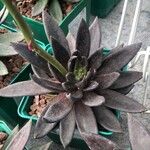
Echeveria affinis
Black Prince · Dark moon · Black Prince is an affinis hybrid · not a common name for it
Description
Source: leafsnapEcheveria 'Black Prince' is a slow-growing succulent plant that is from native Central America, South America, and part of Mexico. This type of succulent is ideal for a house plant. It sprouts rosettes of fleshy, plump, green leaves that turn a dark lavender brown color, almost appearing black. From late fall to early winter, it may bloom with bell-shaped, deep red flowers on short stalks.
Care Guide
💧 Water Every 2-3 weeks
The Black Echeveria requires careful watering depending on the conditions. During its dormancy period in hot or cold weather, water it less frequently, about every 1-2 weeks. In the summer, water in the evening to prevent rot. Monitor the leaves for signs of hydration needs and check the soil moisture regularly. Adjust the watering frequency based on the type of pot.
☀️ Light Full sun
Originating from arid regions, Black echeveria does best in full sun; its native habitat has strong sunlight and very little shade. It will also tolerate partial sun, providing some flexibility in its growth.
What are the sunlight requirements for Black Echeveria?
Black Echeveria thrives in full sunlight, requiring more than 6 hours of sunlight daily, but can also tolerate partial sun, with about 3-6 hours of sunlight. It's important to observe how sunlight moves through your garden to find spots that offer a balance of light and shade, ensuring the plants' health and happiness.
Can Black Echeveria grow in artificial lighting?
Yes, Black Echeveria can grow under artificial lighting, which is especially useful in conditions where natural sunlight is insufficient, such as during winter or in less sunny spaces. Optimal growth under artificial lighting involves choosing the right type of light, such as LED lights, which can be customized for plants' needs. Full sun plants need 30-50 Watts per square foot, partial sun plants 20-30 Watts per square foot, and full shade plants 10-20 Watts per square foot. The light source should be placed 12-36 inches above the plant to mimic natural sunlight and should be left on for 8-12 hours per day.
What are the common symptoms of light deficiency in Black Echeveria?
Black Echeveria may show symptoms of light deficiency when it does not receive enough sunlight, including smaller new leaves, leggy or sparse growth, faster leaf drop, slower or no new growth, lighter-colored new leaves, and conditions such as chlorosis, sunscald, leaf curling, wilting, and leaf scorching. These symptoms indicate that the plant needs more light for optimal growth and health.
How can I address light deficiency problems in Black Echeveria?
To address light deficiency in Black Echeveria, gradually increase sunlight exposure to at least 6 hours daily, use a south-facing window with curtains open during the day, or consider supplemental artificial lighting for at least 8 hours a day. When relocating plants outdoors, do it gradually to avoid sunburn. If trees are blocking sunlight, pruning can help. For smaller plants, consider transplanting during their dormant period to a spot with more sunlight and good drainage. It's important to note that portions of the plant already affected might not recover, but new growth will be healthy with increased light exposure.
🌡️ Temperature 20–37.8°C
Although Black echeveria can tolerate some heat, it mainly does best and grows during cooler periods and becomes dormant in summer. In very hot summer conditions, give it shade to prevent scorching from intense sunlight. Watering should be cut back or stopped during the hottest months to avoid root rot. Winter and spring are the times when Black echeveria grows vigorously. If temperatures do not drop too low, it will continue to grow steadily.
What is the preferred climate for Black echeveria?
Black echeveria thrives in warm and humid climates, typical of its tropical native regions. It is highly adapted to high temperatures and humidity levels but does not fare well with sudden temperature changes. To maintain its health and growth, it's crucial to keep it in an environment with stable temperatures, ideally avoiding any significant fluctuations. During colder months, it's recommended to keep the plant indoors in a spot that receives bright light but is not too close to heaters to avoid damage from excessive dryness or heat. The plant's growth can be adversely affected if temperatures drop too low, leading to cessation of growth or even death. Hence, maintaining indoor temperatures above 20°C during winter is beneficial for the Black echeveria's growth.
How does Black echeveria respond to low temperatures?
Black echeveria is not tolerant of low temperatures and thrives when the temperature remains above 20°C. It's particularly vulnerable during the winter months and requires temperatures to be kept above 0°C to avoid damage. Exposure to temperatures below -5°C may cause the leaves to lighten in color. If the plant suffers from frost damage, it may exhibit a gradual change in leaf color to brown or black and show signs of wilting and drooping. To mitigate damage from low temperatures, it's advisable to trim off the frost-damaged parts and move the plant indoors to a warmer environment. Placing it near a south-facing window ensures it receives sufficient sunlight while avoiding direct placement near heat sources like heaters or air conditioning vents, which could cause air dryness.
What should be done if Black echeveria is exposed to high temperatures?
In the hot summer months, it's crucial to keep Black echeveria's temperature below 38°C to prevent heat stress. Temperatures exceeding 43°C can lighten the leaf color and increase susceptibility to sunburn. To help the plant recover from heat exposure, trim away any sunburned or dried-up parts and relocate it to a spot that offers protection from the intense midday and afternoon sun. It's also beneficial to water the plant in the early morning and late evening to ensure the soil remains moist, which aids in cooling and maintaining the plant's health during high temperature conditions.
💨 Humidity
🪴 Soil 6-7
🌱 Fertilizer
Black echeveria needs only light fertilizer applications once or twice a year during the growing season. Do not fertilize in winter or in summer when it is dormant. Use less fertilizer for repotted plants and wait a few months after repotting before beginning to fertilize. Fertilizing supports healthy growth and encourages flowering.
🪴 Pot & Repot Every 2 years
When repotting Black echeveria, choose a pot only slightly larger than the current one that has good drainage. Use a gritty, well-draining succulent or cactus mix. Gently remove the plant from its old container, brush away excess soil, and place it at the same depth in the new pot. Wait a few days before watering so any root damage can heal. Repot in spring or fall and keep it in a brightly lit spot.
✂️ Pruning
The black echeveria is known for its dark, rosette-shaped leaves and requires very little pruning. The best time to prune is in early spring when the plant is actively growing. To promote healthy growth and improve the plant's appearance, remove any dead leaves and spent flower stalks. Always use sterilized tools to prevent infections and ensure your black echeveria remains healthy and attractive.
🌿 Propagating
🐛 Diseases & pets
☠️ Toxicity
Parents and pet owners rejoice! Echeveria affinis are non-toxic to pets and humans, and pose no risk if ingested. They are so safe that many varieties of Echeveria are even used on wedding cakes as decorations. That being said, they are not necessarily considered edible so we don’t encourage snacking!
Characteristics
- Plant Type
- Succulent
- Life Cycle
- Perennial
- Genus
- Echeveria
- Family
- Crassulaceae
- Hardiness Zone
- 9-11
- Mature Height
- 15 cm
- Mature Spread
- 20 cm
- Leaf Color
- Green
- Leaf Type
- Evergreen
- Flower Color
- Red
- Flower Size
- 2.54 cm
- Bloom Time
- All year round
- Planting Time
- Spring, Summer
- Harvest Time
- All year round
- Native Area
- Mexico