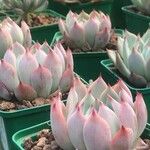
Echeveria colorata
Red top queen
Description
Source: leafsnapEcheveria colorata is a succulent plant belonging to the Crassulaceae family. Native to Mexico, it thrives in rocky areas and on cliffs. The plant forms a rosette shape with fleshy, blue-green leaves covered in fine white hairs. These leaves are arranged in a spiral pattern, giving the plant an attractive appearance. During the summer months, Echeveria colorata produces pink or red flowers on tall stems. The bell-shaped flowers have five petals and add a vibrant touch to the plant’s overall look. This succulent is easy to care for and can be grown both indoors and outdoors. It requires plenty of sunlight, well-draining soil, and occasional watering during its growing season. Echeveria colorata is commonly used for ornamental purposes due to its appealing look. It can be grown alone or combined with other succulents in rock gardens or containers, creating an eye-catching display of colors and textures. Overall, Echeveria colorata is a beautiful addition to any garden or indoor space, requiring minimal maintenance while providing maximum visual appeal.
Care Guide
💧 Water Every 7 days
Water your Echeveria colorata according to its condition and the surrounding environment, rather than following a strict schedule. During its dormant period, typically water it every 1-2 weeks. In the summer, opt for watering in the evening. Keep an eye on the leaves and soil moisture to determine when the plant is thirsty. Using breathable pots can help with evaporation and may require you to adjust how often you water the plant.
☀️ Light Partial sun
Echeveria colorata comes from habitats with dappled light, such as forest understories or rocky sites that offer natural shade. It prefers partial sun but can also tolerate full sun.
🌡️ Temperature 20–37.8°C
Although Echeveria colorata has some heat tolerance, it mainly thrives and grows in the cooler seasons and becomes dormant in summer. In hot summer weather, provide shade to avoid scorching from strong sunlight. Reduce or stop watering during the hottest part of the year to prevent root rot. Winter and spring are when Echeveria colorata shows vigorous growth; as long as temperatures don’t fall too low, it will keep growing steadily.
What is Echeveria colorata?
Echeveria colorata, known by its botanical name as 'Echeveria colorata', does not have specific details provided regarding its essentials, content, or additional information.
💨 Humidity
🪴 Soil 6-7
🌱 Fertilizer
Echeveria colorata only needs light fertilizer applications once or twice a year during the growing season. Do not fertilize in winter or in summer when the plant is dormant. Cut back on fertilizer for repotted specimens and wait a couple of months after repotting before feeding. Fertilizing helps maintain healthy growth and promotes blooming.
🪴 Pot & Repot Every 2 years
When repotting Echeveria colorata, choose a pot slightly larger than the current one that has good drainage. Use a gritty, well-draining cactus or succulent mix. Carefully remove the plant from its old pot, brush off excess soil, and plant it at the same depth. Wait a few days before watering so any root damage can heal. Repot in spring or fall and place it in a brightly lit spot.
✂️ Pruning
The Echeveria colorata is known for its rosette-shaped leaves and vibrant colors. To improve air circulation and promote its health, it's best to prune it in early spring by removing dead leaves. This practice encourages growth and helps prevent disease. Make sure to use sterile tools and avoid excessive pruning. Focus on essential trimming to maintain the plant's shape.
🌿 Propagating
🐛 Diseases & pets
☠️ Toxicity
Characteristics
- Plant Type
- Succulent
- Life Cycle
- Perennial
- Genus
- Echeveria
- Family
- Crassulaceae
- Hardiness Zone
- 9-11
- Mature Height
- 25 cm
- Mature Spread
- 30 cm
- Leaf Color
- Green, Red
- Leaf Type
- Evergreen
- Flower Color
- Pink, Orange
- Flower Size
- 1.02 cm to 1.52 cm
- Bloom Time
- All year round
- Planting Time
- Spring, Summer, Autumn
- Harvest Time
- All year round
- Native Area
- Mexico