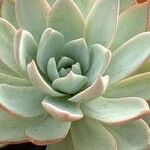
Echeveria desmetiana
Description
Source: wikipedia (CC BY-SA)Echeveria desmetiana, incorrectly known as Echeveria peacockii, is a succulent plant in the family Crassulaceae. L. de Smet was the first grower of this plant.
🌳 Although its main function is as an ornamental, peacock echeveria fills a distinct niche in xeriscaping, a landscaping technique that lowers irrigation requirements. With water scarcity becoming more common, peacock echeveria presents an attractive choice by contributing exotic character and durability to gardens designed for water conservation. Its impact goes beyond mere appearance, as it can help shape sustainable gardening practices and may aid in easing water-use pressures in arid regions.
🎭 Love more powerful than stone
Care Guide
💧 Water
☀️ Light Full sun
Peacock echeveria needs ample sunlight to do well, mirroring the strong sun of its native habitat. It can tolerate spots with less light, but excessive sun can scorch the leaves, while too little light can cause stunted growth and faded color.
🌡️ Temperature 20–37.8°C
Peacock echeveria's native temperature conditions are a hot, dry climate with temperatures from 20 to 38 ℃ (68 to 100.4 ℉). The plant prefers warmth and can tolerate winter lows down to 10 ℃ (50 ℉). During summer, keep it in a well-ventilated spot and avoid subjecting it to temperatures over 38 ℃ (100.4 ℉).
💨 Humidity
🪴 Soil 6-7
🌱 Fertilizer
Peacock echeveria needs only light fertilizer applications once or twice a year during the growing season. Do not fertilize in winter or in summer when it is dormant. Cut back on feeding for recently repotted plants and wait a couple of months after repotting before applying fertilizer. Fertilizing helps maintain healthy growth and encourages flowering.
🪴 Pot & Repot Every 2 years
When repotting a peacock echeveria, choose a pot just a bit larger than the current one that has good drainage. Use a gritty, well-draining cactus or succulent mix. Gently remove the plant from its old pot, brush off excess soil, and set it at the same depth in the new pot. Wait a few days before watering to allow any root damage to heal. Repot in spring or fall, and place it in a brightly lit area.
✂️ Pruning
🌿 Propagating
🐛 Diseases & pets
☠️ Toxicity
Characteristics
- Plant Type
- Succulent, Herb
- Life Cycle
- Perennial
- Genus
- Echeveria
- Family
- Crassulaceae
- Hardiness Zone
- 9-12
- Mature Height
- 6 cm to 30 cm
- Mature Spread
- 10 cm to 15 cm
- Leaf Color
- Blue, Green, Red
- Leaf Type
- Evergreen
- Flower Color
- Red, Pink
- Flower Size
- 1.02 cm to 1.52 cm
- Bloom Time
- Late spring, Early summer, Mid summer
- Planting Time
- Spring, Summer, Autumn
- Harvest Time
- Mid summer
- Native Area
- Mexico