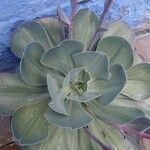
Echeveria gigantea
Giant Hens and Chicks · Echeveria Dusty Rose
Description
Source: leafsnapEcheveria gigantea is a succulent plant that belongs to the Crassulaceae family. Native to Mexico, it can grow up to 60 cm in height and 90 cm in diameter. The plant features a rosette shape with thick, fleshy leaves that are blue-green in color and covered with a waxy coating. The leaves are arranged in an overlapping pattern, giving the plant an attractive and distinctive appearance. Echeveria gigantea produces tall flower stalks that can reach up to 1 meter in height, bearing clusters of small yellow flowers at the top. These flowers typically bloom in late winter or early spring. This succulent requires well-draining soil and moderate watering during its growing season, which spans from spring through fall. It prefers full sun exposure but can also tolerate partial shade. Due to its attractive appearance and low maintenance requirements, Echeveria gigantea is commonly grown as an ornamental plant. It is often used for landscaping purposes or as a houseplant. In summary, Echeveria gigantea is a beautiful succulent with unique features that make it stand out among other plants.
Care Guide
💧 Water Every 7 days
The Giant Hens and Chicks plant thrives in dry conditions by efficiently storing water, making it ideal for environments with minimal hydration. It should be watered approximately every three weeks. Preferring full sunlight, this plant is well-suited for rock gardens and areas with poor soil drainage, thanks to its fleshy leaves that retain moisture.
☀️ Light Partial sun
Giant Hens and Chicks comes from habitats with dappled light, such as the understory of forests or rocky areas that provide natural shade. It prefers partial sun but can tolerate full sun.
🌡️ Temperature 20–37.8°C
Giant Hens and Chicks is native to mild, sunny climates and prefers a temperature range of 68 to 100 °F (20 to 38 ℃). Carefully adjust indoor heating in winter and cooling during the summer to mimic its native growing environment and maintain optimal development.
💨 Humidity
🪴 Soil 6-7
🌱 Fertilizer
For Giant Hens and Chicks, light applications of fertilizer one to two times a year during the growing season are enough. Avoid fertilizing in winter and summer, when the plants are dormant. Reduce fertilizer for repotted plants and wait a couple of months after repotting before applying any. Fertilizing promotes healthy growth and encourages blooms.
🪴 Pot & Repot Every 2 years
When repotting Giant Hens and Chicks, choose a pot slightly larger than the current one that offers good drainage. Use a gritty, well-draining succulent or cactus mix. Gently remove the plant from its old container, brush off excess soil, and plant it at the same depth. Delay watering for a few days to allow any root injuries to heal. Repot in spring or fall and place it in a brightly lit spot.
✂️ Pruning
To keep your giant Hens and Chicks looking their best, prune any redundant or dense branches during the spring and fall. For propagation, choose a sturdy stem with 5-6 leaves and cut it. Treat the cut with sulfur powder, and allow it to heal before planting it in slightly moist soil.
🌿 Propagating
🐛 Diseases & pets
☠️ Toxicity
Characteristics
- Plant Type
- Succulent
- Life Cycle
- Perennial
- Genus
- Echeveria
- Family
- Crassulaceae
- Hardiness Zone
- 9-11
- Mature Height
- 15 cm
- Mature Spread
- 15 cm
- Leaf Color
- Pink, Green
- Leaf Type
- Evergreen, Deciduous
- Flower Color
- Pink
- Flower Size
- 1.02 cm to 2.03 cm
- Bloom Time
- All year round
- Planting Time
- Spring, Summer
- Harvest Time
- All year round
- Native Area
- Mexico