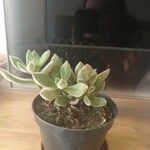
Echeveria harmsii
Red echeveria
Description
Source: leafsnapEcheveria harmsii is a small succulent shrub known as the Plush Plant. It sprouts with slender stalks from which scattered fleshy, light green leaves with red tips emerge. In the spring, it may bloom with bell-shaped, bright red flowers with yellow tips on long stalks.
Care Guide
💧 Water Every 2-3 weeks
Wait until the soil has dried out completely before watering your Echeveria, and then give it a good watering. If it is a hot and sunny place or summertime, the plant will get a lot of light and therefore will need to be watered more often as the soil will dry out faster. When winter comes and the temperatures are lower, the plants need to be watered less frequently (approximately once a month) as they will enter a dormancy period.
☀️ Light Full sun
Native to arid regions, Red echeveria flourishes in full sun, its native habitat marked by strong sunlight and little shade. It also tolerates partial sun, providing some flexibility in its growth.
🌡️ Temperature 20–37.8°C
Although Red echeveria can tolerate some heat, it mainly thrives and grows in cooler seasons and goes dormant in summer. In very hot weather it's important to give it shade to prevent scorching from intense sunlight. Watering should be reduced or stopped during the hottest period to avoid root rot. Red echeveria grows most vigorously in winter and spring, and as long as temperatures do not fall too low, it will continue to grow steadily.
💨 Humidity dry (<40%)
This plant prefers dry conditions, so don't mist it. However, watering it less often can also thrive in higher humidity.
🪴 Soil 6-7
🌱 Fertilizer
For red echeveria, light applications of fertilizer once or twice a year during the growing season are sufficient. Avoid fertilizing in winter or in summer when it is dormant. Cut back on fertilizer for plants that have been repotted and wait a couple of months after repotting before applying fertilizer. Fertilizing helps promote healthy growth and encourages flowering.
🪴 Pot & Repot Every 2 years
When repotting Red echeveria, choose a pot that is just a bit bigger than the current one and has good drainage. Fill it with a gritty, well-draining succulent or cactus potting mix. Gently lift the plant from its old container, brush away excess soil, and set it in the new pot at the same planting depth. Hold off watering for a few days so any injured roots can recover. Repot during spring or fall and place the plant where it will receive bright light.
✂️ Pruning
Generally, Echeverias do not require regular pruning. However, if your Echeveria becomes leggy and elongated due to lack of sunlight it will require some pruning to keep the plant healthy and looking attractive.
🌿 Propagating
🐛 Diseases & pets
☠️ Toxicity
Characteristics
- Plant Type
- Succulent
- Life Cycle
- Perennial
- Genus
- Echeveria
- Family
- Crassulaceae
- Hardiness Zone
- 9-11
- Mature Height
- 30 cm
- Mature Spread
- 30 cm
- Leaf Color
- Red, Green
- Leaf Type
- Evergreen
- Flower Color
- Red, Pink
- Flower Size
- 1.02 cm to 2.03 cm
- Bloom Time
- All year round
- Planting Time
- Summer, Autumn
- Harvest Time
- All year round
- Native Area
- Mexico