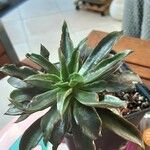
Echeveria lutea
Care Guide
💧 Water
Echeveria lutea is a drought-tolerant succulent that is perfect for arid conditions. Water it every three weeks, making sure to let the soil dry out completely between waterings. When grown indoors, ensure it is planted in well-draining soil to prevent root rot caused by excess moisture.
☀️ Light Full sun
Native to arid regions, Echeveria lutea flourishes in full sun, its native habitat marked by intense sunlight and scant shade. It will also tolerate partial sun, giving it some flexibility in its growth.
🌡️ Temperature 20–37.8°C
Although Echeveria lutea tolerates some heat, it mainly flourishes and grows in the cooler seasons and goes dormant in summer. In very hot summer conditions, provide shade to avoid scorching from intense sun. Watering should be cut back or stopped during the hottest period to prevent root rot. Echeveria lutea grows vigorously in winter and spring, and if temperatures don’t fall too low it will continue to grow steadily.
What are the ideal growing conditions for Echeveria lutea?
Echeveria lutea flourishes in warm environments and benefits from higher temperatures during its growing season to support its growth and metabolism. It enjoys ample sunlight, appropriate moisture levels, and good ventilation. It's crucial to maintain a balance to avoid damage from excessively low temperatures and overwatering, as well as excessively high temperatures and overly dry conditions. During winter, it enters a dormant state and should be moved indoors if temperatures drop below 5°C, preferably near a south-facing window to ensure it receives as much sunlight as possible. Supplemental lighting can be used if natural light is insufficient. Watering should be reduced or stopped when temperatures fall below 20°C to prevent root rot.
How should Echeveria lutea be cared for in low temperatures?
Echeveria lutea thrives best when the temperature is above 20°C and is not tolerant of low temperatures, requiring care to avoid cold damage. During winter, keep it above 5°C, and if the temperature falls below 1°C, the plant may weaken, wilt, and become prone to root rot. In the event of mild frost damage, trim off frostbitten areas and check for root rot. Rotted roots should be cut off, and the plant can be propagated through cuttings. The plant should immediately be brought indoors to a warm environment and placed near a south-facing window for ample sunlight. Use supplemental lighting if natural light is lacking.
What is the impact of high temperatures on Echeveria lutea and how to mitigate it?
Echeveria lutea should be kept below 41°C during the summer to avoid stopping its growth. Temperatures exceeding 45°C can cause the plant to lose water, wilt, and become susceptible to sunburn. To mitigate the damage from high temperatures, remove sunburned and rotten parts and protect the plant from afternoon sunlight until it recovers. For plants with root rot, watering should be ceased until new roots start to emerge.
💨 Humidity
🪴 Soil 6-7
🌱 Fertilizer
Echeveria lutea requires only light fertilizer applications once or twice a year during the growing season. Avoid fertilizing in winter and in summer when it is dormant. Reduce fertilizer for repotted plants and wait a couple of months after repotting before applying fertilizer. Fertilizing supports healthy growth and encourages blooms.
🪴 Pot & Repot Every 2 years
When repotting Echeveria lutea, pick a pot slightly larger than the current one with good drainage. Use a gritty, well-draining succulent or cactus mix. Gently remove the plant from its old pot, brush off excess soil, and place it at the same depth. Wait a few days before watering to allow any root damage to heal. Repot in spring or fall and keep it in a brightly lit location.
✂️ Pruning
To keep the shape of your Echeveria lutea, prune any excess or dense branches in the spring and fall using a knife or scissors, then apply sulfur powder to the cuts. For propagation, cut a sturdy stem with 5-6 leaves, treat the cut end with sulfur, and plant it in slightly moist soil.
🌿 Propagating
🐛 Diseases & pets
☠️ Toxicity
Characteristics
- Plant Type
- Succulent
- Life Cycle
- Perennial
- Genus
- Echeveria
- Family
- Crassulaceae
- Hardiness Zone
- 9-11
- Mature Height
- 15 cm
- Mature Spread
- 15 cm
- Leaf Color
- Light Yellow, Pale Green
- Leaf Type
- Evergreen
- Flower Size
- 1.02 cm to 1.52 cm
- Bloom Time
- All year round
- Planting Time
- Spring, Summer, Autumn
- Harvest Time
- All year round
- Native Area
- Mexico