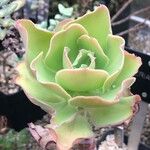
Echeveria pallida
Succulotus Fantasticus · Green spoon · Flapjack
Description
Source: leafsnapEcheveria pallida is a succulent plant that belongs to the Crassulaceae family. Native to Mexico, it thrives in rocky areas and on cliffs. This plant forms a rosette shape with fleshy, pale blue-green leaves coated in a powdery substance called farina. The leaves are arranged in an overlapping pattern, creating a tight rosette that can grow up to 15 cm wide. During the summer months, Echeveria pallida produces tall stems topped with small pink or yellow, bell-shaped flowers. These flowers grow on long stalks that extend above the foliage. This plant is very easy to care for and requires minimal maintenance, making it perfect for beginners or anyone seeking low-maintenance greenery. It prefers well-draining soil and bright sunlight but can also tolerate partial shade. Echeveria pallida is versatile and can be used as an ornamental plant in gardens, patios, or indoor spaces such as offices and homes. Its unique appearance makes it popular among succulent collectors who appreciate both its beauty and ease of care. In summary, Echeveria pallida is a stunning succulent with distinctive features that set it apart from other plants. Its ease of care makes it an excellent choice for those looking to add some greenery to their lives without much hassle.
Care Guide
💧 Water Every 7 days
☀️ Light Full sun
Native to dry regions, Argentine Echeveria does best in full sun, since its natural habitat features intense sunlight and very little shade. It will also tolerate partial sun, giving it some flexibility in its growth.
🌡️ Temperature 20–37.8°C
Although Argentine Echeveria can tolerate some heat, it mainly prospers and grows during cooler seasons and goes dormant in summer. In hot summer temperatures, provide shade to avoid scorching from strong sunlight. Watering should be reduced or stopped during the hottest part of the year to prevent root rot. Argentine Echeveria grows vigorously in winter and spring. As long as temperatures do not fall too low, it will keep growing steadily.
💨 Humidity
🪴 Soil 6-7
🌱 Fertilizer
Argentine Echeveria only requires light fertilizer applications once or twice a year during the growing season. Do not fertilize in winter or during its summer dormancy. Cut back on fertilizer for recently repotted plants and wait a couple of months after repotting before feeding. Fertilizing promotes healthy growth and helps produce blooms.
🪴 Pot & Repot Every 2 years
When repotting Argentine Echeveria, choose a pot slightly larger than the current one with adequate drainage. Use a gritty, well-draining succulent or cactus mix. Gently lift the plant from its old pot, brush off excess soil, and replant it at the same depth. Wait a few days before watering to allow any root damage to heal. Repot in spring or fall and place the plant in a brightly lit area.
✂️ Pruning
To help Argentine Echeveria maintain its shape, prune it in the spring and fall by removing excess or overly dense branches. If you're looking to propagate the plant, follow these steps: First, cut a sturdy stem with 5-6 leaves. Then, treat the cut with sulfur powder to protect it. Once the wound has healed, plant it in soil that is slightly moist.
🌿 Propagating
🐛 Diseases & pets
☠️ Toxicity
It is not advisable to eat Echeveria even though it is not found to be harmful or poisonous because there may be bacteria in the soil that may be left on the plant’s surface that can still cause sickness.
Characteristics
- Plant Type
- Herb
- Life Cycle
- Perennial
- Genus
- Echeveria
- Family
- Crassulaceae
- Hardiness Zone
- 9-11
- Mature Height
- 15 cm
- Mature Spread
- 5 cm
- Leaf Color
- Green, Red
- Leaf Type
- Evergreen
- Flower Color
- Pink, Orange
- Flower Size
- 1.02 cm to 1.52 cm
- Bloom Time
- Summer
- Planting Time
- Spring, Summer, Autumn
- Harvest Time
- Late summer, Early fall, Mid fall
- Native Area
- Mexico