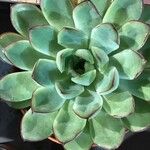
Echeveria pulidonis
Pulido's Echeveria · Chicks n hens · Lady's lipstick · Flowering Green Sun · Hybrid pulidonis x Mexican Giant
Description
Source: leafsnapEcheveria pulidonis is a succulent plant belonging to the Crassulaceae family, native to Mexico. It commonly thrives in rocky areas and cliffs. The plant features a rosette shape with thick, fleshy leaves that are blue-green with reddish tips. These leaves are coated in a powdery substance that helps retain moisture. During the summer, Echeveria pulidonis produces small, bell-shaped flowers on tall stems. The flowers are usually yellow or orange and attract pollinators such as bees and butterflies. This plant is easy to care for and can be grown both indoors and outdoors as long as it receives plenty of sunlight. It prefers well-draining soil that is allowed to dry out between waterings. Echeveria pulidonis can be propagated through leaf cuttings or by separating offsets from the mother plant. With proper care, this succulent can flourish for several years, adding unique beauty to any garden or indoor space.
💡 As an Echeveria ages, the trunk tends to grow long and thick, while the rosette at the tip becomes smaller. To prevent this, consider beheading Pulido's Echeveria when the rosette is still larger than the stem. This method promotes a healthier stem that can produce roots and offset plants. The beheaded portion will develop new roots and continue to grow.
🌳 Pulido's echeveria is a slow-growing and attractive succulent that thrives when planted in containers, where it can beautifully complement other succulents. It is well-suited for sunny spots in rock gardens and succulent gardens. Due to its slow growth, it's best to avoid planting it near aggressive, fast-growing plants.
🎭 ability to keep going through tough, tiring situations
Care Guide
💧 Water Every 7 days
Pulido's echeveria is well-suited for dry environments, displaying impressive drought tolerance thanks to its succulent leaves that store water. It only needs watering once every three weeks and thrives in well-draining soil to prevent root rot. Because of its low moisture needs, it is often kept indoors.
How should I water my Pulido's echeveria plant to make sure it stays healthy?
To properly water Pulido's echeveria, follow these steps. Wait until spring when new leaves are growing before watering. Only water when the soil in the pot is completely dry. You can use tap water or distilled water. Avoid watering from above; instead, water at the base of the plant, applying water slowly and evenly across the soil surface. This method ensures consistent moisture without wetting the above-ground parts of the plant. Keep watering until you see excess water draining from the pot's hole.
What should I do if I give too much or too little water to my Pulido's echeveria plant?
Overwatering is a common problem with Pulido's echeveria, and it can quickly lead to the plant's death. To prevent overwatering, it's important to let the soil dry completely before watering. Many people tend to water the plant incorrectly, especially during dormancy. In this case, we will focus on how to fix the issue of overwatering. If your Pulido's echeveria shows signs of overwatering, it's best to remove it from its current pot and examine the roots. Remove any rot or moisture-related disease from the roots, while some roots can be cleaned and return to health. Then, repot the plant in well-draining soil to reduce the chances of future overwatering. Although less common, underwatering can also occur. In such cases, simply water the plant slightly more frequently, being careful not to overcompensate and overwater the plant.
How frequently should I water my Pulido's echeveria plant?
Pulido's echeveria is a succulent plant that requires less water than most other plants. This is because it is native to a hot and dry region. To care for this plant properly, you should let the soil dry out completely before watering it again. This typically takes around two weeks to a month. The frequency of watering depends on the season. During the spring and summer, when the plant is actively growing, the soil may take 2-3 weeks to dry completely. During the summer, the soil may dry out even faster. However, when the temperature drops below 60 degrees or goes above 85 degrees Fahrenheit, the plant goes into a dormant or semi-dormant state. It does not need as much water during this time. Instead, you should reduce or stop watering until the temperature becomes suitable for growth again, and then resume watering.
How often should I water my Pulido's echeveria?
Pulido's echeveria does not require frequent watering because it can go for extended periods without water. However, when it is time to water the plant, it is important to give it a generous amount of water. Although there is no specific quantity, continue watering until the soil is fully moist. To ensure this, especially if the plant is in a pot, water it until you see water draining through the holes at the bottom. Another way to check if you have watered enough is by inserting a pencil or similar object into the soil. If the pencil comes out damp, you have provided sufficient water.
How can I know if I'm watering my Pulido's echeveria enough?
Generally, overwatering is a bigger problem than underwatering. When you overwater, you'll quickly notice the leaves become mushy, lose their shape, and change colors. Healthy living stone leaves, on the other hand, will remain sturdy and maintain their shape. Underwatering is very rare for Pulido's echeveria since this species can survive without water. However, if underwatering does happen, you'll usually see discolored and dry leaves.
☀️ Light Full sun
Pulido's echeveria requires abundant, unfiltered sunlight, though it can tolerate stretches of gentler, intermittent light. In its native environment with constant sun it does well, but if light is either too scarce or too intense its health may decline.
What are the sunlight requirements for Pulido's echeveria?
Pulido's echeveria thrives in conditions where it can receive abundant, unfiltered sunlight but also does well in periods of softer, broken solar exposure reminiscent of its natural habit of continuous sun. Generally, full sun plants need more than 6 hours of sunlight, while partial sun plants require about 3-6 hours. It's crucial to monitor the sunlight movement through your garden to ensure your plants get the appropriate balance of light and shade for optimal growth.
How can artificial lighting be used for Pulido's echeveria?
When natural sunlight is insufficient, artificial lighting can be a vital solution for indoor plants like Pulido's echeveria, especially in winter or less sunny spaces. LED lights are popular for indoor plant lighting because they can provide specific wavelengths needed by the plants. The amount of artificial light required varies by the plant's sunlight needs: 30-50W/sq ft for full sun plants, 20-30W/sq ft for partial sun plants, and 10-20W/sq ft for full shade plants. The light source should be placed 12-36 inches above the plant, mimicking natural sunlight, and most plants benefit from 8-12 hours of light per day.
What are the symptoms of inadequate lighting for Pulido's echeveria?
Pulido's echeveria may exhibit several symptoms if exposed to suboptimal lighting, including lighter-colored new leaves, indicating a lack of chlorophyll and essential nutrients; leggy or sparse growth, showing the plant's struggle to reach for light; slower or no new growth as the plant enters survival mode; chlorosis, or the loss of green color in leaves; sunscald from intense exposure; leaf curling as a defense against excessive light; wilting due to increased water loss; and leaf scorching, seen as brown, dry edges on leaves. These symptoms highlight the importance of providing adequate light.
How can I remedy insufficient sunlight exposure for Pulido's echeveria?
To remedy insufficient sunlight for Pulido's echeveria, for indoor setups, it's advisable to gradually move the plants to sunnier locations each week until they receive at least 6 hours of direct sunlight daily, utilizing a south-facing window for maximum exposure. If the plant is large or stationary, artificial lighting such as desk, ceiling lamps, or professional grow lights can supplement light for at least 8 hours daily. For outdoor gardens, similarly, move plants gradually to sunnier spots to avoid sunburn, ensuring adaptations to the light environment. Reducing obstructions like tree branches can also help increase sunlight penetration. For plants in the ground that can be moved, consider transplanting them during their dormant period to areas with better sunlight and drainage.
🌡️ Temperature 20–37.8°C
Pulido's echeveria is a temperate woody species that favors temperatures of 68 to 100℉ (20 to 38℃) in its native habitat. It is advisable to change the temperature with the seasons to keep it within that preferred range.
What temperature range is ideal for Pulido's echeveria?
Pulido's echeveria thrives in a temperature range of 68 to 100°F (20 to 38°C) in its native environment. During its growing season in the winter, it's important to keep the temperature above 20°C for optimal growth. It's suggested to adjust temperatures with the seasons to stay within this preferred range. When temperatures drop below 0°C, bringing the plant indoors to a well-lit area is advisable, adjusting watering accordingly and considering additional protection like a temporary greenhouse in consistently low outdoor temperatures.
How should I care for Pulido's echeveria in low temperature conditions?
In low temperature conditions, especially when the thermometer drops below -5°C, Pulido's echeveria is at risk of suffering from water-soaked necrosis and wilting due to its intolerance to extreme cold. Should there be mild frost damage, symptoms such as significant wilting and leaf drop may appear after a week. To manage this, trim off the frostbitten areas and move the plant to a warm indoor environment or set up a makeshift greenhouse to provide cold protection. Ensuring the plant is near a south-facing window will guarantee ample sunlight, and proper ventilation within a greenhouse setup is crucial to prevent decay.
What should I do if Pulido's echeveria is exposed to high temperatures?
During the summer or whenever temperatures exceed 43°C, Pulido's echeveria may enter a dormant state and become more susceptible to rot under high humidity conditions. To care for Pulido's echeveria in high temperatures, promptly remove any dry and rotten parts of the plant. Moving the plant to a partially shaded area will help protect it from direct midday and afternoon sunlight. Watering should be stopped until the weather cools down to prevent further stress to the plant.
💨 Humidity normal (40-60%)
This plant will thrive in moderate humidity, which is probably the level in your home. However, misting it a few times a week can be very beneficial. Make sure the room has good ventilation.
🪴 Soil 6-7
🌱 Fertilizer
For Pulido's echeveria, small amounts of fertilizer once or twice a year during the growing season are adequate. Do not fertilize in winter or summer, when the plant is dormant. Cut back on fertilizer for plants that have been repotted, and wait a couple of months after repotting before applying fertilizer. Fertilizing helps maintain healthy growth and promotes blooms.
Why should I put fertilizer on my Pulido's echeveria?
When you fertilize Pulido's echeveria, you're adding nutrients to the soil which is important for healthy growth. Even though it already stores water and nutrients, applying plant food during the growing season further supports healthy growth. Moreover, fertilizing can also stimulate mature specimens to produce blooms in the growing season.
When should I fertilize my Pulido's echeveria for best results?
Pulido's echeveria, like all plants, benefits from extra nutrients. However, it only needs a small amount of fertilizer during its growing season. It is recommended to fertilize the plant 1-2 times a year, specifically in the spring and autumn, but not during its dormant periods in winter and summer. If the plant has been recently repotted, it's important to be cautious with fertilizer and use less than usual. It's also advisable to wait a few months after repotting before starting to apply fertilizer.
When should I not put fertilizer on my Pulido's echeveria?
Pulido's echeveria, like other plants, enters a dormancy period where fertilizer applications should be halted. This occurs in the summer and winter when the plant stops growing. It is also recommended to refrain from fertilizing for a few months after repotting in the spring.
What kind of plant food does my Pulido's echeveria need?
When fertilizing Pulido's echeveria, it is recommended to use a liquid plant food specifically made for succulents and cacti. Dilute the fertilizer with water to half-strength in order to prevent buildup in the soil. Apply the fertilizer to the base of the plant, ensuring that it is watered thoroughly and any excess moisture drains out of the container or into the ground.
How should I give food to my Pulido's echeveria plant?
When fertilizing Pulido's echeveria, you have the option of using liquid plant food or granules. If you choose the liquid option, make sure to dilute it to half-strength as directed on the packaging. Regardless of which type of plant food you use, always apply it to the soil. For granules, cover them with a thin layer of soil and water.
🪴 Pot & Repot Every 2 years
When transplanting Pulido's echeveria, choose a pot slightly larger than the current one that has good drainage. Use a gritty, well-draining succulent or cactus soil mix. Gently remove the plant from its old pot, brush off excess soil, and place it at the same depth. Wait a few days before watering so any root damage can heal. Repot in spring or fall and keep it in a brightly lit spot.
✂️ Pruning
Large succulent plants, such as Pulido's echeveria, may need pruning to maintain their shape during the spring and fall. To prune, use tools like knives and scissors to remove dense branches. If you want to propagate the plant, cut a sturdy stem with 5-6 leaves. Treat the cut wound with sulfur powder, and once it has healed, plant it in slightly damp soil.
🌿 Propagating
🐛 Diseases & pets
☠️ Toxicity
Good news, pet parents — succulents in the Echeveria genus are safe to grow around pets and humans! In fact, Echeverias are commonly used as decorations on wedding cakes, although organically grown succulents are recommended. Nevertheless, mischievous pets and children should be supervised around Echeverias as although they are non-toxic, consuming them is not recommended.
Characteristics
- Plant Type
- Succulent, Herb
- Life Cycle
- Perennial
- Genus
- Echeveria
- Family
- Crassulaceae
- Hardiness Zone
- 9-12
- Mature Height
- 20 cm
- Mature Spread
- 15 cm to 20 cm
- Leaf Color
- Green, Blue, Red
- Leaf Type
- Evergreen
- Flower Color
- Yellow
- Flower Size
- 1.02 cm to 1.52 cm
- Bloom Time
- Mid spring, Late spring, Early summer
- Planting Time
- Spring, Summer
- Harvest Time
- Early summer, Mid summer
- Native Area
- Mexico