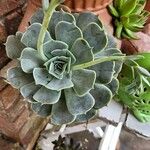
Echeveria secunda
Blue Echeveria · Hens and chicks · Old Hens and Chicks · এচিভরিয়া (hens and chicks) · Echeveria Peacockii
Description
Source: leafsnapEcheveria secunda, called the glaucous echeveria, is a species of succulent flowering plant in the genus Echeveria, native to Mexico, and introduced to the Dominican Republic, New Zealand, and Vietnam. Its cultivar 'Compton Carousel' has gained the Royal Horticultural Society's Award of Garden Merit.
💡 A cluster of blue echeveria resembles a bride's bouquet, while a single plant stands alone as delicate and lovely. When in bloom, the blue echeveria produces a string of small, bell-like flowers that are fresh and elegant. The leaf color of the blue echeveria can range from light green to blue-green, depending on the intensity of the light it receives.
🌳 Aside from its decorative appeal, blue echeveria has shown promise as a bioindicator for certain metals in soil. Its capacity to take up and concentrate specific metals provides a natural signal of the soil's metal levels, which can be useful for environmental monitoring and remediation.
🎭 Dear, moving
Care Guide
💧 Water Every 3 weeks
Blue echeveria, native to arid regions, is highly drought-tolerant and requires minimal watering—about once every three weeks. As an evergreen plant, it keeps its foliage throughout the year and flourishes in well-draining soil. This makes it an excellent choice for indoor cultivation, as it has modest water needs.
How should I water my Blue echeveria plant in the best way?
To properly water Blue echeveria, you should wait until spring when new leaves are growing. Once the soil in the pot is completely dry, you can add water using either tap water or distilled water. Avoid watering from above and instead water at the base of the plant, slowly and evenly across the soil surface. This will keep the soil consistently moist without wetting the above-ground parts of the plant. You can continue watering until you see excess water draining from the pot's hole.
What should I do if I give too much or too little water to my Blue echeveria?
Overwatering is a more common problem with Blue echeveria than underwatering. Overwatering can quickly kill a Blue echeveria, so it's important to let the soil dry out completely before watering. Many people mistakenly water their plants too much, especially when they go into dormancy. To remedy overwatering, remove the plant from its pot and check for any rot or moisture-related diseases in the roots. Some roots may need to be removed, while others can be cleaned and saved. Repot the plant in well-draining soil to prevent future overwatering. Underwatering is less likely, but if it happens, water the plant a bit more frequently without overcorrecting and causing overwatering.
How frequently should I give water to my Blue echeveria?
The water needs of Blue echeveria, a succulent plant, are low because it comes from a hot and dry region. To properly care for this plant, let the soil completely dry out between waterings. This usually takes 2-4 weeks. Watering frequency changes with the seasons. In the spring and summer, when the plant is growing, water every 2-3 weeks. In hotter temperatures, the soil may dry out faster. However, when the temperature goes below 60 degrees or above 85 degrees Fahrenheit, the plant becomes dormant and doesn't need watering. In this case, keep the soil dry until the temperature is right for growth, then resume watering.
How much water does my Blue echeveria plant need?
To care for a Blue echeveria, it's important to understand its watering needs. This plant can withstand periods without water, so it doesn't require frequent watering. However, when you do water it, you should give it a substantial amount. There isn't a specific quantity to follow, but you should continue watering until the soil is fully moist. To ensure this, if you have the plant in a pot, water it until you see water coming out of the drainage holes. Another method is to insert a pencil deep into the soil and remove it to check for moisture. If the pencil is wet, then you have provided enough water.
How can I know if I'm giving enough water to my Blue echeveria?
Overwatering is a bigger problem than underwatering when it comes to plants. When you overwater, you'll quickly see the leaves lose their shape, become mushy, and change colors. This is very different from healthy living stone leaves, which should be firm and maintain their shape. Blue echeveria plants rarely experience underwatering because they can often survive without water. But if it happens, you'll typically notice the leaves changing color and becoming dry.
☀️ Light Full sun
Blue echeveria flourishes in areas where it is exposed to plenty of sunlight throughout the day, although it can also survive in locations where the sunlight is interspersed with shade. Too much or too little sunlight can cause stress or hinder growth, resulting in color loss or wilted leaves. The plant's native habitat provides it with substantial sunlight, aiding its resilience.
What are the sunlight requirements for Blue Echeveria?
Blue Echeveria requires locations that provide a lot of sun exposure throughout the day, thriving in full sun conditions of above 6 hours of sunlight. It can also tolerate partial sun, with about 3-6 hours of sunlight. Ensuring the right balance of light and shade is crucial for the plant's happiness, as both overexposure and underexposure can lead to stress, affecting the plant's coloration and causing leaves to wilt. It's vital to observe how sunlight moves through your garden to select spots that offer the perfect mix of light conditions.
How do I use artificial lighting for Blue Echeveria?
When natural sunlight is insufficient, artificial lighting becomes essential, especially during winter or in less sunny spaces. For optimal growth under artificial lights, ensure adequate lighting levels. Full sun plants, like Blue Echeveria, need 30-50W per square foot, partial sun plants need 20-30W per square foot, and full shade plants require 10-20W per square foot. The light source should be placed 12-36 inches above the plant to mimic natural sunlight conditions, and the lighting duration should mimic natural daylight hours, typically 8-12 hours per day.
What are the symptoms of improper sunlight exposure in Blue Echeveria?
Symptoms of improper sunlight exposure in Blue Echeveria include lighter-colored new leaves, indicating a lack of chlorophyll and essential nutrients due to insufficient sunlight. Leggy or sparse growth, characterized by stretched-out appearance and weak structure, and slower or no new growth, occur when light conditions are poor. Other symptoms include chlorosis or yellowing of leaves, sunscald which presents as pale or necrotic areas, leaf curling as a defense mechanism, wilting from excessive water loss, and leaf scorching marked by brown, dry edges.
How can I solve sunlight-related issues for Blue Echeveria?
To address sunlight-related issues in Blue Echeveria, gradually acclimatize your plant to receive at least 6 hours of direct sunlight daily by moving it closer to a south-facing window or a sunnier location each week. Use curtains to maximize sunlight exposure. If the plant is large or not easily moveable, supplement with artificial light, keeping a lamp on for at least 8 hours daily or investing in professional plant grow lights. Outdoors, move plants gradually to prevent sunburn. If sunlight is blocked by obstacles like trees, consider pruning or transplanting your plant to a location with more sunlight. Remember, parts of the plant damaged by insufficient sunlight may not recover, but increasing light exposure will promote healthy new growth.
🌡️ Temperature 20–37.8°C
Blue echeveria thrives in mild temperatures, ideally between 68 to 100 ℉ (20 to 38 ℃). It is indigenous to regions with hot, arid climates and can withstand changing temperatures across varied seasons. In the summertime, it could gain from some shade to prevent it from getting too hot.
What are the ideal temperature conditions for Blue echeveria?
Blue echeveria thrives in moderate temperatures, ideally between 68 and 100°F (20 to 38°C). It is well-suited to warm, dry climates and is capable of withstanding seasonal temperature fluctuations. During hotter months, it benefits from partial shade to prevent overheating. Winter, being its growing season, demands maintaining temperatures above 20°C for optimal growth. In colder climates, when temperatures drop below 0°C, it is advisable to bring the plant indoors to a well-lit area, increasing watering with higher temperatures and reducing it as they near 0°C. Overwintering outdoors should include placement in a sheltered, sunny spot, or considering a temporary greenhouse if consistently low temperatures persist, ensuring the plant remains adequately moist.
How should you care for Blue echeveria in low temperatures?
Blue echeveria is sensitive to extremely cold temperatures and thrives best between 20°C and 38°C. During winter, it is crucial to keep it above 0°C to avoid damage. Exposure to temperatures below -5°C can cause leaves to exhibit water-soaked necrosis and wilting. In the event of mild frost damage, the plant may initially show no symptoms, but after a week, significant wilting and leaf drop can occur. To mitigate frost damage, trim off frostbitten areas, move the plant to a warmer indoor setting or set up a makeshift greenhouse for protection. If indoors, position the plant near a south-facing window for adequate sunlight, and ensure the greenhouse is well-ventilated to prevent decay from poor airflow.
What steps should be taken if Blue echeveria is exposed to high temperatures?
During the summer, it's crucial to keep Blue echeveria below 38°C. Exposure to temperatures above 43°C can trigger dormancy and increase susceptibility to rot in humid conditions. To address this, remove any dry or rotten parts, relocate the plant to a partially shaded spot to shield it from direct midday and afternoon sunlight, and halt watering until temperatures cool. These measures help prevent heat stress and maintain the health of the plant.
💨 Humidity
🪴 Soil 6-7
🌱 Fertilizer
For Blue echeveria, light applications of fertilizer one to two times a year during the growing season are sufficient. Avoid fertilizing in winter and in summer when the plant is dormant. Reduce fertilizer for repotted plants and wait a couple of months after repotting before fertilizing. Fertilizing supports healthy growth and encourages blooms.
Why should I use fertilizer for my Blue echeveria?
Fertilizing Blue echeveria enhances growth by supplying nutrients to the soil. While this plant does store water and nutrients, applying plant food during the growing season promotes strong and healthy growth. Additionally, fertilizing can stimulate mature Blue echeveria plants to produce beautiful blooms.
When should I fertilize my Blue echeveria?
Blue echeveria plants require only a light dose of fertilizer during their growing season. It is recommended to fertilize them 1-2 times a year, specifically in the spring and autumn. It is important to note that fertilization should be avoided during the dormant periods in winter and summer. For repotted plants, it is advisable to reduce the amount of fertilizer used. Additionally, it is advisable to wait a few months after repotting before starting to apply fertilizer.
When is it best to not put fertilizer on my Blue echeveria?
Blue echeveria, like other plants, goes through a dormancy period where you should avoid using fertilizer. This period occurs in both summer and winter when the plant stops growing. It is also recommended to hold off on fertilizing for a few months after repotting in the spring.
What kind of plant food does my Blue echeveria require?
To properly fertilize your Blue echeveria, use a liquid plant food specifically made for succulents and cacti. Remember to dilute the fertilizer with water to make it half as strong. Avoid accumulating excess fertilizer in the soil by applying it to the base of the plant. Afterward, give the plant a thorough watering and make sure any excess moisture drains away.
How do I help my Blue echeveria grow better?
When fertilizing Blue echeveria, there are two options: using liquid plant food or granules. If you choose liquid plant food, make sure to dilute it to half-strength as instructed on the packaging. No matter which type of plant food you use, always apply it to the soil. For granules, cover them with a thin layer of soil and water the plant.
🪴 Pot & Repot Every 2 years
While rehousing Blue echeveria, choose a slightly bigger container than its current one, with excellent drainage. Opt for a succulent or cactus mixture that drains well and is gritty. Cautiously extract the plant from its former pot, brush off any additional dirt and re-plant it at the original depth. Delay watering the plant a few days to let any harm to the roots mend. Carry out the repotting in spring or fall and place it in a place that gets plenty of light.
✂️ Pruning
To maintain the shape of large succulent plants such as blue echeveria, it's advisable to prune them in the spring and fall. This involves removing any dense or redundant branches. If you're interested in propagating your succulent, start by cutting a sturdy stem with 5-6 leaves. Apply sulfur powder to the cut to aid healing, and once it has healed, plant the stem in slightly moist soil.
🌿 Propagating
🐛 Diseases & pets
☠️ Toxicity
Characteristics
- Plant Type
- Succulent, Herb
- Life Cycle
- Perennial
- Genus
- Echeveria
- Family
- Crassulaceae
- Hardiness Zone
- 9-12
- Mature Height
- 15 cm to 61 cm
- Mature Spread
- 6 cm to 20 cm
- Leaf Color
- Green, Gray, Silver
- Leaf Type
- Evergreen
- Flower Color
- Red
- Flower Size
- 1.02 cm to 1.52 cm
- Bloom Time
- Late spring, Early summer, Mid summer
- Planting Time
- Spring, Summer, Autumn, Winter
- Harvest Time
- Mid summer
- Native Area
- Mexico