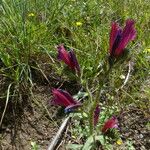
Echium creticum
Cretan viper's bugloss · Cretan Vipersbugloss
Description
Source: leafsnapEchium creticum, commonly known as Cretan viper's bugloss, is a flowering plant in the Boraginaceae family. Native to the Mediterranean region, especially Crete in Greece, it typically grows up to 60 cm in height and has a bushy appearance with lance-shaped leaves covered in stiff hairs. The flowers of Echium creticum are bell-shaped and range in color from pinkish-purple to blue-violet, blooming from late spring through summer. Echium creticum thrives in well-drained soils with full sun exposure but can also tolerate partial shade. Although it is drought-tolerant, regular watering during the growing season ensures optimal growth. The plant can be propagated through seeds or cuttings. In traditional medicine, Echium creticum has been used for its anti-inflammatory properties and to treat respiratory ailments such as coughs and bronchitis. Overall, Echium creticum is an attractive ornamental plant that adds vibrant color to gardens and landscapes while offering medicinal benefits valued by some cultures.
🌳 Purple viper's bugloss has an uncommon ability to reveal the presence of certain metals in the soil, a characteristic that can be very useful for environmental monitoring. Its growth patterns and overall condition can mirror the concentrations of metals such as cobalt, and thus it can be applied in biogeochemical prospecting. The species is regarded as invasive in some areas, which, surprisingly, can benefit ecosystems by outcompeting more damaging invasive species and creating a naturalized balance.
Care Guide
💧 Water Every 7 days
The Cretan viper's bugloss, native to the Mediterranean region, flourishes in dry summers and mild, wet winters. Although it is drought-tolerant, it prefers moderate humidity. To keep the plant healthy, it's important to water it weekly. It also benefits from the natural rainfall patterns when grown outdoors, which influence its growth cycles and seasonal requirements.
How should I water my Cretan viper's bugloss plant?
When watering the Cretan viper's bugloss, it is best to use filtered water at room temperature. Tap water may contain harmful particles, so filtering it is important. It is also important to use water that is at room temperature or slightly warmer because the Cretan viper's bugloss is used to a warm environment and cold water can be a shock to its system. Additionally, overhead watering should be avoided as it can cause issues with the foliage. Instead, it is recommended to apply the filtered room temperature water directly to the soil until it is completely soaked. This helps moisten the roots and allows them to spread through the soil and collect the necessary nutrients.
What should I do if I give my Cretan viper's bugloss plant too much or too little water?
Overwatering is a more common problem than underwatering for the health of your Cretan viper's bugloss. If this plant receives excessive water, its stems and leaves may wilt and turn yellow. Prolonged overwatering can also cause root rot, mold, and mildew, which can be fatal. Underwatering is less common, but can still happen. In this case, the leaves become brittle and brown. It's important to quickly identify signs of overwatering to prevent irreversible damage. If you notice early signs, reduce your watering schedule and check the soil drainage. Replace poorly draining soil with a well-draining potting mix. If the plant is not receiving enough water, increase the watering frequency until the signs improve.
How often should I give water to my Cretan viper's bugloss plant?
If your Cretan viper's bugloss is in a pot, the most precise way to determine if it needs water is by sticking your finger into the soil. If the top two to three inches of soil are dry, it's time to water it. If you're growing the plant outdoors in the ground, you can also use this method. When the top few inches of soil are dry, it's time to water. In the spring and early fall, watering once a week is usually sufficient. However, during extremely hot weather, you may need to water twice or more per week. It's worth noting that mature, well-established Cretan viper's bugloss plants can withstand drought quite well.
How much water does my Cretan viper's bugloss plant need?
When watering your Cretan viper's bugloss, don't be afraid to give it a generous amount of water. Make sure the first two to three inches of soil are dry, and then give it a thorough watering that completely soaks the soil. The water should be enough to flow through the drainage holes at the bottom of the pot. If you don't see excess water draining, it means you haven't watered enough. However, be careful not to let the water accumulate inside the soil, as this can harm the plant. On the other hand, if water doesn't drain properly from the pot, it may indicate poor soil drainage, which is not good for the plant's health. If the plant is outdoors, you can rely on 1 inch of rain per week for sufficient watering.
How do I water my Cretan viper's bugloss as it grows?
The water requirements of the Cretan viper's bugloss can vary based on its growth stages. Initially, when the plant is young or has been recently transplanted, it needs more water than usual. During this phase, the plant focuses on developing new roots to support future growth, which requires additional moisture. As the plant matures over a few seasons, it will require less water. However, during the bloom period, the Cretan viper's bugloss may need more water due to the significant amount of moisture that flower development demands.
☀️ Light Full sun
The purple viper's bugloss, native to sun-drenched environments, flourishes best when subject to generous sunlight during its various growth phases. Insufficient sunshine could compromise its health, reducing its flowering capacity. Generally, this plant can withstand direct sunlight, as it is native to areas with unobstructed solar exposure. However, when placed in an environment with inadequate light, its growth rate and color vibrancy can be somewhat diminished.
What are the sunlight requirements for Cretan viper's bugloss?
Cretan viper's bugloss thrives in conditions where it receives full sun, defined as above 6 hours of sunlight daily. It is essential to observe how sunlight moves through your garden to choose spots that provide the perfect balance of light and shade, ensuring the plant's happiness. This plant has a high need for abundant sun exposure throughout its growth stages, evident from its predilection for ample solar exposure and ability to cope without any shade, as seen in its native habitats. Insufficient or excessive light exposure can adversely affect its well-being, potentially causing delays in growth or flowering.
How can artificial lighting be used for Cretan viper's bugloss?
When natural sunlight is insufficient, especially during winter or in less sunny spaces, artificial lighting becomes a critical solution for maintaining optimal growth in Cretan viper's bugloss. Indoor plants benefit from artificial lighting which promotes faster, healthier growth. The right type of light, such as LED lights, can be chosen to provide specific wavelengths needed by the plants. Full sun plants require 30-50W/sq ft, partial sun plants need 20-30W/sq ft, and full shade plants require 10-20W/sq ft of artificial light. The light source should be placed 12-36 inches above the plant, mimicking natural sunlight, and plants typically need 8-12 hours of light per day.
What are the symptoms of inadequate light in Cretan viper's bugloss?
Cretan viper's bugloss exhibits several symptoms when it suffers from inadequate light, including small new leaves, leggy or sparse growth, early leaf drop to conserve resources, delayed or halted growth, and lighter-colored new leaves indicating a lack of chlorophyll. Further symptoms include chlorosis or yellowing of the leaves due to excessive sunlight disrupting photosynthesis, sunscald marked by pale, bleached areas on plant tissue, leaf curling to minimize water loss and damage from intense sunlight, wilting from too much transpiration, and leaf scorching shown by brown, dry edges on leaves caused by excessive sunlight.
What solutions are available to address light issues for Cretan viper's bugloss?
To address light issues for Cretan viper's bugloss, gradual adaptation to sunlight is advisable. For indoor plants, gradually move them to receive at least 6 hours of direct sunlight daily, utilizing south-facing windows for maximum sunlight exposure. If moving the plant is not feasible, consider artificial lighting options like keeping a desk or ceiling lamp on for at least 8 hours daily or investing in professional grow lights. For outdoor plants, find the best sunlight spot and adapt the plant gradually to prevent sunburn. Reducing obstructions like pruning branches or transplanting smaller plants during their dormant period can enhance sunlight exposure. Note that parts of the plant affected by insufficient sunlight may not recover, but new growth post adaptation will be healthy.
🌡️ Temperature 0–32.2°C
The purple viper's bugloss originates from areas with warm temperate climates, making it suitable for a temperature range of 68 to 95 °F (20 to 35 ℃). During the colder months, make sure the purple viper's bugloss receives enough heat to mimic its typical habitat.
💨 Humidity
🪴 Soil 6-7
🌱 Fertilizer
When the majority of the Purple viper's bugloss blossoms have fully opened, it signals the appropriate time to recommence fertilization. Commence fertilizing once more approximately every three to four weeks, weather permitting, when the flowering is at its maximum. Subsequently, when the Purple viper's bugloss starts generating fewer new blossoms, discontinue fertilizing as it's unnecessary when the plant ceases to produce further blooms.
🪴 Pot & Repot
✂️ Pruning
The Cretan viper's bugloss boasts vibrant blue flowers and demonstrates robust growth. To encourage blooming and remove dead stems, prune it from early to late spring. This process enhances air circulation and reduces the risk of disease. Make sure to use clean, sharp tools, and avoid heavy pruning in late summer to support future growth.
🌿 Propagating
🐛 Diseases & pets
☠️ Toxicity
Characteristics
- Plant Type
- Herb
- Life Cycle
- Annual, Biennial, Perennial
- Genus
- Echium
- Family
- Boraginaceae
- Hardiness Zone
- 3-8
- Mature Height
- 20 cm to 61 cm
- Mature Spread
- 40 cm to 49 cm
- Leaf Color
- Green
- Leaf Type
- Evergreen
- Flower Color
- Purple, Blue
- Flower Size
- 5.08 cm to 15.24 cm
- Bloom Time
- Late spring, Early summer, Mid summer
- Planting Time
- Spring, Summer
- Harvest Time
- Mid summer
- Native Area
- Libya, Egypt, Turkey, Tunisia, Montenegro, Cyprus, Bulgaria, Armenia, Greece, Croatia, Slovenia, Morocco, North Macedonia, Belarus, Lebanon, Russia, Serbia, Syria, Jordan, Italy, Spain, Bosnia and Herzegovina, Israel, France, Albania, Azerbaijan, United Kingdom, Algeria, Portugal