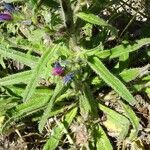
Echium vulgare
Viper's bugloss · Blue echium · Blueweed · Blue thistle · Blue-devil
Description
Source: leafsnapEchium vulgare, commonly known as viper's bugloss or blueweed, is a biennial or short-lived perennial plant belonging to the Boraginaceae family. Native to Europe and western Asia, it has been introduced and naturalized in many parts of the world. The plant typically grows to a height of 1-3 feet, featuring a basal rosette of hairy, rough-textured, lance-shaped leaves. Its stem is also hairy, adorned with branching spikes of blue-purple flowers that bloom from June to September. The tubular flowers, with five petals and protruding stamens, are particularly attractive to bees and other pollinators. Echium vulgare thrives in well-drained soils in full sun but can tolerate some shade. It often grows in disturbed areas such as roadsides, fields, meadows, pastures, waste places, or along coastal cliffs. Historically, the plant has been used for medicinal purposes for centuries due to its anti-inflammatory properties, which can help alleviate respiratory issues such as asthma and bronchitis when consumed as a tea or tincture. However, Echium vulgare can also be considered an invasive species due to its ability to spread rapidly through self-seeding, potentially outcompeting native plants if not properly controlled. Overall, Echium vulgare is an attractive wildflower that provides food for pollinators and possesses medicinal properties. However, it should be monitored carefully if planted outside its native range due to its invasive potential.
💡 Although it has a frightening appearance and some intimidating common names, viper's bugloss is a cherished ornamental plant with many cultivars available. It is also a favorite among many insects, particularly bees and butterflies.
🌳 Viper's bugloss provides an important nectar source for bees and other pollinating insects, helping to support biodiversity. This role is often overshadowed by its ornamental appeal in wildflower mixes. The plant’s potential use in ecological restoration projects and its capacity to signal metalliferous soils are underexplored applications that could benefit environmental management.
🎭 Untruth
Care Guide
💧 Water Every 7 days
Viper's bugloss originates from temperate regions with well-drained soils and thrives with moderate moisture levels. To promote steady growth, it should be watered weekly, ensuring the soil remains neither too wet nor too dry. Natural rainfall helps meet its moisture needs, particularly during the active growing season when the plant produces its vibrant blooms.
How should I water my Viper's bugloss plant?
When watering the Viper's bugloss, it's best to use filtered water at room temperature. Tap water may contain particles that can harm the plant. The Viper's bugloss prefers warm environments, so avoid using cold water, which can shock its system. Instead of overhead watering, apply filtered room temperature water directly to the soil until it's completely soaked. This helps moisten the roots and allows them to spread through the soil and absorb nutrients effectively.
What do I do if I give my Viper's bugloss plant too much or too little water?
The health of your Viper's bugloss can be negatively impacted by both overwatering and underwatering, but overwatering is more commonly seen. When this plant receives too much water, its stems and leaves may wilt and turn yellow. Overwatering for a prolonged period can also lead to diseases like root rot, mold, and mildew, which can be fatal for your plant. On the other hand, underwatering is less common due to the plant's drought tolerance, but it is still possible. When underwatering occurs, the leaves of your Viper's bugloss will become brittle and brown. Recognizing the signs of overwatering is crucial for taking care of your plant. Some diseases caused by overwatering, such as root rot, may not be fixable if you wait too long. If you notice early signs of overwatering, reduce your watering schedule immediately. Additionally, assess the soil quality of your Viper's bugloss. If the soil doesn't drain well, replace it with a loose, well-draining potting mix. On the other hand, if you observe signs of underwatering, simply water more regularly until the signs disappear.
How frequently do I need to water my Viper's bugloss plant?
If your Viper's bugloss is in a pot, the most precise way to determine if it needs watering is to check the soil. Plunge your finger into the soil and if the first two to three inches are dry, it's time to water. If you have the plant outdoors in the ground, you can use a similar method. Check the first few inches of soil and if it's dry, water the plant. Typically, during spring and early fall, watering once a week should be sufficient. However, during extremely hot weather, you may need to water twice or more per week. It's worth noting that mature and well-established Viper's bugloss plants can withstand drought well.
How much water does my Viper's bugloss plant need?
When watering your Viper's bugloss, don't be afraid to give it a generous amount of water. Wait until the top two to three inches of soil are dry, and then water the plant thoroughly. Make sure to add enough water to completely saturate the soil, allowing excess water to drain out of the pot's drainage holes. If you don't see any water draining, it means the plant is not getting enough water. However, be careful not to let the water accumulate inside the soil, as this can harm the plant. On the other hand, if the water doesn't drain well, it could mean that the soil is not draining properly, which is not good for the plant's health. If the plant is outdoors, it generally only needs about 1 inch of rain per week.
How do I water my Viper's bugloss plant as it grows?
The water needs of the Viper's bugloss can change depending on its growth stages. When it is in the early years or if it has been recently transplanted, it requires more water than usual. During these stages, it focuses on growing new roots that will support future growth, and these roots need more moisture. As the Viper's bugloss matures, it will require less water. Another stage that may require more water is during the bloom period when the flower development uses up a significant amount of moisture.
☀️ Light
What are the sunlight requirements for Viper's bugloss?
Viper's bugloss requires full sun exposure, meaning it needs to receive more than 6 hours of sunlight daily to thrive optimally. It can also grow in partial sun conditions, which is about 3-6 hours of sunlight. It's important to observe how sunlight moves through your garden to find spots that provide an ideal balance of light and shade, ensuring the plant's well-being.
How does sun exposure affect the growth of Viper's bugloss?
Sun exposure plays a crucial role in the growth and development of Viper's bugloss. The plant thrives best in areas with abundant sunlight throughout the day. Both excessive and insufficient light can potentially harm the plant. In environments where natural sunlight is not abundant, artificial lighting can be used to supplement the plant's light requirement, with LED lights being a popular choice because they can be customized to provide specific wavelengths needed for optimal plant growth.
What artificial lighting is recommended for indoor cultivation of Viper's bugloss?
When natural sunlight is insufficient for indoor cultivation of Viper's bugloss, artificial lighting becomes essential for its growth. LED lights are recommended due to their capability to mimic natural sunlight. Full sun plants need 30-50W/sq ft, partial sun plants require 20-30W/sq ft, and full shade plants should have 10-20W/sq ft of artificial light. The light source should be placed 12-36 inches above the plant, and the plants typically need 8-12 hours of light per day.
What are common symptoms of inadequate light in Viper's bugloss?
When Viper's bugloss does not get adequate light, it may display several symptoms. These include smaller new leaves, leggy or sparse growth, faster leaf drop, slower or no new growth, and lighter-colored new leaves. Additionally, the plant may experience chlorosis (leaves turning yellow), sunscald, leaf curling, wilting, and leaf scorching due to excessive sunlight or light deficiency.
How can I address light-related issues in Viper's bugloss?
To address light-related issues in Viper's bugloss, gradually acclimate the plant to receive at least 6 hours of direct sunlight daily by moving it closer to light sources each week. If indoors and the plant is large or not easily movable, artificial light sources such as desk or ceiling lamps, or professional plant grow lights, can provide additional light. Outdoors, ensure the plant is gradually moved to sunnier spots, avoiding sudden changes to prevent sunburn. Minimize obstructions like branches from trees and consider transplanting smaller plants during their dormant period to locations with better sunlight exposure.
🌡️ Temperature 20–35°C
Native to temperate areas, Viper's bugloss thrives best in a temperature spectrum of 68 to 95 °F (20 to 35 ℃). If the temperature should drop below or exceed this spectrum in certain seasons, it might be essential to supply additional heating or cooling to sustain the most favorable conditions for growth.
What is the native environment of Viper's bugloss, and what are its temperature preferences?
Viper's bugloss is native to temperate regions and thrives in a temperature range of 68 to 95°F (20 to 35°C). To ensure optimal growth, it may be necessary to provide extra heating or cooling if the temperatures fall outside this range during different seasons. The plant exhibits strong cold resistance, indicating special frost protection measures typically aren't required in winter. However, should winter temperatures are expected to fall below the limit growth temperature, providing cold protection by covering the plant with soil or straw and watering it abundantly before the first freeze to keep the soil moist is advisable. This strategy helps to prevent drought and water scarcity during the colder months and early spring.
How does Viper's bugloss respond to low and high temperatures, and what are the solutions for each?
Viper's bugloss is cold-tolerant, doing best when the temperature remains above a minimum suitable growth temperature. During winter, it is important to keep it above a tolerable growing minimum temperature. A drop below the limit growth temperature might not show immediate effects in winter but can lead to reduced or no sprouting in spring. The solution for non-sprouting parts in spring is to remove them. In contrast, during summer, the plant should be kept below a maximum suitable growth temperature. Exceeding the tolerable growing maximum temperature can cause the leaves to lighten in color, curl, suffer from sunburn, and in severe cases, result in wilting and drying of the plant. To mitigate these issues, sunburned and dried parts should be trimmed away. Moving the plant to a shaded area or using a shade cloth during the most intense sun periods, along with watering in the mornings and evenings, are effective solutions to keep the soil moist and protect the plant.
💨 Humidity
🪴 Soil
🌱 Fertilizer
Viper's bugloss requires periodic nourishment to stimulate blooming but it isn't fond of excessive amounts. It calls for mild frequencies of fertilizer through its whole life span, particularly during the apex of active growth and its blooming period. You should continue to provide nutrients to your Viper's bugloss until its flowering period ends.
Why should I use fertilizer on my Viper's bugloss?
Properly fertilizing flowering plants, such as Viper's bugloss, is crucial for robust growth and vibrant blooming. These plants are known for their prolific blooming, which means they need ample fertilizer to replenish the necessary nutrients for their growth. Nitrogen is important for promoting early season vegetative growth and maintaining green foliage through photosynthesis and chlorophyll production. Phosphorus plays a vital role in enhancing flower formation, strengthening stems, and converting sunlight into usable energy for growth. Potassium aids in water and nutrient movement, facilitating the transportation of essential substances from the roots to the shoots. Additionally, it encourages root growth and enhances the plant's ability to tolerate drought during the summer.
When should I fertilize my Viper's bugloss plant?
Viper's bugloss enjoys a steady amount of fertilizer, but it does not want to be overloaded. Throughout its life cycle, especially during the peak periods of active growth and flowering, it benefits from light doses of fertilizer given regularly. You should continue feeding your Viper's bugloss until it stops blooming. Keep in mind that container-grown plants, due to their smaller root zone and limited access to nutrients, require more frequent fertilization compared to plants grown in the ground.
When is it a bad time to fertilize my Viper's bugloss?
Fertilizer can sometimes be harmful to Viper's bugloss, especially if the plant is already stressed for another reason. It is not recommended to fertilize when the plant is struggling with diseases or insect problems like aphids, spider mites, or whiteflies, as this can weaken the plant's defenses and make it more susceptible to other pest problems or disease infections. It is also important to avoid fertilizing when the soil surface has become hardened or too dry, as this can lead to fertilizer burn on the roots. Instead, it is advised to water the potting soil to make it slightly moist before applying fertilizer. Additionally, during the hottest part of the summer when Viper's bugloss goes dormant, it is best to avoid fertilizing until growth resumes.
What kind of plant food does my Viper's bugloss need?
It is best to use water-soluble or liquid fertilizers for flowering bedding plants like Viper's bugloss. Slow-release products are especially effective. Granular products can be difficult to apply to container-grown plants and tend to leach out of the container quickly. When choosing a fertilizer, you have the option of a balance or all-purpose formula, or you can select a product labeled as a bloom booster, which is particularly beneficial for bedding plants. These plants require more phosphorus during the blooming phase. Fertilizers that promote flowering typically have lower levels of nitrogen, and higher levels of phosphorus to encourage bud development and blossoms instead of vegetative growth. Synthetic products with an approximate N-P-K ratio of 10-30-10 are suitable, while organic fertilizers with a ratio of 2-8-4 can also be used.
How do I make my Viper's bugloss plant grow better?
If you are growing container plants, you don't need to fertilize the seeds when planting if your potting soil has slow-release fertilizer in it. The initial fertilizer in the soil, along with the nutrient reserves in the seed, will be enough for the first couple of weeks. However, if your potting soil doesn't have fertilizer, you should mix a small amount of slow-release starter fertilizer into the potting mix before filling the containers. Once your plants are six to eight weeks old and you see flower buds developing, it's time to start fertilizing Viper's bugloss. Do this every two weeks, using one-third to one-half of the recommended rate listed on the product label. Keep up this schedule until Viper's bugloss stops blooming for the season.
🪴 Pot & Repot Every 12 months
When transplanting Viper's bugloss, choose a pot that's 1-2 inches (2.5–5 cm) bigger in diameter and make sure it offers sufficient drainage. Employ a potting mixture that drains well and think about incorporating perlite for added drainage. Carry out the repotting in the springtime or early summer season, then hydrate the plant adequately, and place it in a location with less sunlight at the initial stage.
✂️ Pruning
Viper's bugloss is a resilient biennial known for its tall spikes of blue flowers. To encourage growth and flowering, prune the plant in early to late spring. Remove dead stems and spent flowers to maintain its health and extend the blooming period. Minimal intervention is ideal, as it supports the plant's natural growth habit and enhances air circulation.
🌿 Propagating
🐛 Diseases & pets
☠️ Toxicity
Characteristics
- Plant Type
- Herb
- Life Cycle
- Biennial, Perennial, Annual
- Genus
- Echium
- Family
- Boraginaceae
- Hardiness Zone
- 3-9
- Mature Height
- 25 cm to 91 cm
- Mature Spread
- 30 cm to 61 cm
- Leaf Color
- Green
- Leaf Type
- Deciduous
- Flower Color
- Blue, Purple
- Flower Size
- 1.02 cm to 2.03 cm
- Bloom Time
- Late spring, Early summer, Mid summer
- Planting Time
- Summer, Winter
- Harvest Time
- Early summer, Mid summer