Elaeocarpus angustifolius
Blue marble tree · Blue-fig · Blue-quandong · Quandong · Ultrasan beads
Description
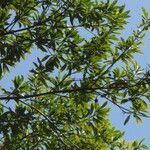
Source: leafsnapElaeocarpus angustifolius, commonly known as the Blue Quandong or Blue Marble Tree, is a large evergreen tree native to Australia. This species can grow up to 40 meters tall and features a dense crown of glossy green leaves that are narrow and elongated. In the spring and summer, the tree produces small white flowers, which are followed by blue, marble-like fruits containing a single seed each. The Blue Quandong plays a crucial role in Australian rainforests by providing food for various native animals, including birds, bats, possums, and flying foxes. Although the fruit is edible for humans, it has a sour taste. The tree's timber is highly valued for its strength and durability, making it ideal for construction purposes such as flooring and furniture making. Additionally, the bark was traditionally used by Indigenous Australians to make string. Elaeocarpus angustifolius prefers moist soils in shaded areas but can tolerate full sun exposure once established. It thrives in tropical regions with high rainfall but can also be cultivated in subtropical areas with regular watering. Overall, Elaeocarpus angustifolius is an important species both ecologically and economically due to its unique characteristics, including fruit production, timber quality, and traditional uses by Indigenous Australians.
Care Guide
💧 Water Every 7 days
The Blue Marble Tree is native to humid subtropical climates and thrives when it receives a consistent, moderate water supply. It should be watered every 1-2 weeks, and it prefers soil that is moist but not waterlogged. As an outdoor plant, it grows best during rainy seasons but also adapts well to both wet and dry periods.
How should I water my Blue marble tree to keep it healthy?
Your Blue marble tree is not picky about how you water it. You can use any common watering tool, such as watering cans, hoses, or even cups. The important thing is to water the soil directly. Make sure to moisten all areas of the soil equally to provide water to the entire root system. It's best to use filtered water to avoid harmful particles, and water at or slightly above room temperature to prevent shocking the tree. However, the Blue marble tree usually responds well to any kind of water.
What should I do if I give too much or too little water to my Blue marble tree?
Outdoor plants, especially newly planted ones or seedlings, are prone to lack of watering. It's important to consistently water them for a few months until the roots are established. Once that happens, the Blue marble tree can rely on rain for moisture. Overwatering is a common issue when the Blue marble tree is in pots. If you accidentally overwater your plant, take immediate action to minimize the damage. Stop watering it right away and remove the tree from its pot to check the roots. If there is no root rot, you can put it back in the pot. But if you find root rot, trim the affected roots and consider applying a fungicide to prevent further damage. Repot the tree in well-draining soil. On the other hand, underwatering is easily fixable. If the plant's leaves droop, dry out, and fall off, simply increase the watering frequency. The leaves will quickly regain their fullness with sufficient water. Make sure to adjust your watering routine promptly when underwatering is noticed.
How frequently should I water my Blue marble tree?
If your area gets enough rainfall, most outdoor plants can grow naturally without extra watering. However, if your area lacks rainfall, you should water your plants adequately every 2 weeks in spring and fall. In summer, plants will need more frequent watering. In winter, plants grow slower and require less water, so watering should be done sparingly, and in some cases, not at all. Young or newly planted Blue marble trees need more frequent watering to establish themselves and eventually become more adaptable and drought tolerant. For potted plants, there are two main ways to determine how often to water your Blue marble tree. One way is to follow a set watering schedule, either once a week or once every other week. However, this approach may not consider the specific growing conditions for your Blue marble tree. Another option is to base your watering frequency on the moisture level of the soil. Generally, it is recommended to wait until the top two to four inches of soil, about 1/3 to 1/2 depth of the pots, have completely dried out before watering again. Keep in mind that during summer, when the plant's water needs are highest, a predetermined watering schedule may not be sufficient.
How much water does my Blue marble tree require?
Watering your Blue marble tree may require less water than you think. If only a few inches of soil have dried since the last watering, give the tree about five to ten ounces of water. You can also gauge the water volume based on the soil moisture. Basing it on how many inches of soil have dried between waterings is a good guide. To ensure the tree gets enough moisture, water enough to moisten all the dry soil layers since the last watering. If over half of the soil is dry, consider giving more water until it drains from the pot's drainage holes. If the tree is in a rainy area outdoors, it may not need extra watering. For young or newly established trees, aim for 1-2 inches of rain per week. As the tree grows, it can survive solely on rainwater, except in hot weather with no rainfall for 2-3 weeks. In those cases, give the tree a full watering to prevent stress.
How can I know if I'm giving enough water to my Blue marble tree?
The Blue marble tree commonly faces the issue of overwatering, which can be identified through a few signs. Look out for yellowing leaves and leaf drop. Overwatering can also lead to a shriveled structure and root rot. Conversely, an underwatered Blue marble tree will start wilting and may have brown or brittle leaves. Regardless of whether you observe signs of overwatering or underwatering, taking action to revive the tree's health is essential.
☀️ Light Full sun
The blue marble tree prefers a spot where it gets abundant sunlight for most of the day. Although partial sun won't seriously harm it, it does much better with generous light. Coming from a sunny habitat, inadequate light can cause stunted growth and unhealthy foliage.
What are the sunlight requirements for a Blue Marble Tree?
The Blue Marble Tree (Elaeocarpus angustifolius) thrives in environments where it can enjoy an abundance of sunlight for most of the day, requiring full sun exposure of above 6 hours of sunlight daily for optimal growth. It can tolerate partial sun, which means about 3-6 hours of sunlight, but it performs best when it receives generous sunlight exposure. Insufficient light may lead to stunted growth and unhealthy foliage. Observing how sunlight moves through your garden will help you find the optimum balance of light and shade, ensuring a happy and healthy plant.
How does artificial lighting affect the growth of indoor Blue Marble Trees?
When natural sunlight is insufficient, especially during winter or in spaces that don't get much sunlight, artificial lighting becomes crucial for the optimal growth of indoor Blue Marble Trees. Adequate lighting promotes faster, healthier growth. LED lights are recommended due to their ability to provide specific wavelengths needed by plants. Full sun plants require 30-50W/sq ft of artificial light, partial sun plants need 20-30W/sq ft, and full shade plants need 10-20W/sq ft. The lights should be placed 12-36 inches above the plant to mimic natural sunlight and kept on for 8-12 hours per day to simulate natural daylight hours.
What are the key symptoms of insufficient light for a Blue Marble Tree?
A Blue Marble Tree exhibits several symptoms when it's not getting enough light: new leaves might grow smaller than older ones, resulting in a tree with small leaves; the tree might experience leggy or sparse growth as the spaces between leaves or stems lengthen; there can be faster leaf drop as the plant conserves resources; growth may be delayed or stop entirely; new leaves might appear lighter in color, indicative of a lack of chlorophyll; chlorosis, where leaves lose their color; sunscald, causing damage from intense light; leaf curling as a defense against excessive light; wilting due to increased water loss; and leaf scorching, characterized by brown or crispy leaf edges. These symptoms highlight the plant's struggle in suboptimal lighting conditions.
How can you optimize light conditions for Blue Marble Trees both indoors and outdoors?
To optimize light conditions for Blue Marble Trees, gradually acclimatize them to brighter conditions. For indoor plants, start by moving them each week to sunnier spots until they receive at least 6 hours of direct sunlight daily. Utilize south-facing windows and keep curtains open during daylight hours. If natural light is insufficient or the plant is large, consider additional artificial lighting, keeping it on for at least 8 hours daily. For outdoor plants, move them to sunnier locations while avoiding sudden changes to prevent sunburn. Observe the environment to eliminate obstructions like overhanging branches. For smaller plants, consider transplanting during their dormant period to a spot with ample sunlight and good drainage. Note that parts of the plant affected by previous insufficient sunlight might not recover, but new growth will be healthier with improved lighting conditions.
🌡️ Temperature 20–37.8°C
Blue marble tree is native to tropical areas, where the climate is generally warm and humid. Therefore, it is adapted to high heat and humidity. It does not like sudden temperature shifts and favors a consistent temperature, so avoiding indoor temperature fluctuations is important. It usually cannot tolerate cold and needs warmer conditions to grow. If the ambient temperature falls too low, the plant may stop growing or even die.
💨 Humidity
🪴 Soil 6-7
🌱 Fertilizer
The best time to fertilize a Blue marble tree is in early spring, when it comes out of dormancy. This encourages overall growth and flower formation. Fertilization improves the foliage, stems, and branches, while encouraging flowers that are large, colorful, and long-lasting. It helps move nutrients from the roots to the blooms and enhances the plant’s health and resistance to disease.
Why should I use fertilizer on my Blue marble tree?
No matter what type of Blue marble tree you have, regular fertilization is essential for its overall health. Providing the right nutrients promotes strong growth and improves the tree's ability to withstand challenging conditions and fight off diseases and pests. The foliage of your Blue marble tree is particularly beautiful, so it's important to preserve it. To achieve this, establish and follow a fertilization schedule tailored to your specific Blue marble tree. By doing so, you will encourage the growth of deep-colored, lush leaves.
When should I fertilize my Blue marble tree?
To properly fertilize your Blue marble tree, there are two key times to keep in mind. The first is in late winter or early spring, when your tree will benefit from the added nutrients as it prepares for the upcoming warmer weather. Additionally, if you live in a warmer climate region, it can be advantageous to provide an extra fertilizer feeding in early fall. This will not only give the tree added nutrients for the following growing season, but also help it become more resilient to winter conditions, preventing foliage damage. Fertilizing earlier in the year will also allow enough time for new branches to grow and withstand the cold winter.
When should I not add fertilizer to my Blue marble tree?
There are certain periods throughout the year when it is best to avoid fertilizing your Blue marble tree. Firstly, during the early and mid-winter months, the tree is dormant and does not require any nutrients. Secondly, it is not recommended to fertilize the plant in late spring and throughout the summer, as these months tend to be hotter with drier conditions. Fertilizing during this time can have a detrimental effect on the tree. To prevent any problems, it is advisable to stick to a fertilization schedule that focuses on feeding only in early spring and early fall.
What kind of fertilizer should I use for my Blue marble tree?
The Blue marble tree primarily needs nitrogen as its most important nutrient, but phosphorus and potassium should not be overlooked either. A balanced fertilizer with equal amounts of all three nutrients, like a 10-10-10, can be effective. However, a more specific ratio of nutrients often promotes optimal growth for the Blue marble tree. Fertilizers with slightly higher nitrogen content, such as a 10-6-4 ratio, tend to yield better results. Granular or liquid-based fertilizers can both be used for fertilization.
How should I feed my Blue marble tree?
To fertilize your Blue marble tree, you have two options: using a granular fertilizer or a liquid fertilizer. If you choose to use a granular fertilizer, simply sprinkle it on the soil at the right time. The advantage of granular fertilizer is that it releases nutrients gradually over time. Before applying the fertilizer, it's a good idea to lightly water your tree. Alternatively, you can use a liquid fertilizer, although this is not as common. In this case, mix the fertilizer with water and pour it around the base of your tree. It may also be helpful to perform a soil test before fertilizing to check if the pH needs to be adjusted.
🪴 Pot & Repot
✂️ Pruning
The blue marble tree is an evergreen tree known for its glossy leaves and distinctive blue fruits. To maintain its health, prune the tree from early to late winter. Focus on removing dead branches and enhancing air circulation. Always use clean, sharp tools to minimize any potential damage during pruning. This timing coincides with the tree's dormancy, promoting faster recovery and healthier growth.
🌿 Propagating
🐛 Diseases & pets
☠️ Toxicity
Characteristics
- Plant Type
- Tree
- Life Cycle
- Perennial
- Genus
- Elaeocarpus
- Family
- Elaeocarpaceae
- Hardiness Zone
- 10-12
- Mature Height
- 49.99 m
- Mature Spread
- 9.14 m
- Leaf Color
- Dark Green, Forest Green
- Leaf Type
- Evergreen
- Flower Color
- White, Yellow, Cream
- Flower Size
- 2.03 cm to 4.06 cm
- Bloom Time
- Late spring, Summer
- Planting Time
- Summer, Autumn
- Harvest Time
- Late summer, Fall
- Native Area
- India, Malaysia, Indonesia, Cambodia, Vietnam, Myanmar, Vanuatu, Philippines, Bangladesh, Thailand, China