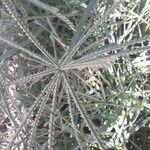
Eleusine indica
Crowfoot grass · Goose grass · Crabgrass · Wire grass · Yard grass
Description
Source: leafsnapEleusine indica, the Indian goosegrass, yard-grass, goosegrass, wiregrass, or crowfootgrass, is a species of grass in the family Poaceae. It is a small annual grass distributed throughout the warmer areas of the world to about 50 degrees latitude. It is an invasive species in some areas. Eleusine indica is closely related to Eleusine coracana (finger millet or African finger millet), and the diploid E. indica is likely an ancestor of the allotetraploid E. coracana. Seeds of E. indica are edible and are sometimes used as a famine food, but yields are low. It is an important weed of cultivated crops, lawns, and golf courses. It thrives in disturbed areas with compacted soils in full sun. Both tillage and herbicides are used in its control. This low-growing grass is capable of setting seed even when closely mown. Some populations have evolved resistance to certain herbicides, including glyphosate. Eleusine indica performs C4 photosynthesis and therefore can grow in hot climates and in the hotter months of the temperate zone. Its seeds germinate later in spring than most other temperate zone weeds, such as crabgrasses. Though usually considered an annual, it may survive for more than a year in climates not subject to frost.
💡 Goosegrass is a humble and unassuming wild vegetable that often goes unnoticed. It thrives among weeds and in farmland, quietly blending into the background. Much like invisible love that surrounds us, it subtly permeates our lives.
🌳 Goosegrass is often overlooked as an indirect bioindicator. Responsive to soil compaction and indicative of poor soil fertility, goosegrass prospers in these harsh conditions and points to potential agricultural problems. Its abundance suggests attention to soil health is needed, making it an unwitting sentinel of the land rather than merely a nuisance.
🎭 Determination, and hidden love
Care Guide
💧 Water Twice per week
Goosegrass, a plant native to tropical regions, thrives in environments with high humidity and regular rainfall. It prefers consistent moisture, so watering it twice a week is ideal. Although goosegrass is quite resilient to different watering patterns as an outdoor plant, it grows best when the soil remains evenly moist during its active growth season.
What do I do if I give my Goosegrass too much or too little water?
Proper watering is crucial for the performance of this beautiful ornamental grass. When planted in the ground, watering issues can be easily resolved. However, in a container, it is essential to avoid giving too much or too little water, as both can quickly kill Goosegrass. Insufficient watering can cause stunted growth, drooping leaves, weak seed head production, and browned leaves. On the other hand, overwatering can lead to yellow leaves with brown tips. If you suspect your Goosegrass is not receiving adequate water, the first step is to determine whether it is being over or under-watered. If it is receiving too much water, stop watering immediately and wait for the soil to dry out. When you see new growth, test the soil moisture level before deciding whether to water again. On the contrary, if your Goosegrass is being underwatered, the solution is simply to give it a deep watering and observe if it improves. Keep in mind that a long, deep watering is always better than frequent, shallow waterings. This encourages the growth of deep roots, making the grass more resilient to drought and water-related problems.
How many times should I water my Goosegrass plants?
The watering needs of Goosegrass can vary depending on where it is planted. Generally, it is recommended to water this grass every week. However, in hot climates, watering once or twice a week during the summer may be necessary. In moderate climates, watering once every seven days or more may be sufficient. It's important to note that grass in containers typically requires more frequent watering compared to grasses planted in the ground. Additionally, the location of the grass matters as well. Grasses in shaded areas require less frequent watering compared to grasses planted in the ground. To determine when to water Goosegrass, there are a few key signs to look out for. Checking the soil moisture by pressing your finger a couple of inches into the soil can indicate if it is dry. For potted grass, you can weigh the grass with a portable scale or simply feel the pot to determine if it is light, indicating a need for water. If the roots lack sufficient water, the blades of the grass may appear folded along their centers and thinner than usual. Although Goosegrass is drought-tolerant, regular and deep waterings will result in a beautiful color. In its natural habitat, Goosegrass grows in open scrubland exposed to extreme heat, bright sun, and intermittent rain. Despite its ability to withstand dry conditions, this grass still requires care and attention. Gardeners recommend consistent watering for optimal growth. When Goosegrass is first planted, it needs more frequent watering until it establishes deep roots. For potted Goosegrass, the soil tends to dry out quickly, especially if the pot is exposed to hot, direct sun for a significant part of the day. Testing the soil every 3 to 4 days and watering only when it feels dry is recommended. In-ground Goosegrass generally requires less watering, but the frequency depends on the type of soil. Clay soil retains water for longer periods, so it may feel dry at the surface while still being moist below ground. On the other hand, sandy soils that drain quickly will need to be watered more often.
What do I need to watch out for when watering my Goosegrass in different seasons, climates, or during different growth stages?
You can use the growth rate of your grasses as a clue to determine if you're watering enough. For example, during the hottest months, goosegrass can grow twice as fast in just one year. So if the weather is hot and your grass isn't growing vigorously, you may need to adjust your watering schedule. In winter, you might be able to get away with watering only once a month. However, it's still a good idea to check the soil for moisture. During the warmest months, when the grass is in a growth cycle, it will require more water than usual. But during winter and cooler months, the need for water will decrease significantly. Remember, the soil should always be allowed to dry out completely before adding water to goosegrass.
☀️ Light Full sun
Goosegrass requires plentiful sunlight to grow best, although it can survive in shade or locations with reduced sun as well. Coming from regions with strong sun exposure, it has adjusted to prosper under a range of light conditions. Both too much and too little sunlight can harm its health, potentially restricting its growth and vigor.
What are the sunlight requirements for Goosegrass?
Goosegrass requires full sun, defined as more than 6 hours of sunlight daily, to thrive optimally. However, it can also grow in partial sun to full shade, which is about 3-6 hours of sunlight. Monitoring the movement of sunlight through your garden is crucial for choosing the best spots that offer a perfect balance of light and shade, ensuring the wellbeing of your plants.
Can Goosegrass grow with artificial lighting?
Yes, Goosegrass can grow with artificial lighting, especially when natural sunlight is not sufficient, like in winter or less sunny spaces. Adequate lighting is essential for optimal growth indoors. LED lights are recommended because they can be customized to provide specific wavelengths of light needed by plants. The requirements for artificial light vary based on plant types: full sun plants need 30-50W/sq ft, partial sun plants need 20-30W/sq ft, and full shade plants need 10-20W/sq ft. The artificial light source should be placed 12-36 inches above the plant and should mimic natural daylight hours, typically requiring 8-12 hours of light per day.
What are the symptoms of inadequate light in Goosegrass?
When grown indoors with inadequate light, Goosegrass may show several symptoms indicating light deficiency. These include smaller new leaves, leggy or sparse growth, faster leaf drop, slower or no new growth, lighter-colored new leaves, and symptoms like chlorosis, sunscald, leaf curling, wilting, and leaf scorching. These symptoms reflect the plant's struggle with insufficient sunlight, impacting its health and growth.
How can I improve the light conditions for indoor Goosegrass?
To improve light conditions for indoor Goosegrass, you can gradually move the plant to a sunnier spot, ensuring it receives at least 6 hours of direct sunlight daily, ideally using a south-facing window. If the plant is large or not easily movable, or when natural light is insufficient, consider using artificial light sources like desk or ceiling lamps on for at least 8 hours daily or investing in professional plant grow lights to provide ample light.
What steps should be taken to improve light conditions for outdoor Goosegrass?
For outdoor Goosegrass, it's important to gradually acclimate the plants to sunnier conditions by moving them to a sunnier location each week, avoiding sudden changes in light intensity to prevent sunburn. If the plant has been affected by insufficient sunlight, new growth should be healthier following increased light exposure. Additionally, reducing obstructions such as pruning trees or branches that block sunlight and transplanting smaller plants during their dormant period to a location with ample sunlight and good drainage can also improve light conditions.
🌡️ Temperature 5–35°C
Goosegrass originates from regions where temperatures fall between 68 and 95 °F (20 to 35 °C). The plant achieves its optimal growth within that temperature band. To maintain its growth across seasons, consider adjusting the ambient temperature to replicate its natural habitat.
What are the ideal temperature conditions for growing Goosegrass?
Goosegrass thrives in climates where temperatures range from 68 to 95°F (20 to 35°C). This range is optimal for its growth, and it is beneficial to adjust the ambient temperature accordingly to mimic its natural habitat across different seasons. Despite its strong cold resistance, measures should be taken to protect it from temperatures dropping below -25°C, such as covering the plant with soil or straw, and watering abundantly before the first freeze in autumn to ensure the soil remains moist through winter and early spring.
How does Goosegrass respond to low temperatures, and what are the recommended solutions?
Goosegrass is cold-tolerant and performs best when temperatures are above 20°C. It should be protected to remain above 0°C during winter. Exposure to temperatures below -25°C might not show immediate effects, but could lead to decreased sprouting or no sprouting in spring. To mitigate this, any parts that have failed to sprout in spring should be removed.
What should be done if Goosegrass is exposed to high temperatures?
In summer, Goosegrass should be kept at temperatures below 35°C. Exposure to temperatures above 41°C may result in the leaves becoming lighter in color, prone to curling, susceptible to sunburn, and in severe cases, wilting or drying out completely. The recommended solutions include trimming away the sunburned and dried parts, moving the plant to a shaded location, especially during midday and afternoon sun, or using a shade cloth. Additionally, watering the plant in the morning and evening helps keep the soil moist.
💨 Humidity
🪴 Soil 5-7
🌱 Fertilizer
🪴 Pot & Repot
✂️ Pruning
🌿 Propagating
🐛 Diseases & pets
☠️ Toxicity
Characteristics
- Plant Type
- Grass
- Life Cycle
- Annual, Biennial
- Genus
- Eleusine
- Family
- Poaceae
- Hardiness Zone
- 5-10
- Mature Height
- 10 cm to 91 cm
- Mature Spread
- 5 cm to 8 cm
- Leaf Color
- White
- Leaf Type
- Deciduous
- Flower Color
- White, Yellow, Green
- Flower Size
- 2.54 cm
- Bloom Time
- Late spring, Early summer, Mid summer
- Planting Time
- Spring
- Harvest Time
- Summer
- Native Area
- Sri Lanka, Burkina Faso, Lesotho, Egypt, Turkey, Malaysia, India, Angola, Namibia, Madagascar, Rwanda, Pakistan, Thailand, Nigeria, Yemen, Kenya, Uganda, Tanzania, Zimbabwe, Uzbekistan, Niger, Mali, Guinea-Bissau, Benin, Sierra Leone, Indonesia, Equatorial Guinea, Cameroon, Liberia, Mozambique, Burundi, Koppen, Oman, Ghana, Ethiopia, South Korea, Botswana, Congo, Nepal, Saudi Arabia, Malawi, Central African Republic, South Africa, Zambia, Sudan, Philippines, Laos, Armenia, Guinea, Myanmar, Japan, Togo, Bhutan, Senegal, Eswatini, Iran, Côte d'Ivoire, Azerbaijan, Gambia, Congo (DRC), Turkmenistan, Gabon