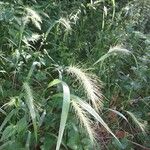
Elymus canadensis
Canada wild rye · Great Plains wild rye · Canada Wildrye · Great Plains Wildrye · Nodding Wildrye
Description
Source: leafsnapElymus canadensis, commonly known as Canada wild rye, is a perennial grass species native to North America. It typically thrives in prairies, meadows, and open woodlands across the continent. The plant can grow up to 1.5 meters in height and features long, flat, narrow green leaves. Canada wild rye produces flowers during the summer months, which are arranged in spikelets on tall stems that rise above the foliage. The flowers range in color from greenish-yellow to purplish-brown and eventually give way to small seeds that are dispersed by the wind. This plant serves as an important food source for various animals, including deer, elk, and bison, as well as numerous bird species such as sparrows and finches. Additionally, it has several practical uses for humans, such as erosion control and roadside planting due to its ability to tolerate salt. Overall, Elymus canadensis is a vital component of many ecosystems across North America, thanks to its ecological significance and versatility. It benefits both wildlife conservation efforts and human needs.
🌳 Canada wildrye is mainly valued for its role in land reclamation and soil stabilization. Its deep root system makes it an excellent choice for controlling erosion, especially on disturbed lands. Although not widely recognized, Canada wildrye has also been identified as having potential as a biomass energy source. Its dense foliage and rapid growth make it a suitable candidate for bioenergy crops, contributing to more sustainable energy solutions.
🎭 Affection, Faithfulness
Care Guide
💧 Water Every 7 days
Canada wildrye thrives in prairie environments and is well-adapted to varying moisture levels, demonstrating strong tolerance to drought conditions. It needs a moderate amount of water, typically requiring watering twice a week during its active growth periods. As an outdoor plant, Canada wildrye efficiently utilizes seasonal rainfall, adjusting its growth to match water availability.
What should I do if I give my Canada Wildrye too much water or not enough water?
Proper watering is crucial for the performance of this beautiful ornamental grass. When planted in the ground, watering issues can be resolved, but in a container, improper watering can quickly lead to the demise of Canada Wildrye. Insufficient watering can cause stunted growth, with symptoms of drooping leaves, weak seed head production, and browning. On the other hand, overwatering can result in yellow leaves with brown tips. To address the issue, it is important to determine if the problem is too much or too little water. If overwatering is suspected, immediate cessation of watering is necessary. Bear in mind that in heavy soils, it may take weeks for the soil to dry out, so be patient. Once signs of new growth appear, test the soil for moisture and decide if additional watering is needed. If Canada Wildrye is receiving too little water, simply give it a deep drink and observe if it perks up. It is worth noting that a thorough, deep watering is always preferable to frequent but shallow waterings. This method encourages deep root growth, making the grass more resistant to drought and less susceptible to watering-related problems.
How frequently should I give water to my Canada Wildrye plant?
The watering needs of Canada Wildrye vary depending on its planting location. Generally, watering this grass once a week is recommended. However, in hot climates, it may require watering once or twice a week during the summer. In moderate climates, watering every seven days or more may be sufficient. Grass in containers usually needs more frequent watering compared to grass planted in the ground. The species' ability to thrive in full sun or part shade also affects its watering needs. Shaded grasses require less frequent watering than grasses planted in the ground. To determine when to water Canada Wildrye, check if the soil is dry by pressing your finger a couple of inches into it. For potted grass, you can weigh it using a portable scale or simply feel if the pot feels light due to lack of water. Insufficient water supply may cause the grass blades to appear folded along their centers and thinner than usual. Despite its drought tolerance, regular and deep waterings will result in a beautiful color. In the wild, Canada Wildrye grows in open scrubland, exposed to extreme heat, bright sun, and intermittent rain. Although it is drought-resistant, it still requires care and attention. Consistent water provides optimal conditions for this hardy grass. When newly planted, Canada Wildrye needs more frequent watering until it develops deep roots. Potted Canada Wildrye, particularly in hot and sunny locations, dries out quickly and should be checked every 3 to 4 days. Watering should only be done when the soil feels dry. Canada Wildrye planted in the ground generally requires less watering, depending on the soil type. Clay soil retains moisture below ground even if it appears dry at the surface, while sandy soils that drain quickly will need more frequent watering.
What do I need to watch out for when I water my Canada Wildrye in different seasons, climates, or during different stages of growth?
Your grass's rate of growth can indicate if it's receiving sufficient water. For example, Canada Wildrye typically doubles in size during the hottest months. If the weather is hot but the grass isn't growing vigorously, you may need to adjust your watering schedule. In winter, watering once a month might be sufficient, but it's still important to check the soil for moisture. During the warmest months, the grass will require more water during its growth cycle. However, during winter and cooler months, the need for water will decrease significantly. Remember to allow the soil to dry out completely before watering Canada Wildrye again.
☀️ Light Full sun
Canada Wildrye grows best when exposed to full sun every day. The amount of sunlight it receives is important for its vigorous growth and overall vitality, though it can tolerate locations with less light. However, too much or too little sun can negatively affect its growth and general health.
What are the sunlight requirements for Canada Wildrye (Elymus canadensis)?
Canada Wildrye thrives in locations that provide full sun exposure for more than 6 hours a day. Sunlight plays a crucial part in its growth and vitality, although it can survive in areas with less sunlight. It's important to observe how sunlight moves through your garden to find spots with the perfect balance of light and shade, ensuring the plant's well-being. In situations where natural sunlight is insufficient, especially during winter or in less sunny spaces, artificial lighting can be a beneficial solution. Indoor plants, including Canada Wildrye, may require artificial lighting to support optimal growth, with recommendations such as LED lights for their ability to provide specific wavelengths needed by plants. Full sun plants need 30-50W/sq ft of artificial light, partial sun plants need 20-30W/sq ft, and full shade plants need 10-20W/sq ft.
What symptoms indicate Canada Wildrye is not receiving enough sunlight?
When Canada Wildrye does not receive adequate sunlight, it may exhibit several symptoms including smaller new leaves than the previous ones, leggy or sparse growth, faster leaf drop, and slower or no new growth. These symptoms indicate the plant is struggling with light deficiency and entering survival mode. Lack of chlorophyll and essential nutrients can cause the leaves to develop irregular color patterns or appear pale, whereas excessive sunlight exposure can lead to chlorosis, sunscald, leaf curling, wilting, and leaf scorching, showing both ends of the spectrum of sunlight impact on the plant.
How can you mitigate sunlight-related issues for Canada Wildrye?
Mitigating sunlight-related issues for Canada Wildrye involves adjusting its exposure to sunlight. If the plant is kept indoors and not receiving enough light, gradually move it to a sunnier location each week until it receives at least 6 hours of direct sunlight daily. The use of a south-facing window or artificial lighting such as desk or ceiling lamps for at least 8 hours daily can provide the necessary light exposure. For outdoor plants, gradually transitioning them to sunnier spots while avoiding drastic changes in light intensity is essential to prevent sunburn. Additionally, for plants affected by obstructions, minimizing these by pruning nearby trees or transplanting the plant to a sunnier location with ample sunlight and good drainage during its dormant period can significantly improve light access.
🌡️ Temperature 0–32.2°C
Canada Wildrye is native to areas where temperatures range from 32 to 90 °F (0 to 32 °C). It does best in those conditions and may need extra care to adapt to other climates. Monitor temperature changes carefully, particularly through the different seasons.
What is Canada Wildrye and where is it indigenous to?
Canada Wildrye, scientifically known as Elymus canadensis, is indigenous to environments where the temperature ranges from 32 to 90 °F (0 to 32 °C). It is best suited to these conditions and may require specific care to adapt to different climates.
How does Canada Wildrye handle cold temperatures?
Canada Wildrye is highly cold-tolerant and doesn't require additional frost protection in winter. To prepare for the first freeze of autumn, it is recommended to water the plant generously, ensuring the soil remains moist and enters a frozen state. This preparation helps prevent drought and water scarcity for the plant during the winter and early spring.
What should be done if winter temperatures drop below -35°C?
Although Canada Wildrye is extremely cold-tolerant, if the winter temperature falls below -35°C, it may affect the plant's ability to sprout in spring. There might be a decrease in sprouting or even no sprouting at all. If this occurs, it's suggested to remove any parts of the plant that have failed to sprout in the spring.
How does Canada Wildrye react to high temperatures?
Canada Wildrye is not tolerant to high temperatures. When temperatures exceed 32°C, the plant's growth may halt, and it becomes more susceptible to rot. To mitigate damage from high temperatures, trim away sunburned and dried-up parts. Move the plant to a location with shade during the midday and afternoon sun, or use a shade cloth. Also, water the plant in the morning and evening to keep the soil moist and cool.
💨 Humidity
🪴 Soil 6-7
🌱 Fertilizer
Canada Wildrye needs extra nutrients to encourage healthy new growth. In spring, adding some compost around the base of the plant will effectively supply the nutrition it requires. Fertilizing helps support vigorous growth and improves the plant’s ability to resist diseases and pests.
🪴 Pot & Repot
✂️ Pruning
Canada Wildrye is a cool-season perennial grass characterized by its graceful, arching blue-green leaves. To encourage new growth, manage its height, and increase its density, it's best to prune this grass in early spring. Be sure to use clean and sharp tools to cut dead stems at ground level. This helps maintain the plant's health and ornamental appeal.
🌿 Propagating
🐛 Diseases & pets
☠️ Toxicity
Characteristics
- Plant Type
- Grass
- Life Cycle
- Perennial
- Genus
- Elymus
- Family
- Poaceae
- Hardiness Zone
- 3-7
- Mature Height
- 0.61 m to 1.52 m
- Mature Spread
- 49 cm
- Leaf Color
- Green, Blue
- Leaf Type
- Semi-evergreen, Deciduous
- Flower Color
- Green, Brown, White, Yellow, Silver
- Flower Size
- 25.40 cm
- Bloom Time
- Early summer, Mid summer
- Planting Time
- Spring, Summer
- Harvest Time
- Mid summer
- Native Area
- Mexico