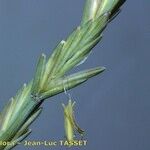
Elytrigia obtusiflora
Tall wheatgrass
Description
Source: leafsnapThinopyrum obtusiflorum is a species of grass known by the common names tall wheatgrass, rush wheatgrass, and Eurasian quackgrass. It is native to Eurasia and it has been introduced to many other parts of the world, including much of the Americas and Australia.This perennial bunchgrass can grow up to 2 meters tall. The ribbed leaves have pale green blades a few millimeters wide. The inflorescence is a spike studded with spikelets up to 3 centimeters long, each containing up to 12 flowers.This grass is used as a forage and for hay in many places. It is good for land with saline soils, and it can help reduce the salinity. It is also good for non-saline soils. This grass is commonly crossed with its relative, wheat, in order to give the wheat traits such as stress tolerance and pest resistance.
Care Guide
💧 Water
☀️ Light Full sun
Tall wheatgrass is a perennial herbaceous plant that loves the sun and typically comes from open environments, frequently flourishing in meadows and grasslands. While it prefers full sunlight, it can also withstand conditions with partial sun.
🌡️ Temperature 5–35°C
Tall wheatgrass is capable of adjusting to a diverse set of temperature environments, although its spread might be curtailed by distinct pairs of water and temperature situations. It flourishes optimally in hot summertime climates with sufficient rainfall or hydration. Extended bouts of overcast and rainy climate, along with prolonged high heat, can heighten the propensity of Tall wheatgrass to perish. During the winter, ensuring adequate protection against the cold can boost the survival odds of the plant.
💨 Humidity
🪴 Soil 6-7
🌱 Fertilizer
To achieve maximum growth, Tall wheatgrass necessitates three sessions of fertilization: prior to planting, a month following the sprouting of the seedlings, and a last application 1 to 1.5 months after the previous one. Certain varieties of Tall wheatgrass may profit from supplemental fertilizer at the time of planting to encourage swift growth.
🪴 Pot & Repot
✂️ Pruning
🌿 Propagating
🐛 Diseases & pets
☠️ Toxicity
Characteristics
- Plant Type
- Grass
- Life Cycle
- Perennial
- Genus
- Elytrigia
- Family
- Poaceae
- Hardiness Zone
- 4-9
- Mature Height
- 0.61 m to 1.22 m
- Mature Spread
- 30 cm to 61 cm
- Leaf Color
- Green, Blue
- Leaf Type
- Deciduous
- Flower Color
- Yellow
- Flower Size
- 0.51 cm to 0.76 cm
- Bloom Time
- Early summer, Mid summer
- Planting Time
- Spring, Autumn
- Harvest Time
- Late summer, Early fall
- Native Area
- Egypt, Turkey, Tunisia, Cyprus, Bulgaria, Greece, Morocco, Ukraine, Russia, Portugal, Italy, Kazakhstan, Spain, Israel, Albania, Algeria, Romania, France