Empodisma minus
Description
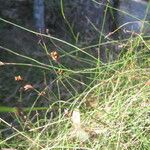
Source: wikipedia (CC BY-SA)Empodisma minus, commonly known as (lesser) wire rush or spreading rope-rush, is a perennial evergreen belonging to the southern-hemisphere family of monocotyledonous plants Restionaceae. The Latin name Empodisma minus translates to “tangle-foot” “small”. E. minus is found from Queensland to South Australia, Tasmania and throughout New Zealand south of 38 ° latitude, or the central north island. Its current conservation status is “Least concern”. In 2012, the new species Empodisma robustum was described in New Zealand, with what was previously described as E. minus from the lowland raised bogs of Waikato and Northland now being re-classified as E. robustum. E. minus remains an important peatformer in the south of New Zealand and in high altitude peatlands.
Care Guide
💧 Water
☀️ Light Partial sun
Wire rush is indigenous to habitats like forest understories and rocky places, where it grows under natural shade. It favors partial sun but can tolerate both full sun and full shade, illustrating its versatile and hardy character.
🌡️ Temperature 15–35°C
Wire rush can tolerate a broad range of temperatures, but its distribution may still be restricted by different combinations of water and heat. It does best in warm summer climates with sufficient rainfall or watering. Long periods of cloudy, rainy weather, and extended high temperatures can increase the chance of Wire rush dying. In winter, providing proper protection from cold can boost the plant's survival rate.
💨 Humidity
🪴 Soil 6-7
🌱 Fertilizer
For Wire rush, a single fertilizer application in spring is generally adequate, though several feedings can boost growth to the maximum. Apply fertilizer every one to one and a half months. Fertilization improves leaf appearance and performance, maintaining even color and a healthy texture. It also encourages root development and nutrient uptake, supporting the plant’s long-term health.
🪴 Pot & Repot
✂️ Pruning
Wire rush is an evergreen plant characterized by its dense, wiry stems. To maintain its health and appearance, prune the plant in early spring. Removing old or damaged stems at this time helps increase light and air circulation. This process revitalizes the plant after winter dormancy, encouraging vigorous growth and preserving its aesthetic appeal.
🌿 Propagating
🐛 Diseases & pets
☠️ Toxicity
Characteristics
- Plant Type
- Herb
- Life Cycle
- Perennial
- Genus
- Empodisma
- Family
- Restionaceae
- Hardiness Zone
- 7-10
- Mature Height
- 30 cm to 61 cm
- Mature Spread
- 30 cm to 49 cm
- Leaf Color
- Dark Green
- Leaf Type
- Evergreen
- Flower Size
- 0.20 cm to 0.25 cm
- Bloom Time
- Late fall, Winter
- Planting Time
- Spring, Summer, Autumn
- Harvest Time
- Mid winter, Late winter, Early spring
- Native Area
- New Zealand