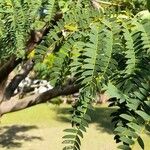
Enterolobium contortisiliquum
Earpod tree · Pacara earpod tree · Oreja de Negro · Pacara Ear-pod-tree · Timb¢ Colorado
Description
Source: leafsnapEnterolobium contortisiliquum, commonly known as the Brazilian earpod tree or the ear tree, is a large deciduous tree native to South America. It can reach heights of up to 30 meters and boasts a wide-spreading canopy that provides ample shade. The tree has compound leaves that can grow up to 30 centimeters in length, with each leaflet measuring about 2 to 3 centimeters long. The most distinctive feature of this plant is its seed pods, which are shaped like ears and can grow up to 20 centimeters long. These pods contain numerous seeds that are dispersed by animals such as birds and monkeys. The Brazilian earpod tree has many uses in traditional medicine, including treatments for fever, coughs, diarrhea, and skin infections. It also holds cultural significance in South American folklore, where it is believed that hanging an earpod from a string around one's neck will bring good luck. In addition to its medicinal properties, Enterolobium contortisiliquum plays a vital ecological role by providing habitat for various animals, including birds and insects. Its wood is valued for furniture making due to its durability and resistance to termites. Overall, Enterolobium contortisiliquum serves significant ecological and cultural purposes. As such, conservation efforts should be made to preserve this species for future generations as an important part of South American flora biodiversity.
Care Guide
💧 Water Every 7 days
The pacara earpod tree is native to arid regions and is highly drought-tolerant. It thrives with minimal moisture, requiring watering only every 2 to 3 weeks. Its deep root system makes efficient use of water, making it an ideal choice for xeriscapes and water-conserving environments.
☀️ Light Full sun
The pacara earpod tree does best in places with abundant sunlight throughout the day, making ample sun exposure vital for its healthy growth. Its native habitat features constant sunshine. Too much sunlight does not harm the tree, while too little light can impede its growth and development.
🌡️ Temperature 20–37.8°C
The Pacara earpod tree comes from tropical areas, where the climate is generally warm and humid. Consequently, it is well suited to high heat and moisture. It does not tolerate sudden temperature changes and prefers a stable thermal environment, so it's important to prevent temperature fluctuations indoors. It usually cannot endure cold and needs higher temperatures to grow. If the ambient temperature falls too low, the plant may stop growing or even die.
💨 Humidity
🪴 Soil 6-7
🌱 Fertilizer
The best time to fertilize a Pacara earpod tree is in early spring as it comes out of dormancy. Applying fertilizer then encourages overall growth and flower development. It improves the leaves, stems, and branches, and supports the formation of large, vibrant, long-lasting flowers. Fertilization also helps transport nutrients from the roots to the flowers and boosts the plant’s health and disease resistance.
🪴 Pot & Repot
✂️ Pruning
Prune the pacara earpod tree in early spring to remove dead or overlapping branches, which will improve air circulation and light penetration. Use clean, sharp tools and make cuts just above the buds for optimal healing. This practice promotes structural strength, healthy growth, and overall vitality in the pacara earpod tree.
🌿 Propagating
🐛 Diseases & pets
☠️ Toxicity
Characteristics
- Plant Type
- Tree
- Life Cycle
- Perennial
- Genus
- Enterolobium
- Family
- Fabaceae
- Hardiness Zone
- 9-11
- Mature Height
- 13.72 m to 30.48 m
- Mature Spread
- 14.94 m to 24.99 m
- Leaf Color
- Dark Green, Forest Green
- Leaf Type
- Deciduous
- Flower Color
- White
- Flower Size
- 2.54 cm to 5.08 cm
- Bloom Time
- Late spring, Early summer
- Planting Time
- Spring, Summer
- Harvest Time
- Late summer, Early fall, Mid fall
- Native Area
- Brazil, Bolivia