Enterolobium cyclocarpum
Earpodtree · Monkeysoap · Devil's-ear · Elephant's-ear · Ear tree
Description
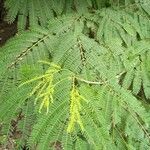
Source: leafsnapEnterolobium cyclocarpum, commonly known as the Guanacaste tree, is an impressive and large species belonging to the legume family. Native to Central America, it can be found in Mexico, Guatemala, Belize, Honduras, Nicaragua, and Costa Rica. This majestic tree can grow up to 30 meters tall, with a trunk diameter reaching up to 3 meters. The Guanacaste tree has compound leaves, composed of numerous small leaflets arranged in a fern-like pattern. Its small flowers, which are either white or yellowish, grow in clusters on long stalks. The tree’s fruit is large, up to 15 cm long, with a woody shell that splits open when ripe. The wood of the Guanacaste tree is highly prized for its durability and resistance to decay, making it ideal for use as timber or for crafting furniture. Additionally, indigenous communities have traditionally used it for medicinal purposes, including treating skin conditions and respiratory problems. Ecologically, the Guanacaste tree is vital for providing shade, which helps regulate temperature levels in its environment, and offering habitat for various species, such as birds and insects. Overall, Enterolobium cyclocarpum is a significant plant species both culturally and ecologically in Central America.
🌳 Guanacaste is not only an impressive feature in the landscapes of Central and North America but also fills an unexpected role as a source of amusement. Beyond its familiar uses for timber and shade, local children often use the tree's large, hollow seedpods as natural rattles, enjoying the lighter side of this botanical giant. The seeds are also used as a supplemental feed for livestock, taking advantage of their nutritional value. This range of uses highlights guanacaste's cultural significance in addition to its ecological presence.
🎭 Development, steadiness, connection to life
Care Guide
💧 Water Every 7 days
Guanacaste trees are well-suited to arid regions due to their high drought tolerance and ability to thrive with limited rainfall. They typically need watering only once every one to two weeks, reflecting the conditions of their native dry habitats. As deciduous trees, their water requirements change with their leaf shedding cycle. They need less water during their dormant period when they lose their leaves.
How should I water my Guanacaste tree?
To ensure optimal root development, it is recommended to place a garden hose at the base of the plant. It is important to avoid directly spraying the leaves. If the plant is located outdoors and exposed to direct sunlight, the leaves may require additional watering. Bubblers can be used to provide moisture directly to the roots of each plant. Soaker hoses that cover the entire garden or flower bed are also effective in ensuring deep root growth when adding or removing plants. Excess water should be drained and the soil allowed to dry before watering again. Watering at ground level helps prevent diseases. On sunny days, it may be beneficial to spray the entire bush with water. Whether the plant is in a pot or in the ground, it is important to remember that Guanacaste plants prefer deep watering rather than light sprinkling.
What should I do if I give Guanacaste too much or too little water?
If you overwater your Guanacaste plant, you may notice yellowing, wilting, and dropping leaves, as well as a general unhealthy appearance with mushy stems. Adjust your watering schedule when you see these signs. Conversely, if the plant is underwatered, the leaves may become crispy and dry. Check the soil moisture and give it a thorough watering if it's dry. However, be aware that the damaged root system may cause the plant to still have dry and yellow leaves even after it recovers. Indoors, be cautious of overwatering and look for black spots, in which case, allow the soil to dry out for a few days. Overwatering can lead to root rot, so if you notice discolored and slimy roots, consider transferring the plant to a different pot. When planting the Guanacaste outdoors, make sure to check the soil moisture and provide adequate watering if it is too dry.
How many times should I water my Guanacaste tree?
The Guanacaste plant prefers deep and infrequent watering. This is especially important when it is planted in pots, as their water storage is limited and the soil can dry out quickly. In colder regions, watering every 3 to 5 days is necessary. It is best to water in the early morning when the soil is dry, whether the plant is indoors or outdoors. You can also check the soil moisture by feeling it. When the top 2-3 inches of soil are dry, it is time for a full watering. During hot days, you may need to check the moisture daily as the heat can quickly dry out the potting soil. If you have a garden, you will also need to irrigate the soil. In hot climates, watering once a week is sufficient. Only water when you notice that the top 2-3 inches of soil are too dry. Take into account any rainfall, and avoid overwatering to prevent root rot. Guanacaste plants generally grow during spring and fall. If they are planted outdoors, adding 3 to 4 inches of mulch can help conserve water. Sandy soil requires more frequent watering, while clay soil can go 2-3 days without watering to avoid root rot. To keep track of watering, mark the date on the calendar and pay attention to any drooping leaves, which may indicate that watering is needed a day earlier.
How much water does my Guanacaste tree need?
To properly water your Guanacaste plant, it generally requires about a gallon of water on a regular schedule. For potted plants, it's important to water them deeply until you notice water dripping from the bottom of the pot. After that, allow the soil to dry before watering again. You can use a water calculator or moisture meter to determine how much water you've given the plant in a week. During the flowering period, be sure to provide ample water, but allow the moisture to evaporate afterward to avoid root rot. If your Guanacaste is planted outdoors and receives sufficient rainfall, it may not need additional watering. However, when the plant is young or newly planted, it should receive 1-2 inches of rain per week. As the Guanacaste grows, it can rely solely on rainfall. Only during excessively hot weather or in the absence of rain for 2-3 weeks, consider giving the plant a thorough watering during the cooler part of the day to prevent damage from high heat. Additional watering will be necessary during extended dry periods.
Should I water my Guanacaste tree more or less depending on the time of year or weather conditions?
To properly care for your Guanacaste plant, it is important to understand its watering needs throughout the different seasons. During the spring and fall growing seasons, it is best to keep the soil consistently moist, but not overly saturated. Alternating between dry and moist soil conditions will promote healthy growth. However, in the summertime, hot weather can cause water to evaporate quickly, so it may be necessary to water more frequently and provide extra moisture. In the winter, the plant typically requires less water because it will enter a dormant phase and drop its leaves. Using a well-draining but moisture-retentive soil mixture, such as terracotta, can help with water evaporation during this period. Once the plant begins to leaf out and go dormant in the spring, watering can be skipped as the Guanacaste can rely on natural rainfall. When the temperature warms up, it is time to cultivate the plant and encourage growth and blooming. It is important to ensure good drainage at all times, especially during the winter, to prevent waterlogging. When the Guanacaste is potted, it has limited root growth, so regular watering is essential, especially in the summer months. Avoid cold and wet roots by providing sufficient drainage. Deep watering, ensuring that the entire root system is soaked, at least once or twice a week, depending on the weather, is recommended. Shallow sprinkles that only reach the leaves should be avoided as they can promote fungal growth and do not reach the roots effectively. Even during dormancy in the fall and winter, it is important not to let the plant dry out completely. However, be cautious not to overwater and allow the plant to sit in water for extended periods, as this can be detrimental. Applying mulch when possible can help reduce stress, conserve water, and promote healthy blooms.
☀️ Light Full sun
The guanacaste thrives with ample sunlight, displaying optimal growth when light is plentiful. Its native habitats are generally open and sunny. However, the plant can also tolerate locations with moderate light. Insufficient sunlight may slow its growth, while excessive light can cause the leaves to redden.
What are the sunlight requirements for Guanacaste and how does light impact its growth?
The Guanacaste (Enterolobium cyclocarpum) thrives in conditions of full sun, meaning it requires more than 6 hours of sunlight daily, but it can also adapt to partial sun, roughly 3-6 hours of sunlight. This ample sun exposure is critical for its optimal growth, as it originates from open and sunny habitats. However, the plant can adjust to moderate light areas. Insufficient sunlight may slow down its growth, while an excess could lead to leaf reddening. It's important to observe the movement of sunlight through your garden to find spots that balance light and shade, ensuring the plants' well-being.
How can artificial lighting be used for Guanacaste plants and what are the best practices?
Indoor Guanacaste plants require adequate lighting, especially when natural sunlight is insufficient, like during winter or in less sunny spaces. Artificial lights are beneficial for promoting faster, healthier growth. LED lights are recommended because they can provide specific wavelengths needed by plants. For full sun plants, 30-50W/sq ft of artificial light is needed; partial sun plants require 20-30W/sq ft, and full shade plants need 10-20W/sq ft. The light source should be placed 12-36 inches above the plant to mimic natural sunlight and should be on for 8-12 hours per day, mirroring natural daylight hours for the species.
What are the signs of insufficient or excessive sunlight in Guanacaste plants?
Guanacaste plants show various symptoms when they experience insufficient or excessive sunlight. Insufficient light may lead to smaller new leaves, leggy or sparse growth, faster leaf drop, slowed or halted growth, lighter-colored new leaves, indicating lack of chlorophyll. Excessive sunlight can cause chlorosis, sunscald, leaf curling, wilting, and leaf scorching. Chlorosis involves leaves turning yellow due to chlorophyll breakdown, while sunscald appears as pale or necrotic areas on the plant. Leaf curling minimizes water loss, and wilting occurs when the plant can't maintain hydration. Leaf scorching signifies damage from too much sunlight.
What are the solutions for managing light exposure for Guanacaste plants?
To manage light exposure for Guanacaste plants and ensure optimal growth, gradually relocate them to receive at least 6 hours of direct sunlight if they're indoors, using a south-facing window or artificial light sources like desk or grow lights for at least 8 hours daily. For outdoor plants, move them to optimal sunlight spots gradually to avoid sunburn. Removing obstacles that block sunlight or transplanting to sunny locations with good drainage can also be effective. It's key to make these changes gradually and during the plant's dormant period for best results. Note that parts of the plant already affected by light issues may not recover, but new growth should be healthy with proper light conditions.
🌡️ Temperature 20–37.8°C
The guanacaste is native to areas where temperatures range from 20 to 38 ℃ (68 to 100 ℉). It prefers warm conditions and can adapt to seasonal variations by adjusting its growth rate. In colder seasons it may slow its growth, but will thrive once temperatures rise.
What is the native temperature range for Guanacaste?
The Guanacaste is native to regions where temperatures range from 20 to 38°C (68 to 100°F). It thrives in warm temperatures and is able to adjust its growth rate to seasonal changes. During colder seasons, its growth may slow, but it will thrive again once temperatures increase. The plant loves heat and can be harmed by cold. In autumn, it's recommended to bring outdoor Guanacaste plants indoors, placing them near a bright window but away from heaters. Keeping the temperature above 20°C during winter supports its growth, while temperatures approaching 5°C can be harmful.
How does low temperature affect Guanacaste, and what are the solutions?
Guanacaste prefers warm temperatures and doesn't tolerate cold well. It thrives best when temperatures are above 20°C, and during winter, the temperature should be kept above 5°C. Exposure to temperatures below 1°C may cause the leaves to lighten in color, and frost damage can turn them brown or black, leading to wilting and drooping. The solution to frost damage is trimming off the frost-damaged parts and moving the plant to a warm environment indoors. Placing it near a south-facing window ensures ample sunlight, but the plant should not be placed near heaters or air conditioning vents to avoid excessive dryness.
How does high temperature affect Guanacaste, and what are the solutions?
During the summer, it's important to keep Guanacaste below 38°C. Temperatures above 43°C can cause the leaves to become lighter and increase susceptibility to sunburn. To address sunburn, trim away sunburned and dried parts, and move the plant to a location that provides shade during the midday and afternoon sun. Watering the plant in the morning and evening helps keep the soil moist and supports the plant’s health in high temperatures.
What is the botanical name of Guanacaste?
The botanical name of Guanacaste is Enterolobium cyclocarpum.
💨 Humidity dry (<40%)
This plant prefers dry conditions, so don't mist it. However, watering it less often can also thrive in higher humidity.
🪴 Soil 7-7
🌱 Fertilizer
Fertilization is essential for Guanacaste care. Regular feeding throughout the growing season preserves the energy required for its showy leaves and aids overall growth. Skipping fertilization can cause unhealthy foliage, reduced ornamental value, and stunted or weak growth that is liable to break.
Why is it important to fertilize my Guanacaste tree?
Guanacaste plants require regular fertilization for two main reasons. First, their showy leaves require a significant amount of energy to develop and maintain. Not only do they need energy for leaf maintenance, but also for the growth of stems, branches, roots, and other important structures. Neglecting fertilization can lead to two likely outcomes. Firstly, the leaves of the Guanacaste plant may lose their natural color and texture, appearing generally unhealthy and diminishing their decorative appeal. Secondly, the overall growth of the Guanacaste plant may slow down, or it may produce weak growth that is prone to breakage.
When should I fertilize my Guanacaste tree?
Guanacaste plants in need of occasional feeding. Therefore, there is no need to establish a fixed feeding schedule when planting them. A simple way to fertilize your Guanacaste is to apply fertilizer during watering sessions. Additionally, during the growing season, it is important to ensure that your Guanacaste receives an adequate amount of water. Feeding this plant once every two to three weeks will suffice, and this frequency should be maintained throughout the duration of its new growth production.
When is the best time to not use fertilizer on my Guanacaste?
For most of the year, you can follow a regular fertilization schedule for your Guanacaste. This means fertilizing during the active growing season in spring, summer, and early fall. However, during the winter, it is important not to give the plant any fertilizer. This is because the Guanacaste enters a dormant growth phase during winter, where it either doesn't grow or grows very little. Since there is minimal growth, the plant doesn't need as much energy, and therefore, fertilization is not required during this time.
Which fertilizer is best for my Guanacaste tree?
When fertilizing a Guanacaste tree, it is important to use a specific blend of nutrients in relatively low amounts. The ideal fertilizer will have a balanced N-P-K ratio of 3-1-2. However, a general-purpose fertilizer with an even blend of nutrients can also work well in some cases. Regardless of the type of fertilizer used, it is crucial to ensure that the ratio numbers representing the volume of each nutrient are at 3 or lower. You have the option of using either granular or liquid-based fertilizer. If you opt for a liquid-based fertilizer, it is generally recommended to dilute it by half. While granular fertilizer has few downsides, using liquid fertilizer is often the preferred choice, especially if you are watering your Guanacaste tree at the same time.
How can I make my Guanacaste tree grow better?
Fertilizing a Guanacaste tree is simple and can be done in two ways. The first method involves using a liquid fertilizer. To do this, gather your fertilizer and a watering can. Dilute the fertilizer with water and then pour the mixture onto the soil around the tree, allowing it to soak down to the roots. Another option is to use a granular fertilizer. Sprinkle the granules onto the soil where the tree is planted. Granular fertilizers are slow-release, so you won't have to fertilize as frequently as with a liquid fertilizer. Regardless of the method you choose, it's important to water the tree while you feed it to ensure optimal results.
🪴 Pot & Repot
✂️ Pruning
Guanacaste benefits from pruning in early spring, which focuses on removing dead or crossing branches to improve health and shape. This practice encourages new growth, reduces the risk of disease, and strengthens structural integrity by thinning out dense areas. This allows for better sunlight and air circulation, supporting overall vitality and balanced branch development.
🌿 Propagating
🐛 Diseases & pets
☠️ Toxicity
Characteristics
- Plant Type
- Tree
- Life Cycle
- Perennial
- Genus
- Enterolobium
- Family
- Fabaceae
- Hardiness Zone
- 10-12
- Mature Height
- 24.99 m to 35.05 m
- Mature Spread
- 2.44 m to 3.05 m
- Leaf Color
- Green
- Leaf Type
- Deciduous
- Flower Color
- White
- Flower Size
- 1.02 cm to 1.52 cm
- Bloom Time
- Spring, Early summer
- Planting Time
- Spring
- Harvest Time
- Mid summer, Late summer, Fall, Winter
- Native Area
- Colombia, Belize, Honduras, Mexico, Guatemala, Bolivia, Venezuela, Guyana, Brazil, Nicaragua, Costa Rica, Panama