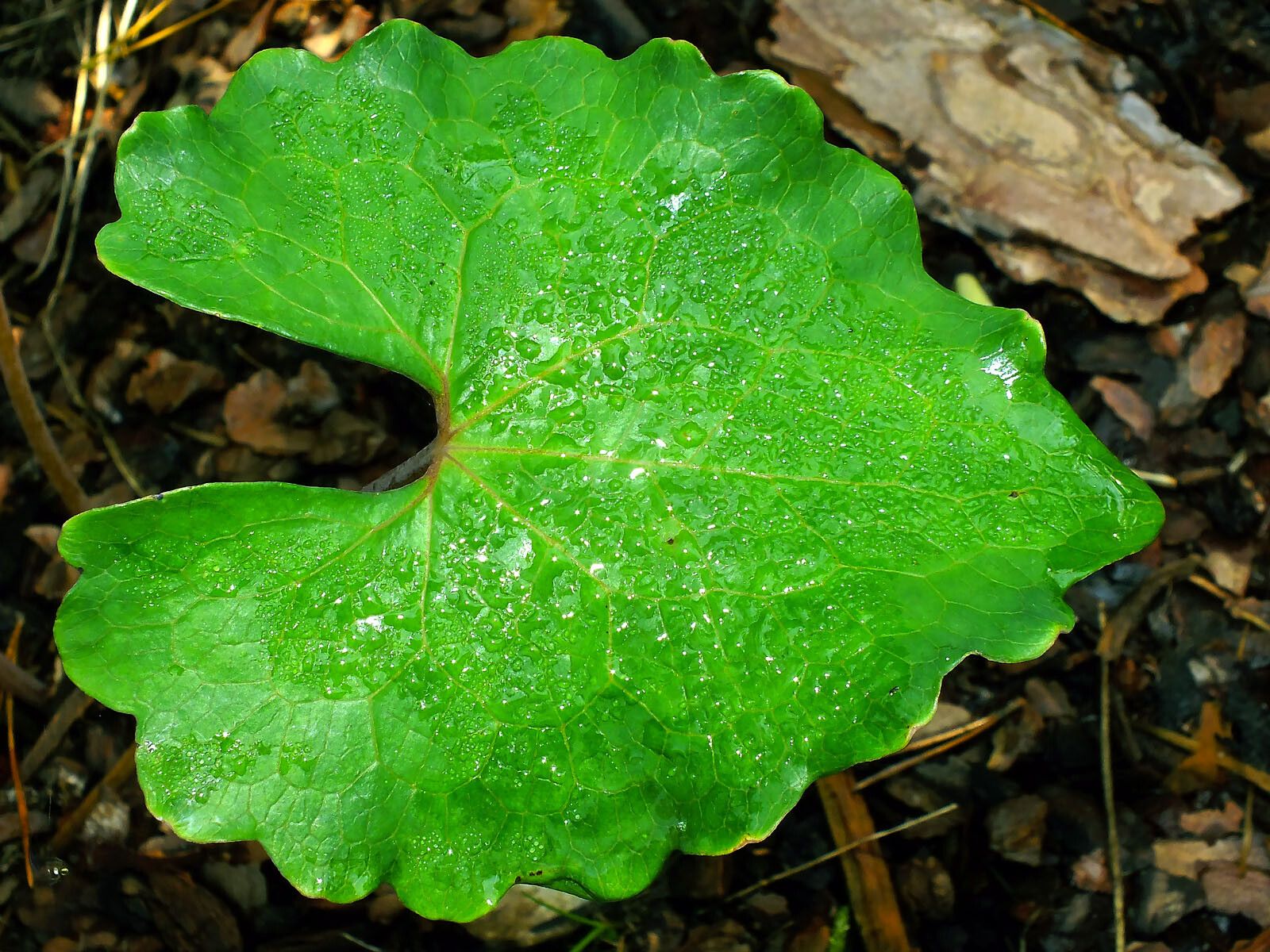
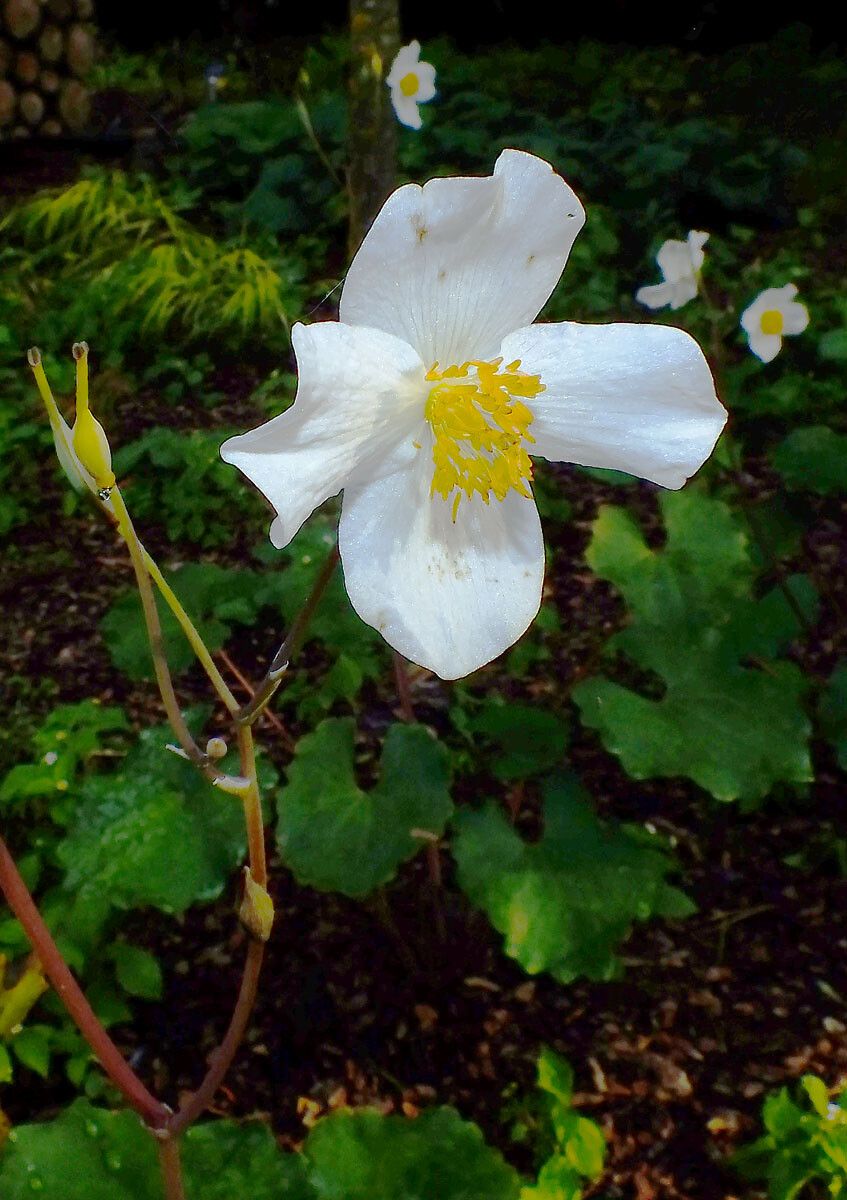
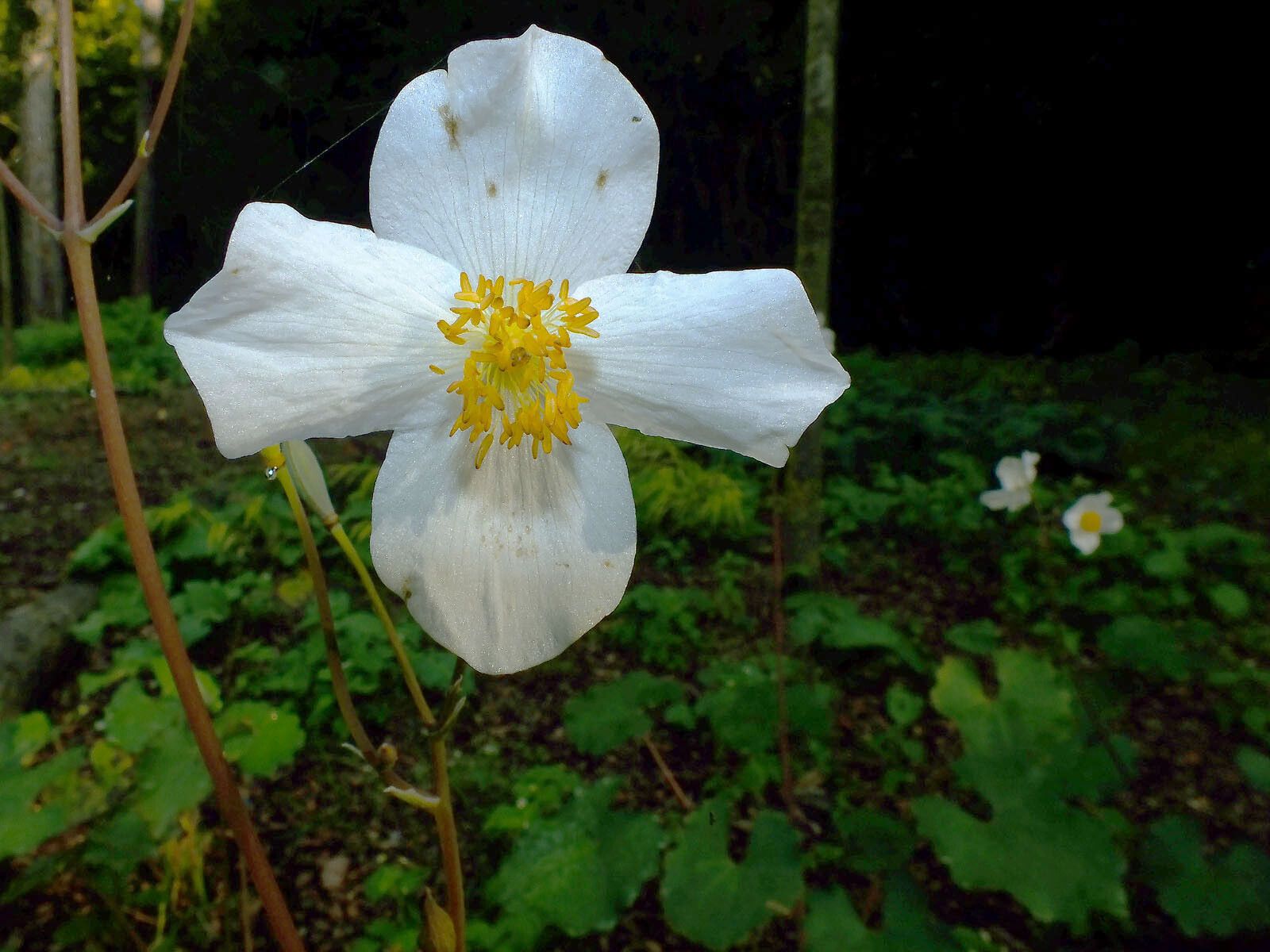
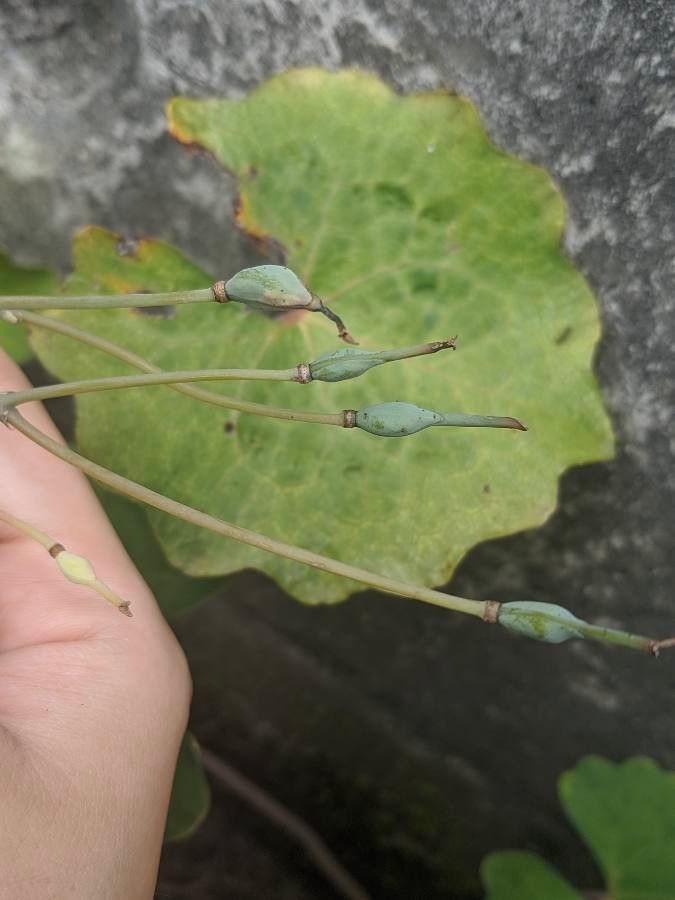
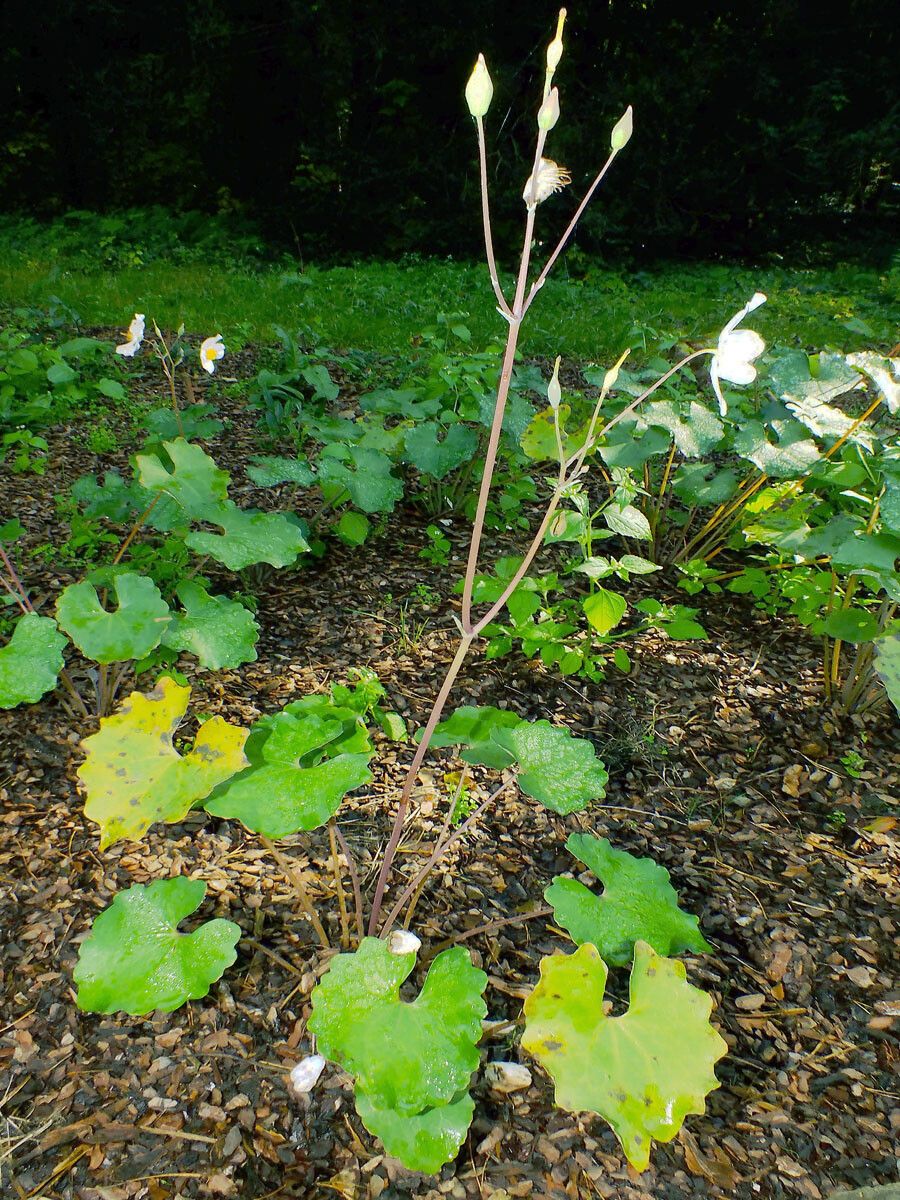
Eomecon is a monotypic genus of flowering plants in the poppy family containing the single species Eomecon chionantha. Its common names include snow-poppy and dawn-poppy. It is native to China.This perennial herb produces stolons from its branching rootstock, spreading to form patches on the ground. Its roots are orange. The leaves are all basal, borne on bluish petioles up to 30 centimeters long. The leaf blades are heart-shaped or kidney-shaped, with wavy, scalloped edges. They are greenish, sometimes with a purple tinge on the undersides. They are up to 26 centimeters long by 20 wide. The scape is blue-gray with a mauve tint. It grows up to 40 centimeters tall and bears 3 to 5 flowers. The flower bud is about a centimeter long and pointed. The open flower has two membranous sepals that join to form a spathe. The four white petals are up to 2.5 centimeters long and are arranged in two layers. At the center of the flower are over 70 stamens with yellow anthers. The fruit is a capsule about 2 centimeters long.Extracts of this plant have been effective at eliminating the freshwater snail Oncomelania hupensis, the intermediate host of Schistosoma japonicum, a fluke that causes schistosomiasis. The molluscicidal compounds in the plant are alkaloids.
Snow poppy is fairly resistant to disease and typically does not suffer from many illnesses. Still, it can be vulnerable to pests and diseases present in its environment. Such infections are generally mild. Regarding care, this plant needs moderate maintenance. It should be pruned on a regular basis to preserve a neat appearance and support healthy growth. Applying fertilizer can also help encourage flowering. Snow poppy is a good choice for anyone with outdoor space, like a garden or patio, and does not demand extensive care experience. It may need more attention if cultivated indoors.
How to keep Eomecon Chionantha.
Light
The snow poppy prefers an environment with moderate sunlight but can tolerate a range of light exposures. Its growth and health may be affected if light conditions are heavily skewed toward either extreme. Originating from habitats with a wide spectrum of sun exposure, it adapts well to varied lighting conditions.
Water
The snow poppy thrives in moist environments and needs to be watered weekly to avoid waterlogging. This herbaceous perennial, native to woodland areas, flourishes during seasonal rains. The availability of water is crucial for its blooming and growth cycles.
Temperature
The snow poppy originates from habitats with moderate temperatures between 68 and 95 °F (20 and 35 °C). It favors consistent warmth but can tolerate seasonal fluctuations. In cooler months, keep the snow poppy away from temperatures below 68 °F (20 °C).
Fertilizer
For Snow poppy, the primary time to apply fertilizer is in early spring while the flowers are developing. The appropriate fertilizer promotes better blooms and helps the Snow poppy produce attractive flowers. Fertilizing in early spring ensures strong flowers during the season and supplies energy for dormant growth periods.
Pruning
To ensure your snow poppies thrive, it's best to prune them between early and late spring. Concentrate on cutting away dead stems and thinning out the plant to improve air circulation. Pruning at the right time boosts the number of blooms, helps maintain the plant's shape, and reduces the risk of disease by allowing better airflow and sunlight to reach all parts of the plant.
Pot & Repot
The snow poppy is a ground cover plant that does not climb. To help it thrive, repot it every 2-3 years in early spring. Choose a spacious, shallow pot to accommodate its rhizomatous roots and keep the soil lightly moist. Place the plant in partial shade to ensure optimal recovery and growth in cool conditions.
Botanical profile.
- Plant Type
- Herb
- Life Cycle
- Perennial, Annual
- Genus
- Eomecon
- Family
- Papaveraceae
- Hardiness Zone
- 6-9
- Mature Height
- 30 cm to 46 cm
- Mature Spread
- 2.13 m
- Leaf Color
- Green, Gray, Silver
- Leaf Type
- Deciduous
- Flower Color
- White
- Flower Size
- 3.05 cm to 5.08 cm
- Bloom Time
- Early spring, Mid spring
- Planting Time
- Spring
- Harvest Time
- Late spring, Early summer
- Native Area
- China
Other names.
Reader questions.
How should I water my Snow poppy plant in the best way?
To properly water the Snow poppy
Why is it important to fertilize my Snow poppy?
Snow poppies benefit from fertilization because it provides necessary nutrients for the plant to grow. While fertilization needs for a Snow poppy are minimal, it can still greatly benefit from annual fertilization. This not only keeps the plant alive but also improves the quality and duration of its flowers. Therefore, those who want their Snow poppy to thrive should make sure to fertilize it each year.
How much sunlight does Snow poppy need to grow?
To help the snow poppy thrive, it needs about 3-6 hours of direct sunlight per day. However, it also requires some shade during the hottest parts of the day to avoid sun damage. Ideally, the snow poppy prefers morning sunlight, but it can handle some afternoon sun if the temperature is not excessively hot. For the best sunlight balance, consider planting the snow poppy in a location that receives partial sun, like under a tree or on the east side of a building.
What temperature is best for Snow poppy?
Snow poppy's temperature preferences vary based on the time of year. There are two main seasons to consider: the growing season and the dormancy season. During the growing season, which is when Snow poppy is sprouting, the ideal temperature range is between 65-80℉ (18-27℃). If the temperature drops below 15℉ (-10℃), the plant may suffer, leading to browning and wilting of the leaves. However, if it's just a short cold snap, the Snow poppy may survive with some assistance. In the warmer parts of the year, Snow poppy needs protection from excessively high temperatures. The upper limit of its temperature range is 95-105℉ (35-40℃). Anything beyond that can harm the foliage and blooms, causing wilting, drooping, and even sunburn on the leaves. Recovering from such damage can be challenging for Snow poppy. Fortunately, there are several quick and easy methods to address this issue.
What should I do if I give my Snow poppy too much or too little water?
Overwatering and underwatering can harm your Snow poppy, but overwatering is more common. When there's too much water, the stems and leaves wilt and turn yellow. Overwatering for a long time can also lead to diseases like root rot, mold, and mildew, which can kill the plant. Underwatering is less likely because this plant can tolerate drought. But if it happens, the leaves become brittle and brown. It's important to spot the signs of overwatering early. Some diseases caused by overwatering, like root rot, may not be fixable if you wait too long. If you see early signs, reduce watering immediately. Check the soil quality. If it drains poorly, replace it with a loose, well-draining potting mix. If you notice signs of underwatering, simply water the plant more regularly until the signs go away.
When should I fertilize my Snow poppy?
The best time to fertilize a Snow poppy is in late winter to early spring when it is transitioning from dormancy to active growth. Fertilizing during this time promotes healthy growth and sets the plant up for a successful season. Although it is generally recommended to fertilize in early spring, it is also acceptable to fertilize in the fall. However, it is not advised to feed a Snow poppy during summer or winter.
What will happen if Snow poppy doesn't get enough sunlight?
Snow poppy can experience various negative effects when exposed to excessive direct sunlight. These effects include yellowing and drying out of the leaves, as well as the possibility of them getting burnt. Additionally, you may observe wilting or stunted growth in the plant. To prevent such sun damage, it is important to provide shade for Snow poppy during the hottest times of the day. This can be achieved by using a shade cloth or by planting Snow poppy near taller plants that can offer natural shade.
The Snow poppy that is in its first year or just a small plant has specific temperature needs.
If this is the first year you have a Snow poppy planted outside, it will need some extra care during the coldest months of the year. Frost can cause significant damage to a first-year Snow poppy and prevent it from growing back as a healthy plant in the spring. To protect it, make sure the temperature stays above 40℉(5℃) by either bringing the Snow poppy inside or using mulch or fabric barriers. During the first year or two, it's best to plant the Snow poppy in a shadier area. Smaller and weaker plants have a harder time regulating their own temperature in hot weather. Limit the direct sunlight to no more than five hours per day, especially if the temperature goes above 80℉(27℃). To control the summer heat, use shadecloth and water or mist the plant frequently.
How often should I water my Snow poppy? --> How many times do I need to water my Snow poppy?
If your Snow poppy is in a pot, the most precise way to determine if it needs water is by checking the soil with your finger. If the top two to three inches of soil are dry, it's time to water it. If you have your Snow poppy planted outdoors, you can use a similar method to test the soil. Once the first few inches of soil have dried out, it's time to water it. In the spring and early fall, you'll likely need to water this plant once a week using this method. When it gets extremely hot, you may need to increase the watering frequency to about twice a week or more. However, mature and well-established Snow poppies can tolerate drought well.
When is the best time to not fertilize my Snow poppy?
To properly care for your Snow poppy, it's best to fertilize it only during late winter and early spring. This plant doesn't require much fertilizer, so a single annual feeding is sufficient. Overfertilizing during spring, summer, and fall can lead to complications, unless you skipped fertilizing in the spring, in which case it's okay to fertilize in the fall. It's important to note that fertilizing is not necessary during winter when the Snow poppy is in a dormant growth phase and does not produce new growth.
What happens if Snow poppy gets too much sunlight?
If Snow poppy doesn't receive sufficient sunlight, it can become tall and thin with sparse leaves. The leaves may also become yellow or pale green, which means the plant is not producing enough chlorophyll due to lack of sunlight. To fix this issue, you can try moving Snow poppy to a sunnier location or trim nearby foliage to enable more light to reach the plant.
How can I keep Snow poppy safe from very hot or very cold weather?
During the growing season, if there are cold temperatures (below 15℉(-10℃)), there are a few steps you can take to protect Snow poppy from frost or cold damage. If you have Snow poppy in a container, simply bring the container inside with bright, indirect light until temperatures rise above the lower threshold again. If Snow poppy is planted in the ground, use mulch or horticultural fabric to create a barrier around the plant to protect it from frost and cold wind. For temperatures hotter than 80℉(27℃) in the shade during the day, be careful to expose Snow poppy to no more than six hours of sunlight per day, preferably in the morning. Putting up shade cloth or a fine plastic mesh can help reduce direct sunlight during the hottest parts of the day. You can also install a misting system to release cooling mist around the base of the plant during the day and lower ground temperatures.