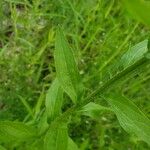
Erigeron strigosus
Common eastern fleabane · Daisy fleabane · Prairie fleabane · Rough fleabane · Whitetop
Description
Source: leafsnapErigeron strigosus is a species of flowering plant in the family Asteraceae known by the common names prairie fleabane, common eastern fleabane, and daisy fleabane.Erigeron strigosus is native to eastern and central North America as far west as Manitoba, Idaho and Texas. It has also become naturalized in western North America as well as in Europe and China as a somewhat weedy naturalized species.Erigeron strigosus is an annual or biennial herb reaching heights of up to 80 cm (32 inches). It has hairy, petioled, non-clasping, oval-shaped leaves a few centimeters long mostly on the lower part of the plant. One plant can produce as many as 200 flower heads in a spindly array of branching stems. Each head is less than a centimeter (0.4 inches) wide, containing 50–100 white, pink, or blue ray florets surrounding numerous yellow disc florets. VarietiesErigeron strigosus var. calcicola J. R. Allison - Alabama, Georgia, Tennessee Erigeron strigosus var. dolomiticola J. R. Allison - Alabama Erigeron strigosus var. strigosus - much of North America; introduced in China Erigeron strigosus var. septentrionalis (Fernald & Wiegand) Fernald - much of North America; introduced in Europe
💡 Prairie fleabane, like all plants in the fleabane genus Erigeron, may have been named due to the belief that it can repel fleas. However, there is no real evidence to support its effectiveness in this regard. Instead, prairie fleabane is valuable for its ability to pioneer and stabilize newly disturbed soil.
🌳 Aside from its visual appeal, daisy fleabane functions as an ecological indicator of disturbed soils, helping in the biomonitoring of landscape changes. Its rapid appearance in disrupted areas enables scientists and conservationists to evaluate ecological impacts and monitor land-use changes over time.
🎭 Liveliness, guilelessness
Care Guide
💧 Water
Prairie fleabane thrives in conditions similar to its native habitat, where it receives regular moisture and can withstand short dry spells. It is generally grown outdoors and benefits from weekly watering. Natural rainfall is ideal for supporting its growth cycles, as it aligns with the seasonal availability of water.
How should I water my Prairie fleabane?
Watering Prairie fleabane can be done using various common watering tools, such as a garden hose with a spray nozzle or a watering can. This plant is not particular about the type of water it receives and can thrive with rainwater, tap water, or even filtered water. However, it is recommended to avoid watering from overhead as it can harm the leaves, flowers, and potentially cause disease. A drip irrigation system is often the most effective method for watering Prairie fleabane, as it ensures even and direct application of water to the soil. When watering a Prairie fleabane grown in a container, you can use similar watering techniques but with different tools, such as a cup, watering can, or tap, to apply water directly to the soil.
What should I do if I give my Prairie fleabane too much or too little water?
To avoid underwatering your Prairie fleabane, simply increase the frequency of watering when you notice it lacks moisture. However, overwatering can be more problematic. If your Prairie fleabane is overwatered, it can develop diseases that may lead to its decline and death. To prevent this, it's important to choose a suitable location with ample sunlight for drying the soil and good drainage to prevent water accumulation. If you have overwatered a potted Prairie fleabane, you may need to transfer it to a new pot with proper drainage holes and loose soil to ensure efficient drainage.
How frequently should I water my Prairie fleabane?
Prairie fleabane requires regular watering throughout its growing season. In spring, water it once a week. As the season progresses and temperatures rise, increase watering to two to three times a week. However, excessive watering can harm the plant. Maintain moist soil without it being wet, regardless of the frequency of watering. Watering Prairie fleabane in a pot is slightly different. Generally, you'll need to water more frequently because pot soil heats up and dries out faster than ground soil. In most cases, water container-grown Prairie fleabane a few times a week, compared to once a week for an in-ground plant.
How much water does my Prairie fleabane plant require?
When determining how much water to give your Prairie fleabane, there are a few different approaches you can take. One method is to feel the soil to gauge moisture levels and water until the first six inches feel moist. Another method involves using a specific measurement, such as two gallons per week, depending on factors like temperature and soil dryness. However, it's important to avoid overwatering if your plant actually requires less water. When growing Prairie fleabane in a container, a different approach is necessary. You should add enough water to moisten all the dry layers of soil, which can be checked by inserting your finger into the soil or observing excess water draining from the pot's holes.
How can I know if I'm giving enough water to my Prairie fleabane?
Avoiding overwatering your Prairie fleabane can be challenging due to its deep root system, which requires weekly watering. However, Prairie fleabane is highly prone to root rot and browning when overwatered. Underwatering is less of a concern as these plants can survive without extra watering for a while, although prolonged absence of water may cause wilting and dry leaves.
☀️ Light Full sun
Daisy fleabane does best with ample sunlight, which greatly promotes healthy growth. It can also do well in spots with lighter sun exposure. However, continual exposure to very low light can hinder its development and may lead to an unhealthy plant.
What are the sunlight requirements for Prairie fleabane?
Prairie fleabane thrives best when it is exposed to full sun, which means it should receive more than 6 hours of sunlight daily. However, it can also grow in partial sun, receiving about 3-6 hours of sunlight. It's important to observe how sunlight moves through your garden to find the best spots that offer a harmonious balance of light and shade, ensuring the plants are happy and healthy.
Can Prairie fleabane grow in artificial lighting?
Yes, Prairie fleabane can grow under artificial lighting, which becomes essential when natural sunlight is insufficient, especially in winter or less sunny spaces. Artificial lights, particularly LED lights, can be tailored to provide the specific wavelengths that plants need. Full sun plants require 30-50W/sq ft, partial sun plants need 20-30W/sq ft, and full shade plants need 10-20W/sq ft of artificial light. The light source should be placed 12-36 inches from the plant, mimicking natural daylight hours, with most plants needing 8-12 hours of light per day.
What are the signs of insufficient light in Prairie fleabane?
When Prairie fleabane does not receive enough light, it may show several symptoms indicating light deficiency. These include smaller new leaves, leggy or sparse growth, and faster leaf drop as the plant tries to conserve resources. Growth may become delayed or stop entirely, and the leaves may develop lighter colors or appear pale, indicating a lack of chlorophyll. Other symptoms like chlorosis, sunscald, leaf curling, wilting, and leaf scorching may occur due to excessive sunlight, which is also detrimental.
How can I ensure my Prairie fleabane receives enough sunlight?
To ensure your Prairie fleabane receives enough sunlight, gradually move the plants to sunnier locations, aiming for at least 6 hours of direct sunlight daily. Use south-facing windows for indoor plants, keeping curtains open during the day. Consider using artificial lighting if natural light is insufficient. Outdoor plants should also be gradually acclimated to sunnier spots to prevent sunburn. If obstructions like trees block sunlight, consider pruning them or transplanting smaller plants to sunnier locations during their dormant periods for optimal growth and health.
🌡️ Temperature 0–35°C
Daisy fleabane is native to temperate regions with temperatures between 68 and 95 °F (20 and 35 ℃). It favors this warm but moderate climate, though with proper care it can tolerate somewhat cooler temperatures.
What is Prairie fleabane and where does it originate?
Prairie fleabane, botanically known as Erigeron strigosus, is a plant originating from climates where temperatures typically range from 68 to 100 °F (20 to 38 °C). This plant thrives in environments that provide consistent warmth and requires protection during cooler seasons to maintain optimal temperature conditions.
Does Prairie fleabane require special frost protection measures?
Prairie fleabane has strong cold resistance, and special frost protection measures are usually not necessary. However, if winter temperatures are expected to drop below -25°C, it is important to provide cold protection by covering the plant with materials like soil or straw. It is also recommended to water the plant abundantly before the first freeze in autumn to ensure the soil remains moist, thereby preventing drought and water scarcity during winter and early spring.
What should be done if Prairie fleabane experiences temperatures below its comfort zone?
For Prairie fleabane, temperatures above 20°C are ideal, and during winter, it should be kept above 0°C. If temperatures fall below -25°C, there might not be noticeable changes during winter, but come spring, there could be a decrease in sprouting or even no sprouting at all. In such cases, it is advised to remove any parts of the plant that have failed to sprout.
How does Prairie fleabane react to high temperatures, and what measures can be taken?
During summer, Prairie fleabane should ideally be kept below 38°C. Exposure to temperatures above 43°C can result in the leaves becoming lighter in color, curling, being prone to sunburn, and in severe cases, the entire plant may wilt and become dry. To protect the plant, trim away the sunburned and dried-up parts, move it to a location with shade from the midday and afternoon sun, or use a shade cloth. Ensuring the soil remains moist by watering in the morning and evening can also help.
💨 Humidity
🪴 Soil 6-7
🌱 Fertilizer
Daisy fleabane benefits from regular, light applications of fertilizer to encourage healthy leaf development. You should fertilize Daisy fleabane about once a month during the summer. Nitrogen is vital for the foliage, and adding nitrogen-rich sources helps Daisy fleabane flourish.
🪴 Pot & Repot
✂️ Pruning
🌿 Propagating
🐛 Diseases & pets
☠️ Toxicity
Characteristics
- Plant Type
- Herb
- Life Cycle
- Annual, Biennial
- Genus
- Erigeron
- Family
- Asteraceae
- Hardiness Zone
- 3-9
- Mature Height
- 0 cm to 5 cm
- Mature Spread
- 49 cm
- Leaf Color
- Green
- Leaf Type
- Deciduous
- Flower Color
- White, Yellow
- Flower Size
- 1.02 cm to 1.52 cm
- Bloom Time
- Late spring, Early summer, Mid summer
- Planting Time
- Spring
- Harvest Time
- Early summer, Mid summer
- Native Area
- Nicaragua, Costa Rica, Panama