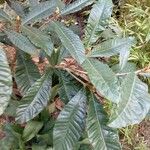
Eriobotrya japonica
ازگيل ژاپنى · ازگیل · Μουσμουλιά · Loquat · Nispero
Description
Source: leafsnapEriobotrya japonica, commonly known as the loquat tree, is a small evergreen tree or shrub native to southeastern China. Belonging to the family Rosaceae, it can grow up to 10 meters tall. The leaves are large and leathery, with a glossy dark green color on top and a fuzzy light green underside. The flowers are small, white or cream-colored, and appear in clusters in late autumn or early winter. The fruit of the loquat tree is oval-shaped and has a yellow-orange skin when ripe. It boasts a sweet flavor reminiscent of apricots or peaches, but with slightly tart undertones. The fruit contains several large seeds that are not edible. The loquat tree has been cultivated for its fruit for thousands of years in China and Japan. It has also been introduced to other parts of the world, including North America, Europe, Australia, and South America. Besides its culinary uses in fresh form or as preserves, jams, jellies, compotes, liquors, syrups, candies, baked goods, and flavorings for tea, wine, vinegar, sauces, dressings, marinades, rubs, spices, and herbs, Eriobotrya japonica also has medicinal properties. Its leaves contain compounds such as triterpenoids (ursolic acid), flavonoids (quercetin), phenolics (chlorogenic acid), and polysaccharides (arabinogalactan), which exhibit antioxidant, anti-inflammatory, hypoglycemic, and hypolipidemic properties according to some studies conducted on animals, cells, and humans. However, more research is needed to make conclusive health claims. Overall, the Eriobotrya japonica plant is an attractive ornamental due to its evergreen foliage, fall flowers, and winter fruits. It is an important crop plant because of its delicious and nutritious fruit and a potential source of natural medicine due to its bioactive compounds.
🌳 In addition to its familiar uses, loquat has potential in bioenergy. Studies indicate that oil extracted from loquat seeds can be converted into biodiesel. This sustainable energy option could utilize loquat's abundant seed production, offering an environmentally friendly alternative to fossil fuels, although this application remains under research and is not yet mainstream.
🎭 Unspoiled and one-of-a-kind beauty, riches.
Care Guide
💧 Water Every 7 days
Loquat, which originates from a subtropical climate, is drought-tolerant but prefers consistent moisture. To keep the soil evenly moist without saturating it, water the loquat every 1 to 2 weeks. Often grown outdoors, loquat benefits from a layer of mulch, which helps retain moisture and reduces the need for frequent watering.
When Should I Water My Loquat?
The right time to water a loquat plant is crucial for its health and growth. Start by checking the soil's moisture level; if the soil is dry at a depth of 1-2 inches, it's time to water. Observe the plant's leaves for signs like wilting or color changes, which indicate a need for water. The soil surface should also be monitored; dryness indicates that watering may be necessary. Keep in mind the plant's stage of development, particularly during bud development, as adequate watering is essential for flowering. Adjust your watering practices with changes in temperature, and always avoid watering when the soil is still moist to prevent root diseases. Regular monitoring and timely watering will keep your loquat healthy.
How Should I Water My Loquat?
Watering your loquat properly involves several considerations to ensure the plant stays healthy. Loquat prefers consistently moist but well-drained soil. The best technique is deep soaking, which ensures the water reaches the entire root system. Use a watering can with a narrow spout to avoid wetting the foliage, which could lead to fungal growth. Utilizing a moisture meter can help determine when the plant needs water. It's important to avoid overwatering and let the soil dry out slightly between watering sessions. In dry climates, misting the foliage can help increase humidity, but be careful not to overdo it to prevent fungal issues.
How Much Water Does Loquat Really Need?
Loquat, originating from subtropical regions, thrives in moist, well-drained soils. Water requirements depend on various factors, including pot size, root depth, and plant size. Generally, for an adult plant in a 12-inch pot, watering until runoff is a good indicator, requiring about one to two liters. Signs of proper watering include vibrant, deep green leaves. However, both overwatering and under-watering pose risks such as root rot or dehydration, so maintaining a balanced approach is critical for the plant's wellbeing.
What Kind of Water is Best for Loquat?
Loquat plants show moderate sensitivity to water and prefer being watered with distilled water, which is free of contaminants, though rainwater is a suitable alternative if collected cleanly. Tap water is least recommended due to its potential chlorine content, to which loquat is highly sensitive and could cause leaf burn. To mitigate this, letting tap water sit for 24 hours before use can allow chlorine to evaporate, and using a carbon filter can remove impurities. Room temperature water is ideal to avoid shocking the plant.
How Do Loquat's Watering Needs Change with the Seasons?
Seasonal changes significantly influence loquat's watering needs. In spring, the plant demands more water due to its active growth phase and budding. Summer brings a reduction in watering requirements despite hotter conditions. During autumn, while the plant prepares for dormancy, regular watering is still necessary based on the soil moisture levels. Winter minimizes loquat's water needs due to dormancy, yet it's essential to prevent the soil from completely drying out, especially in heated indoor conditions.
☀️ Light Full sun
The loquat is a plant species that does best with plentiful sunlight, although it can still grow in somewhat shaded conditions. Originating in an environment of abundant sun, it grows vigorously under those circumstances. Too little sunlight can slow its growth, while excessive sun exposure can cause harm.
What are the sunlight requirements for Loquat plants?
Loquat plants require a generous amount of sunlight to thrive, ideally flourishing under full sun exposure of above 6 hours of sunlight a day but can still grow with about 3-6 hours of partial sun. The plant originates from environments rich in sunlight, supporting its robust development when these conditions are met. Insufficient sunlight may impede its growth, while excessive sunlight could have detrimental effects. Observing how sunlight moves through your garden and selecting locations that offer an ideal balance of light and shade is crucial for ensuring the plants' health and happiness.
How crucial is artificial lighting for Loquat plants grown indoors?
Artificial lighting is vital for Loquat plants grown indoors, especially when natural sunlight is inadequate, such as during winter or in less sunny spaces. Adequate lighting is essential for optimal growth, promoting faster and healthier development. LED lights are recommended because they can be tailored to provide specific wavelengths needed by the plants. Full sun plants require 30-50W/sq ft of artificial light, partial sun plants need 20-30W/sq ft, and full shade plants need 10-20W/sq ft. The light source should be placed 12-36 inches above the plant to mimic natural sunlight, and most plants will need 8-12 hours of light per day.
What symptoms indicate that a Loquat plant is getting too little or too much sunlight?
Symptoms of insufficient sunlight in Loquat plants include smaller new leaves, leggy or sparse growth, faster leaf drop, slower or halted growth, and lighter-colored or chlorotic leaves. Excessive sunlight can cause symptoms such as sunscald, leaf curling, wilting, leaf scorching, and chlorosis, indicating the breakdown of chlorophyll and reduced photosynthetic capacity. These symptoms highlight the plant's struggle in inappropriate light conditions, whether too little or too much, affecting its overall health and growth.
What solutions can improve sunlight exposure for Loquat plants?
To optimize sunlight exposure for Loquat plants, gradually acclimate them to sunnier locations, aiming for at least 6 hours of direct sunlight daily. For indoor plants, a south-facing window is ideal, or use artificial light if the plant is large or immobile, keeping a light source on for at least 8 hours a day. Outdoors, move plants to better sunny spots gradually to prevent sunburn. Prune trees or other obstructions to increase sunlight and consider transplanting smaller plants to more sunlight-rich locations during their dormant period for improved light access and better growth. Remember, parts of the plant that suffer from insufficient light may not recover, but new growth will be healthy post-adjustment.
🌡️ Temperature 15–37.8°C
In its native habitat, loquat grows best in places with moderate temperatures between 15 and 38 ℃ (59 to 100.4 ℉). It favors warm days and cool nights, so it is well adapted to temperate climates. In summer, provide plenty of shade and water to prevent the plant from overheating. In winter it tolerates light frosts but can be damaged by prolonged freezing.
What are the ideal growing conditions for loquat?
Loquat thrives in environments with moderate temperatures, ideally ranging from 15 to 38°C (59 to 100.4°F). It flourishes with warm days and cool nights, making temperate regions its perfect habitat. To ensure its health through the summer, providing ample shade and water is crucial to shield it from overheating. In winter, while it can handle mild frosts, loquat may succumb to damage if faced with prolonged freezing temperatures. It possesses a degree of cold tolerance and often doesn't need extra cold protection measures when temperatures are above its tolerable growing temperature minimum. Yet, if temperatures are expected to fall below this threshold, protective measures like wrapping the plant in plastic film or fabric should be employed and removed once temperatures rise.
How does loquat react to temperature extremes and what are the solutions?
Loquat has a moderate tolerance to low temperatures, faring best above its suitable growth temperature minimum. Through winter, it's important to keep it above its tolerable growing temperature minimum. Below its limit growth temperature, leaves may droop, and severe cold can lead to wilting and leaf loss. Solutions include trimming frost-damaged parts and wrapping the plant with non-woven fabric, cloth, or constructing a wind barrier for future cold events. Conversely, during summer, keeping loquat below its suitable growth temperature maximum is advisable. Exceeding its tolerable growing temperature max can lighten leaf color, lead to dry, withered leaf tips, curling leaves, and increase susceptibility to sunburn. Solutions involve trimming sunburned areas, relocating the plant for better shade, using a shade cloth, and ensuring the soil remains moist with morning and evening watering.
💨 Humidity high (>60%)
This plant needs special care because it loves high humidity levels of 60-80% or more. The best way to achieve this is by placing a humidifier near the plant. Daily misting is also essential! Make sure the room has good ventilation.
🪴 Soil 6-7
🌱 Fertilizer
The loquat plant needs adequate nutrients to achieve optimal fruit production. Fertilize in early spring to support new growth and bloom development. Regular fertilization keeps the plant healthy, promotes more flavorful fruit, and prevents nutrient-deficiency issues like yellowing leaves and poor fruit production.
Why do I have to put fertilizer on my Loquat plant?
Plants, especially fast-growing ones like the Loquat, need regular fertilization to replenish the nutrients they deplete from the soil. Fertilization not only keeps the plant healthy but also helps it produce more delicious fruit. Without proper fertilization, plants can experience various problems. Nutrient deficiencies can lead to issues with the foliage, such as yellowing leaves, reddish coloration, unusual shapes, withered tips, or significant dieback. Some nutrient deficiencies can even affect the bark, causing disorders, stunted growth, poor shoot development, and limited fruit production.
When should I fertilize my Loquat tree?
The best time to fertilize your Loquat tree is in the early spring, before the buds start to appear. This is when the tree is coming out of its winter dormancy and using up its stored energy to grow. To support the development of blooms, it is recommended to fertilize the tree about 2 to 4 weeks before you expect it to bloom. This gives enough time for the nutrients to be absorbed by the plant. You can continue to fertilize during the spring, but it is not advisable to do so in the autumn. Fertilizing in autumn can lead to excessive foliage growth, which can be damaged during the winter.
When is it a bad idea to put fertilizer on my Loquat?
In the first year of growth, it is best to avoid fertilizing Loquat altogether. Even in subsequent years, it's important to be cautious and only provide fertilizer if truly necessary. If you pruned 20% or more of the plant the previous year, refrain from fertilizing. The same goes for plants that are diseased or damaged, as fertilizer can do more harm than good in these cases. Instead of relying on fertilizer as a cure-all, it's important to address the underlying issue before considering feeding the plant again. During the hottest parts of the summer, avoid fertilizing as it can cause excessive growth right before winter, which is not ideal. Similarly, during hot and dry times of the year, refrain from fertilizing as dry soil is less effective at delivering nutrients, and excessive growth stimulated by fertilization may require more water than what is available. It's best to apply fertilizer earlier in the season when temperatures are cooler. Lastly, keep in mind that Loquat can absorb fertilizer that has been applied to nearby plants or lawns, so be cautious about unintentionally giving plants a double dose of fertilizer.
What kind of fertilizer does my Loquat tree require?
Using fertilizer that contains a balance of nitrogen, phosphorus, and potassium can bring many benefits to plants. Nitrogen is important for leaf growth and chlorophyll production. Phosphorus helps support the root system and promotes the development of blossoms, fruits, and seeds. Potassium plays a role in photosynthesis and the movement of water and nutrients throughout the plant. When choosing a fertilizer, you can opt for a commercial one that is specifically designed for a particular type of tree. Alternatively, you can use organic sources of nitrogen such as manure, feather meal, or blood meal. To ensure you apply fertilizer accurately, conducting a soil test can give you a better understanding of the condition of your soil. For commercial fertilizers, if your soil lacks sufficient phosphorus and potassium according to the soil test, you can use a balanced granular fertilizer with a ratio of 10-10-10 or similar. In most cases, nitrogen in the soil is continuously depleted with rainfall. If your soil already has enough phosphorus and potassium, it would be more appropriate to use a high-nitrogen fertilizer with a ratio of 6-2-1 or 10-2-2.
How should I add plant food to my Loquat tree?
To properly fertilize your Loquat tree, it is essential to follow the directions for the specific type of fertilizer and conduct research on its application. It is crucial not to over-fertilize the tree to prevent any harm, particularly in the case of fruit trees. To determine the correct amount of fertilizer, you can use the tree's age or trunk diameter as indicators. A general guideline is to use one-tenth of a pound of fertilizer per year or per inch of trunk, with a maximum limit of one pound. Keep in mind that Loquats should not be fertilized during the first few years. For granular fertilizers or organic options like blood meal, sprinkle the substance around the base of the tree and extend it towards the drip line, avoiding contact with the trunk. Over time, the granules will break down and gradually seep into the soil, allowing the roots to absorb the nutrients. After fertilizing, apply a one-inch layer of compost around the base of the tree and ensure thorough watering.
🪴 Pot & Repot 2-3 years
When repotting a Loquat, select a container 1-2 inches (2.5–5 cm) larger that has good drainage. Use a well-draining potting mix. Repot in spring or fall, making sure the root ball sits slightly below the rim of the pot. Water thoroughly after repotting and place it in a warm spot with indirect sunlight.
✂️ Pruning
The loquat is an evergreen fruit tree characterized by its large, glossy leaves and sweet fruits. To maintain a healthy tree and encourage new growth, it's best to prune in early to late spring. Make your cuts just above outward-facing buds. Regular pruning helps improve fruit quality, maintain tree health, and enhance its appearance. However, be careful not to prune too heavily, as this can decrease fruit production.
🌿 Propagating
🐛 Diseases & pets
☠️ Toxicity
Characteristics
- Plant Type
- Tree
- Life Cycle
- Perennial
- Genus
- Eriobotrya
- Family
- Rosaceae
- Hardiness Zone
- 8-11
- Mature Height
- 3.05 m to 10.06 m
- Mature Spread
- 6.1 m
- Leaf Color
- Green
- Leaf Type
- Evergreen
- Flower Color
- White
- Flower Size
- 1.27 cm to 2.03 cm
- Bloom Time
- Early spring, Mid spring
- Planting Time
- Spring, Autumn
- Harvest Time
- Late spring, Early summer, Mid summer
- Native Area
- Japan, China