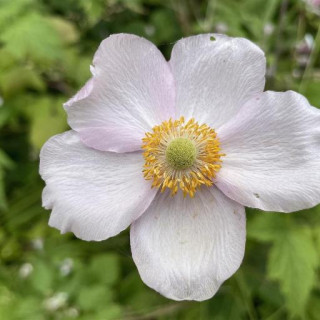
Eriocapitella tomentosa
Japanese anemone · Windflower
Description
Source: leafsnapEriocapitella tomentosa, a species of flowering plant in the buttercup family Ranunculaceae, is native to Asia. The specific epithet tomentosa means "thickly matted with hairs, tomentum (padding)". In Chinese, a common name is da huo cao (大火草), which means "big fire grass" or "great fireweed".
💡 According to legend, in ancient times a farmer suffered from abdominal pain whenever he ate. An old, white-haired man appeared and advised the farmer to consume the weeds growing nearby to alleviate his discomfort. Desperate from the pain, the farmer followed the man's advice and ate the weeds. After a short while, his abdominal pain subsided. These fluffy weeds turned out to be Japanese anemone.
🌳 The Japanese anemone is a woody-based, deciduous perennial often seen in sunlit gardens. It is highly valued for its beautiful blooms and its ability to spread, making it ideal for garden beds and as underplanting. Due to its salt tolerance, it is frequently used in coastal areas. Additionally, the Japanese anemone is well-suited for Japanese or cottage-style gardens. To create a striking color contrast, consider pairing it with companion plants like Oriental lilies or asters.
🎭 Gifted, clever
Care Guide
💧 Water
The Japanese anemone, native to woodlands, thrives in consistently moist soil and requires weekly watering to stay hydrated. Once it is established, it can tolerate moderate drought and grows well outdoors, especially when rainfall and irrigation meet its moisture needs. This balance enhances its vegetative growth and flowering potential.
☀️ Light Full sun
Japanese anemone prefers sites with full sun but can tolerate locations with moderate sunlight. It comes from regions that receive abundant sunshine. Both too much and too little sun can harm the plant, affecting its vigor and normal growth.
🌡️ Temperature 15–37.8°C
Japanese anemone generally grows best in temperature conditions similar to its native habitat, requiring temperatures from 59 to 100.4 °F (15 to 38 ℃). Seasonal adjustments can be made to replicate this preferred temperature range.
💨 Humidity
🪴 Soil 6-7
🌱 Fertilizer
Appropriate fertilization is vital for a Japanese anemone's health and appearance. Feed the Japanese anemone in summer, repeating the application monthly throughout the season. Nutrients power growth and maintain the plant's parts. Fertilizing improves the Japanese anemone's flower display, ensuring the best blooms.
🪴 Pot & Repot
To ensure the optimal health and development of Japanese anemone, plant them in flowerpots that are 20 to 30 cm (8 to 12 inches) deep.
✂️ Pruning
The Japanese anemone is easily identifiable by its velvety leaves and late summer blossoms. To ensure healthy and vigorous growth, this plant requires annual pruning. In late winter or early spring, cut the old stems down to ground level to promote new growth and improve air circulation. Additionally, remove spent flowers to prevent the plant from self-seeding and thin it out every few years to maintain its vitality.
🌿 Propagating
🐛 Diseases & pets
☠️ Toxicity
Characteristics
- Plant Type
- Herb
- Life Cycle
- Perennial
- Genus
- Eriocapitella
- Family
- Ranunculaceae
- Hardiness Zone
- 8-12
- Mature Height
- 0.4 m to 1.52 m
- Mature Spread
- 61 cm
- Leaf Color
- Dark Green, Forest Green
- Leaf Type
- Evergreen
- Flower Color
- White
- Flower Size
- 2.03 cm to 3.05 cm
- Bloom Time
- Mid summer, Late summer
- Planting Time
- Spring, Summer
- Harvest Time
- Late summer, Fall
- Native Area
- China