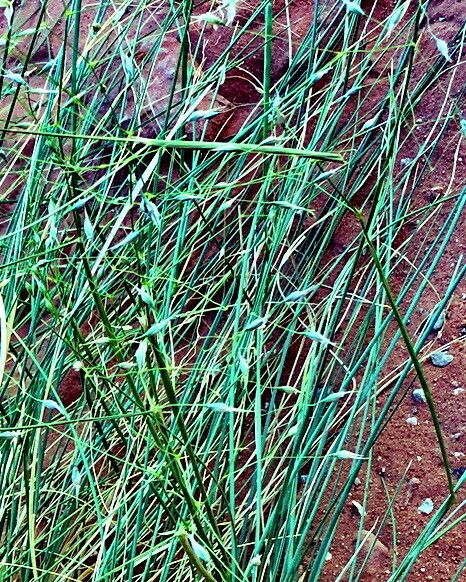
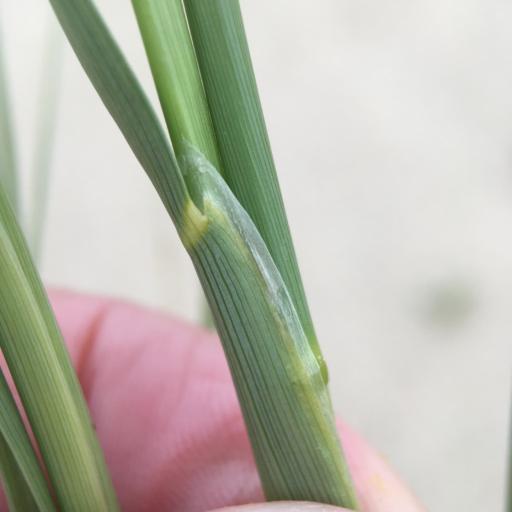
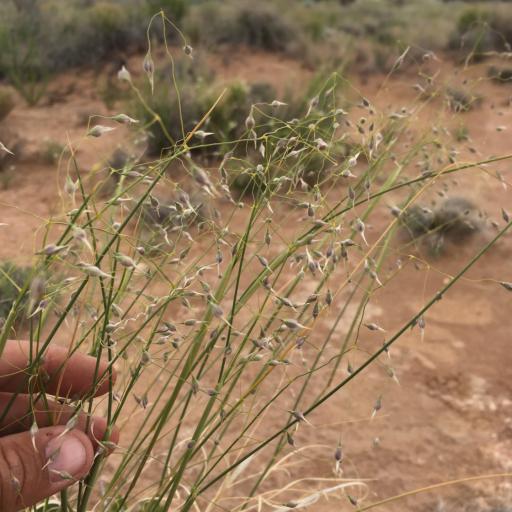
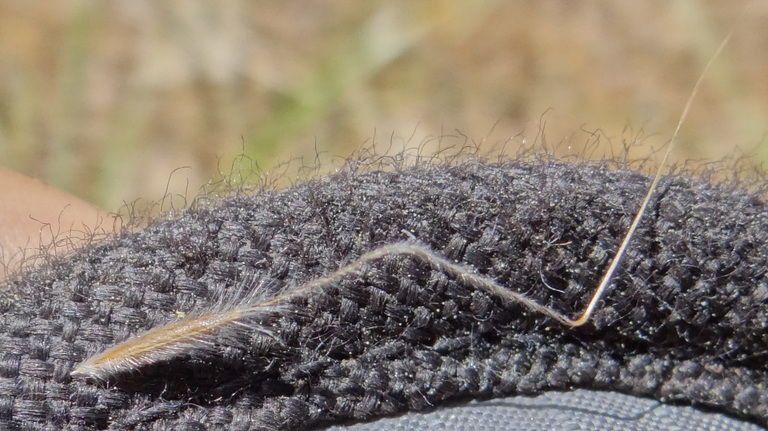
Oryzopsis hymenoides (syn: Stipa hymenoides or Achnatherum hymenoides, common names: Indian ricegrass and sand rice grass) is a cool-season, perennial bunchgrass with narrow, rolled leaf blades. It is native to western North America east of the Cascades from British Columbia and Alberta south to southern California, northeastern Mexico, and Texas. In the wild, it typically grows 4 to 24 in (10 to 61 cm) tall and 8 to 12 in (20 to 30 cm) wide. O. hymenoides grows in a variety of habitats from desert scrub to ponderosa pine forests. It can live in soils from sand to clay, but it does particularly well in sand, where it is the dominant grass growing with sagebrush, and may occur almost unmixed with other plants. It stabilizes shifting sand.
Indian ricegrass is fairly disease-resistant and is typically not prone to illnesses. However, it can be vulnerable to pests and pathogens present in its environment. Such infections are generally mild. Regarding care, the plant needs moderate maintenance. Regular pruning is necessary to keep a neat appearance and support healthy growth. Fertilizing can also help promote flowering. Indian ricegrass is appropriate for anyone with outdoor space, like a garden or patio, and does not require extensive care experience. It may need additional attention when grown indoors.
How to keep Eriocoma Hymenoides.
Light
Indian ricegrass needs a substantial amount of sunlight to thrive, mirroring its native habitat where plants get plenty of sun. The species can tolerate somewhat lower light levels. However, too much or too little sunlight adversely affects its growth — too much hampers its photosynthesis, while too little injures its tissues.
Water
Indian ricegrass, native to the arid regions of North America, is highly drought-tolerant and can thrive with minimal moisture. Typically, it only needs to be watered twice a week. In open spaces, it benefits from natural precipitation, reducing the need for additional irrigation during the growing season when rainfall is plentiful.
Temperature
Indian ricegrass is adapted to do well in areas where the average annual temperature is between 32 and 77 °F (0 and 25 ℃). When seasons change, modify the environment as needed to maintain those conditions.
Fertilizer
For optimal growth, Indian ricegrass needs three fertilization applications: one before planting, one about one month after seedling emergence, and a final application 1 to 1.5 months after the second. Certain types of Indian ricegrass also benefit from extra fertilizer applied at planting to promote rapid growth.
Pruning
Indian ricegrass, with its slender stems and delicate, wispy appearance, benefits greatly from early spring pruning. To encourage new growth while maintaining its shape, remove the dead stems and trim up to one-third of the older stems. For the best results in terms of plant health and garden aesthetics, perform pruning after the last frost.
Botanical profile.
- Plant Type
- Herb
- Life Cycle
- Perennial
- Genus
- Eriocoma
- Family
- Poaceae
- Hardiness Zone
- 3
- Mature Height
- 25 cm to 76 cm
- Mature Spread
- 20 cm to 30 cm
- Leaf Color
- Light Green
- Leaf Type
- Evergreen
- Flower Color
- White, Tan
- Flower Size
- 0.25 cm to 0.51 cm
- Bloom Time
- Late spring, Early summer
- Planting Time
- Spring, Summer
- Harvest Time
- Mid summer, Late summer
- Native Area
- Mexico
Other names.