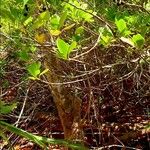
Erithalis fruticosa
Candlewood · Rompe machete · Black-torch · Flambeau
Description
Source: leafsnapErithalis fruticosa, commonly known as Wild Coffee or Black Torch, is a shrub or small tree in the Rubiaceae family. Native to the Caribbean and South America, this plant thrives in diverse habitats, including forests, savannas, and coastal areas. The plant can grow up to 6 meters tall and features a dense crown of glossy, dark green leaves. These oval-shaped leaves have pointed tips and prominent veins. During spring and summer, Erithalis fruticosa produces small white flowers that bloom in clusters at the ends of its branches. Erithalis fruticosa is notable for its medicinal properties, as it contains alkaloids like caffeine, which have stimulant effects on humans when consumed in moderation. Traditionally, indigenous people have used it to treat a variety of ailments, including headaches, fever, diarrhea, and dysentery. Ecologically, the plant plays a crucial role by providing habitat and food for birds and other wildlife species. Its fruits serve as a food source, and the plant itself offers shelter. Overall, Erithalis fruticosa is a valuable species both ecologically and medicinally, making it a worthwhile addition to gardens and natural area restoration projects.
Care Guide
💧 Water Every 7 days
The Black Torch plant thrives with moderate water and requires irrigation every 2-3 weeks. It prefers balanced humidity and adapts well to various climate zones and rainfall patterns, showcasing its versatility in different watering conditions.
☀️ Light Full sun
Black torch comes from open habitats like sunny meadows and forest edges that provide plenty of light. It does best in Full Sun but can also tolerate Partial Sun, adapting well to different sunlight levels.
What are the sunlight requirements for Black Torch plants?
Black Torch, known botanically as Erithalis fruticosa, thrives in environments with abundant sunlight. It requires full sun, defined as more than 6 hours of sunlight daily, but can also tolerate partial sun, which is about 3-6 hours of sunlight. The plant's natural habitats, such as sunny meadows and forest edges, provide it with ample light, making it adaptable to various sunlight conditions. It's essential to observe how sunlight moves through your garden to choose spots that offer the perfect balance of light and shade, ensuring the plant's health and happiness.
How do artificial lights support the growth of indoor Black Torch plants?
For indoor Black Torch plants or when natural sunlight is insufficient, artificial lighting is a practical solution for optimal growth. LED lights are particularly beneficial as they can be customized to provide specific light wavelengths necessary for the plant. Full sun plants require 30-50W/sq ft, partial sun plants need 20-30W/sq ft, and full shade plants should have 10-20W/sq ft of artificial light. The light source should be placed 12-36 inches above the plant to mimic natural sunlight and turned on for 8-12 hours a day to simulate the length of natural daylight hours, promoting faster and healthier growth.
What symptoms indicate light deficiency in Black Torch plants?
Black Torch plants show several symptoms under suboptimal lighting, including smaller new leaves, leggy or sparse growth, faster leaf drop, slower or halted growth, lighter-colored new leaves, and symptoms of too much sunlight like chlorosis, sunscald, leaf curling, wilting, and leaf scorching. These signs suggest the plant is not receiving enough light, causing it to enter survival mode or develop conditions such as chlorosis from excessive sunlight. Adopting measures to increase light exposure is crucial for the plant's health.
How can I improve light conditions for my Black Torch plant?
Improving light conditions for Black Torch plants involves both indoor and outdoor strategies. Indoors, gradually move the plant to a sunnier location each week until it receives at least 6 hours of direct sunlight daily, use south-facing windows for maximum exposure, and consider artificial lighting for additional support. Outdoors, avoid sudden changes in light intensity and gradually move plants to sunnier locations. Reduce obstructions like overhanging branches, and for smaller plants, consider transplanting during their dormant period for better sunlight exposure and health.
🌡️ Temperature 20–37.8°C
Black torch comes from tropical areas, where the climate is generally warm and humid. Consequently, it is well suited to high temperatures and moisture. It does not tolerate sudden shifts in temperature and prefers a consistent thermal environment, so avoiding indoor temperature swings is important. It typically cannot withstand cold and needs warmer conditions to grow. If the temperature falls too low, the plant may stop growing or even perish.
💨 Humidity
🪴 Soil 6-7
🌱 Fertilizer
The best time to fertilize a Black torch is in early spring, when it breaks dormancy. This encourages overall growth and flower development. Fertilization improves the foliage, stems, and branches, and promotes flowers that are large, vibrant, and long-lasting. It also helps move nutrients from the roots to the flowers and enhances the plant’s health and resistance to disease.
🪴 Pot & Repot
✂️ Pruning
The black torch plant flourishes with its lush foliage and beautiful white flowers. For optimal growth and health, prune the plant from early to late winter, concentrating on removing any dead branches to enhance airflow. Light shaping can encourage bushier growth. Regular pruning not only helps prevent disease but also promotes better blooming. Always use sanitized tools during maintenance to ensure the plant remains healthy and attractive.
🌿 Propagating
🐛 Diseases & pets
☠️ Toxicity
Characteristics
- Plant Type
- Tree, Shrub
- Life Cycle
- Perennial
- Genus
- Erithalis
- Family
- Rubiaceae
- Hardiness Zone
- 10-12
- Mature Height
- 2.13 m to 6.1 m
- Mature Spread
- 2.13 m to 3.96 m
- Leaf Color
- Dark Green
- Leaf Type
- Evergreen
- Flower Color
- White
- Flower Size
- 1.02 cm to 1.52 cm
- Bloom Time
- Late spring, Summer, Early fall, Mid fall
- Planting Time
- Spring, Summer, Autumn
- Harvest Time
- Late summer, Fall, Early winter, Mid winter
- Native Area
- Colombia, Bahamas, Belize, Cuba, Honduras, Mexico, Venezuela, Jamaica