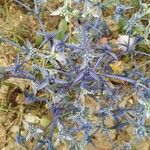
Eryngium creticum
Eryngo · Cretan Eryngo · Small-headed blue eryngo · Small-headed eryngo
Description
Source: leafsnapEryngium creticum, or the field eryngo, is a species of flowering plant in the family Apiaceae native to Greece, Jordan, Lebanon, Palestine, and Syria. It is known in Lebanon and Palestine as قرصعنة.
Care Guide
💧 Water
Field eryngo is a drought-tolerant plant that thrives in arid conditions. It is native to areas with low rainfall and high temperatures. This evergreen plant requires minimal watering, needing only about once a week. Its ability to efficiently retain water throughout the year reduces the overall frequency of watering needed.
☀️ Light Full sun
Field eryngo is a sun-loving perennial herbaceous plant native to open habitats, commonly thriving in meadows and grasslands. It prefers full sun but can also tolerate partial sun.
What are the sunlight requirements for Field eryngo?
Field eryngo, scientifically known as Eryngium creticum, thrives in full sun conditions, requiring more than 6 hours of sunlight each day to grow optimally. However, it can also tolerate partial sun conditions, meaning it can grow well with about 3-6 hours of sunlight daily. Understanding how sunlight moves through your garden and selecting sites that offer a good balance of light and shade is crucial for the plant's success.
What are the essentials for growing Field eryngo?
As a sun-loving perennial herbaceous plant, Field eryngo flourishes in open habitats like meadows and grasslands. Its growth is optimum under full sunlight, but it can also adapt to partial sun conditions. For indoor plants with insufficient natural light, artificial lighting serves as an essential alternative, ensuring healthy growth. The use of LED lights is recommended as they can be adjusted to provide the specific light wavelengths needed. Full sun plants should have 30-50W/sq ft of artificial light, partial sun plants need 20-30W/sq ft, and full shade plants require 10-20W/sq ft. The artificial light source should be placed 12-36 inches above the plant, and the duration of lighting should mimic natural daylight hours, typically 8-12 hours per day.
What are the symptoms of inadequate sunlight for Field eryngo, and how can they be addressed?
Field eryngo shows various symptoms when it receives inadequate sunlight, including smaller new leaves, leggy or sparse growth, faster leaf drop, slower or halted growth, pale or irregularly colored new leaves, chlorosis, sunscald, leaf curling, wilting, and leaf scorching. Solutions include gradually moving the plants to sunny locations to ensure at least 6 hours of direct sunlight daily, using artificial light if moving the plant is not feasible, and adapting the outdoor plants to increased sunlight exposure gradually to prevent sunburn. Additionally, reducing obstructions such as pruning trees that block sunlight or transplanting smaller plants to sunnier areas can improve light access. It's important to note that parts of the plant already affected by insufficient sunlight may not recover, but new growth will be healthy following increased light exposure.
🌡️ Temperature 5–35°C
Field eryngo can adjust to a wide range of temperature conditions, though its distribution may still be restricted by different combinations of moisture and heat. It performs best in warm summer climates with sufficient rainfall or watering. Extended periods of cloudy, rainy weather or prolonged high temperatures increase the risk of the plant dying. In winter, shielding it from cold can boost its chances of survival.
What is Field eryngo?
Field eryngo, scientifically known as Eryngium creticum, is a plant species. However, there isn't detailed information provided about its essential characteristics, symptoms it may cause or treat, or any additional contexts in the provided data. For more specific information about Field eryngo, consulting a detailed botany or plant science resource is recommended.
💨 Humidity
🪴 Soil 6-7
🌱 Fertilizer
The best time to fertilize a Field eryngo is in early spring, as it comes out of dormancy and begins active growth. Fertilization supplies key nutrients needed for healthy growth. Although Field eryngo has fairly low fertilization requirements, an annual application can improve its survival and encourage better, longer-lasting flowers.
🪴 Pot & Repot
✂️ Pruning
Field eryngo is a herbaceous perennial plant with spiky leaves and thistle-like flowers. To encourage healthy growth, prune it from early to late spring by removing any dead stems. Be careful not to over-prune, as the plant grows slowly. Ensure that you use clean, sharp tools for precise cuts, which will improve the plant’s appearance and enhance air circulation.
🌿 Propagating
🐛 Diseases & pets
☠️ Toxicity
Characteristics
- Plant Type
- Herb
- Life Cycle
- Perennial
- Genus
- Eryngium
- Family
- Apiaceae
- Hardiness Zone
- 4-9
- Mature Height
- 61 cm
- Mature Spread
- 20 cm to 40 cm
- Leaf Color
- Green, Dark Green
- Leaf Type
- Evergreen
- Flower Color
- Purple, Blue
- Flower Size
- 2.54 cm
- Bloom Time
- Summer
- Planting Time
- Spring, Summer, Autumn
- Harvest Time
- Late summer, Early fall, Mid fall
- Native Area
- Saudi Arabia, Iraq, Turkey, Syria, Egypt, Montenegro, Kuwait, Iran, Cyprus, Greece, Croatia, Slovenia, Bulgaria, Albania, Lebanon