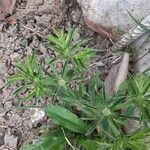
Eryngium foetidum
Culantro · Shadow-beni · Fitweed · Stinkweed · False coriander
Description
Source: leafsnapEryngium foetidum, commonly known as culantro or Mexican coriander, is a tropical herbaceous plant from the Apiaceae family. Native to Central and South America, it is widely used in Caribbean, Latin American, and Asian cuisines for its pungent flavor. The plant features long, deeply serrated leaves with a spiky appearance. It can grow up to 60 cm in height and produces small white or pale blue flowers in clusters on tall stems. The leaves of Eryngium foetidum are rich in essential oils, which give it its distinctive flavor. In addition to its culinary uses, Eryngium foetidum has been used for medicinal purposes, including treating fever, flu symptoms, and digestive issues like diarrhea and constipation. Eryngium foetidum thrives in warm temperatures and well-drained soil rich in organic matter. It can be propagated from seeds or cuttings and requires regular watering during the growing season. Overall, Eryngium foetidum is an important herb with diverse culinary applications across different cultures and valuable medicinal properties, making it a worthy addition to any garden or kitchen!
🌳 Culantro is often found in tropical herb gardens. While its leaves are sometimes harvested, the plant is especially valued for its year-round flower and seed production, which adds ongoing interest to the garden.
Care Guide
💧 Water Every 7 days
Culantro, which is native to tropical regions, thrives in high humidity and consistently moist conditions. To keep the plant well-hydrated without causing the roots to become oversaturated, it should be watered weekly. In warmer climates, it's best to grow culantro outdoors, where rainwater can help replicate the natural precipitation of its native habitat.
How should I water my Culantro plant to keep it healthy?
The Culantro has specific preferences for both the amount of water it receives and how it is provided. It is important to use the proper watering technique to avoid damaging your tomatoes. The best method is to water the Culantro by applying the water directly to the soil in a slow and gentle manner. Avoid pouring all the water into the soil at once or using overhead watering. Slow, deep watering is necessary to ensure all of the soil where the Culantro grows is adequately moist.
What do I need to do if I give my Culantro too much water or not enough water?
If your Culantro has been overwatered and you're worried about the risk of disease, take immediate action. The best approach is to uproot the plant from its current location and allow the roots to dry a bit before replanting in a new spot with well-draining soil. If you're growing in pots, consider moving the plant to a pot with more or larger drainage holes. On the other hand, if you've underwatered your Culantro, simply increase the frequency of watering.
How frequently should I give water to my Culantro plant?
Culantro needs a lot of water while it is growing. To meet this need, water it frequently in the spring and summer. At the start of the season, water once or twice per week. Increase the frequency as the season progresses, potentially needing to water twice per day during the hot summer months. Once the plant reaches its maximum growth, water once a week until the end of the growing season.
How much water does my Culantro plant need?
Culantro is highly popular among gardeners, both professional and amateur. As a result, we have a good understanding of how to care for these plants. One important aspect is knowing how much water they need. Typically, Culantro should receive 1 - 1.5 inches of water per week, which should be evenly distributed during your weekly watering. In warmer weather, you may need to provide more water, but generally, two inches per week is a good rule of thumb.
How can I know if I'm giving enough water to my Culantro plant?
Culantro can experience problems with both underwatering and overwatering, and these issues can show similar symptoms. When underwatered, the leaves will initially curl and droop, and the overall growth and development of the plant will be stunted. Overwatering, on the other hand, increases the risk of disease and can lead to unpleasant smells from the soil. Symptoms of underwatering appear more quickly, while overwatering can be observed through the presence of standing water or waterlogged soils.
☀️ Light Full sun
Culantro grows best in full sunlight for optimal development and vigor. Although it tolerates strong light, it can also do well with moderate sun exposure. Too much or too little light can affect its development. Because it comes from areas with intense sunlight, its light needs stay largely the same across growth stages.
What are the sunlight requirements for Cultivation?
Culantro requires full sun exposure, defined as above 6 hours of sunlight per day, for optimal growth and health. However, it can also tolerate partial sun, which involves about 3-6 hours of sunlight daily. It's important to observe the movement of sunlight through your garden to find spots that offer the right balance of light and shade for your plants, ensuring they thrive.
How important is light for Cultivation and what are the effects of inadequate lighting?
Light is crucial for the healthy growth of Culantro, which thrives best under full sunlight but can also accept moderate sun exposure. Originating from regions with intense sunlight, its growth requirements remain consistent. Inadequate lighting can affect Cultivation's growth negatively. Also, indoor plants may require artificial lighting, especially in less sunny spaces or during winter. LED lights are recommended for indoor plants, needing placement of about 12-36 inches above the plant and providing 8-12 hours of light per day depending on the plant's natural light requirements.
What are the common symptoms of light deficiency in Cultivation when grown indoors?
When Cultivation is grown indoors with insufficient light, it may exhibit symptoms such as small, new leaves growing smaller than mature ones, leggy or sparse growth, faster leaf drop, slower or no new growth, lighter-colored new leaves, and symptoms of chlorosis, sunscald, leaf curling, wilting, and leaf scorching. These issues highlight the importance of providing adequate light to avoid hindering the plant's development.
How can one address issues related to insufficient sunlight for Culantro?
To address insufficient sunlight for Culantro, it's vital to gradually move the plants to a sunnier location, aiming for at least 6 hours of direct sunlight daily. For indoor plants, consider using artificial light when natural light is insufficient, keeping lights on for at least 8 hours a day. For outdoor and ground-planted Cultivation, gradually acclimatize them to sunnier spots, and consider pruning or removing obstructions that block sunlight. Remember, while parts of the plant already affected by low light may not recover, new growth should be healthy with improved light conditions.
🌡️ Temperature 15–37.8°C
Culantro is native to habitats with a preferred temperature range of 68 to 100 °F (20 to 38 °C). If kept within that range, it can adjust to seasonal changes.
What are the preferred environmental conditions for Culantro cultivation?
Culantro, scientifically known as Eryngium foetidum, thrives in environments with temperatures ranging from 68 to 100 °F (20 to 38 °C). It is adaptable to seasonal changes as long as it is kept within this temperature range. To encourage growth, especially during winter, the plant should be maintained at temperatures above 20°C, with precautions taken to ensure the minimum temperature stays above the freezing point. Protective measures, such as bringing the plant indoors or covering it with plastic film or fabric, should be considered when outdoor temperatures approach -5°C (25°F) to prevent freezing damage.
How does low temperature affect Culantro, and what are the recommended solutions?
Culantro exhibits moderate tolerance to low temperatures but thrives optimally between 20°C and 38°C. It is essential to keep the plant above 0°C during winter to prevent damage. Exposure to temperatures below -15°C can cause the leaves to darken, and in severe cases, lead to water-soaked necrosis, wilting, and the leaves turning brown. If frost damage occurs, the damaged parts should be trimmed away. The plant should be moved indoors to a warm environment or protected in a makeshift greenhouse. If indoor lighting is insufficient, additional supplemental lighting near a south-facing window may be beneficial.
What impact does high temperature have on Culantro, and how can it be mitigated?
During the summer, it is crucial to ensure that Culantro is kept at temperatures below 38°C to prevent heat stress. When temperatures exceed 43°C, the plant may experience slowed growth, and its leaves may lighten in color and become susceptible to sunburn. To mitigate this, sunburned or dried-up parts of the plant should be trimmed away. Relocating the plant to a shaded area, especially during the afternoon sun, and watering it in the morning and evening to maintain soil moisture, can help in reducing the risk of sunburn and ensuring the plant's health.
💨 Humidity normal (40-60%)
This plant will thrive in moderate humidity, which is probably the level in your home. However, misting it a few times a week can be very beneficial. Make sure the room has good ventilation.
🪴 Soil 6-7
🌱 Fertilizer
To maximize Culantro's yield and flavor, provide sufficient nitrogen throughout the entire growth period, including before planting and at harvest. Plants that are well-watered and fertilized produce plentiful, healthy leaves and have reduced bitterness. Before planting, amend the soil with organic matter like compost or manure, preferably 2 to 8 weeks ahead.
🪴 Pot & Repot
When repotting Culantro, choose a pot 1-2 inches (2.5–5.1 cm) larger in diameter, ensuring it has good drainage. Use a well-draining potting mix and consider adding perlite for extra drainage. Repot during spring or early summer, then water thoroughly and place it in a shady location at first.
✂️ Pruning
🌿 Propagating
🐛 Diseases & pets
☠️ Toxicity
Characteristics
- Plant Type
- Herb
- Life Cycle
- Annual, Perennial, Biennial
- Genus
- Eryngium
- Family
- Apiaceae
- Hardiness Zone
- 7-11
- Mature Height
- 49 cm
- Mature Spread
- 49 cm
- Leaf Color
- Green
- Leaf Type
- Deciduous
- Flower Color
- White
- Flower Size
- 2.54 cm
- Bloom Time
- Late spring, Summer
- Planting Time
- Spring
- Harvest Time
- Summer, Early fall
- Native Area
- Belize, Honduras, Mexico, Guatemala, Peru, Panama, Jamaica, Colombia, Cuba, Bolivia, Venezuela, Guyana, El Salvador, Nicaragua, Ecuador, Costa Rica