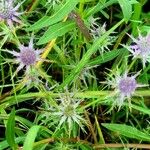
Eryngium hookeri
Hooker's Eryngo · Hooker eryngo
Description
Source: leafsnapEryngium hookeri, commonly known as Hooker's sea holly, is a perennial herbaceous plant in the Apiaceae family. Native to the Himalayas, it is found in Bhutan, India, Nepal, and Tibet. This plant typically grows up to 60 cm tall and features a basal rosette of green-grey, spiny leaves. Its spiny stems bear blue-green flowers that bloom from July to September. Eryngium hookeri thrives in well-drained soil with full sun exposure but can also tolerate partial shade. It is often cultivated for its unique appearance and its ability to attract pollinators such as bees and butterflies. In traditional medicine, Eryngium hookeri has been used for its anti-inflammatory properties, which are believed to help alleviate symptoms associated with arthritis and other inflammatory conditions. Overall, Eryngium hookeri is a captivating plant species that offers both aesthetic appeal and potential medicinal benefits.
Care Guide
💧 Water Every 7 days
Adapted to its native habitat, Hooker's eryngo thrives with moderate watering, ideally receiving weekly irrigation to maintain optimal soil moisture. While this species prefers consistent moisture, it is also drought-resistant. When grown outdoors, it benefits from natural rainfall, which enhances its resilience during dry periods.
☀️ Light Full sun
Hooker's eryngo does best with abundant light, reflecting its native habitat where light is plentiful. Less light can reduce its growth and vibrancy. It can tolerate suboptimal light conditions, but growth will be slower. Prolonged periods of insufficient light can cause damage.
What are the sunlight requirements for Hooker's eryngo?
Hooker's eryngo thrives best in full sun conditions, requiring more than 6 hours of sunlight daily, but it can also grow in partial sun, with about 3-6 hours of sunlight. It's essential to watch how sunlight moves through your garden to choose the best spots for your plants, providing them with a healthy balance of light and shade. This ensures the optimal growth and happiness of your plants.
What are the essentials for growing Hooker's eryngo successfully?
For successful growth, Hooker's eryngo needs generous amounts of light, mimicking its native habitat's light saturation. While it can survive less ideal light conditions, its growth may be slower, and prolonged inadequacy in light exposure can be detrimental. In spaces where natural light is insufficient, especially during winter, artificial lighting can be a vital solution. LED lights are recommended for indoor plants, needing about 30-50W/sq ft for full sun plants, 20-30W/sq ft for partial sun plants, and 10-20W/sq ft for full shade plants. The light source should be placed 12-36 inches above the plant, ensuring it receives 8-12 hours of light daily.
What signs indicate Hooker's eryngo is receiving inadequate light?
When Hooker's eryngo is deprived of sufficient light, it may show several symptoms. New leaves may grow smaller, and the plant can exhibit leggy or sparse growth due to elongated spaces between leaves or stems. There may also be faster leaf drop, slower or no new growth, lighter-colored new leaves, chlorosis (leaves turning yellow), sunscald, leaf curling under extreme sunlight, wilting due to increased water loss, and leaf scorching characterized by brown, dry edges on leaves. These signs suggest the plant needs more light to thrive.
How can I address light deficiency issues in Hooker's eryngo?
To address light deficiency in Hooker's eryngo, gradually move your plants to areas with at least 6 hours of direct sunlight daily, especially if they're indoors. Use a south-facing window and keep curtains open during the day. If moving the plant isn't feasible, consider using artificial light sources like desk lamps or professional grow lights for at least 8 hours daily. Outdoors, gradually acclimate your plants to sunnier spots to prevent sunburn. If sunlight is blocked by obstacles like trees, pruning to let sunlight through or transplanting the plant to a sunnier location with good drainage might be necessary. Note that parts of the plant already affected by low light might not recover, but new growth will be healthy with improved light conditions.
🌡️ Temperature 15–37.8°C
Hooker's eryngo can tolerate a wide range of temperatures, though its distribution may still be restricted by different combinations of moisture and heat. It performs best in warm summer climates with adequate rainfall or irrigation. Long stretches of cloudy, rainy weather or prolonged high temperatures increase the chance that Hooker's eryngo will die. In winter, protecting it properly from cold improves its survival rate.
💨 Humidity
🪴 Soil 6-7
🌱 Fertilizer
When most of Hooker's eryngo's blooms have reached full size, resume fertilizing. Around the time blooms are at peak production, apply fertilizer every three to four weeks, as weather permits. After the plant begins producing fewer new blooms, stop fertilizing; there is no need to feed it when it can no longer produce additional blooms.
🪴 Pot & Repot
✂️ Pruning
Hooker's eryngo features spiny leaves and striking flower heads. For best results, prune the plant from early to late spring. Remove any damaged stems and cut back the plant by one-third to encourage denser growth. Regular pruning not only enhances the plant's appearance and vigor but also ensures a more impressive display of blooms.
🌿 Propagating
🐛 Diseases & pets
☠️ Toxicity
Characteristics
- Plant Type
- Herb
- Life Cycle
- Annual
- Genus
- Eryngium
- Family
- Apiaceae
- Hardiness Zone
- 8-11
- Mature Height
- 30 cm to 61 cm
- Mature Spread
- 30 cm to 61 cm
- Leaf Color
- Green, Dark Green
- Leaf Type
- Evergreen
- Flower Color
- Purple
- Flower Size
- 2.54 cm to 5.08 cm
- Bloom Time
- Early summer, Mid summer
- Planting Time
- Spring, Summer, Autumn
- Harvest Time
- Late summer, Early fall