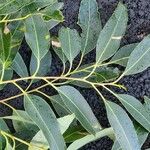
Eucalyptus botryoides
Gippsland-mahogany · Southern-mahogany · Bangalay · Gippsland-mahagany · Mahagany Eucalypt
Description
Source: leafsnapEucalyptus botryoides, commonly known as Southern Mahogany or Bangalay, is a species of eucalyptus tree native to southeastern Australia. This tall and straight tree can reach heights of up to 30 meters, with a trunk diameter of up to 1 meter. Its bark is rough and fibrous, featuring patches of grey and brown. The tree's leaves are glossy green, lance-shaped, and measure around 10-15 cm in length. The flowers, which bloom from late autumn to early winter, are white or cream-colored clusters. Eucalyptus botryoides has numerous applications, including use as an ornamental plant in landscaping due to its attractive appearance. Commercially, its strong wood is valuable for timber production and is utilized in construction, flooring, furniture making, and even boat building. In addition to its ornamental and commercial value, Eucalyptus botryoides possesses medicinal properties. Its essential oil is used in aromatherapy treatments for respiratory issues such as asthma and bronchitis. Furthermore, the tree is known for its insect-repelling properties, making it useful in natural pest control methods. Overall, Eucalyptus botryoides is an important species both ecologically and economically. It provides critical habitat for wildlife and has significant commercial value through its various uses, including timber production and medicinal applications.
Care Guide
💧 Water Every 7 days
Southern mahogany is native to Australia's dry eucalypt forests and requires watering every 2-3 weeks to mimic its natural infrequent moisture levels. This drought-tolerant plant withstands dry conditions and thrives when grown outdoors. Additionally, mulching can help retain soil moisture, further reducing the frequency of watering needed.
☀️ Light Full sun
The southern mahogany prospers when given abundant sunlight on a regular basis. A shortage of light can undermine its health and hinder its growth. It comes from an environment that enjoys plentiful sunshine. Although it tolerates some shade, too much shading can result in stunted growth or diminished health.
What are the sunlight requirements for Southern mahogany?
Southern mahogany (Eucalyptus botryoides) thrives in environments where it can be exposed to full sunlight for more than 6 hours a day, which reflects its origin in sunny regions. It can handle partial sun, meaning about 3-6 hours of sunlight, but less than this can impede growth and affect the plant's health. Watching how sunlight moves through your garden to find spots with the right balance of light and shade is crucial for the plant's happiness and growth.
How essential is sunlight for Southern mahogany's growth?
Sunlight is highly essential for the growth of Southern mahogany, as generous and regular exposure to it ensures healthy development. Inadequate sunlight not only stunts its growth but can also lead to a decline in health. While the plant is capable of enduring some shade, too much of it can negatively impact its growth, making abundant sunshine a key element of its ideal growing conditions.
Can artificial lighting be used for Southern mahogany, and how?
Yes, artificial lighting can be used for Southern mahogany, especially for indoor plants or during periods when natural sunlight is insufficient, such as winter. LED lights are preferred due to their ability to be customized to provide specific wavelengths needed by plants. For full sun plants, 30-50W/sq ft is recommended; partial sun plants require 20-30W/sq ft; and full shade plants need 10-20W/sq ft. The light source should be placed 12-36 inches above the plant, mimicking natural sunlight for about 8-12 hours per day.
What are the symptoms of insufficient sunlight in Southern mahogany?
Southern mahogany displays several symptoms when exposed to inadequate sunlight, including smaller new leaves, leggy or sparse growth, faster leaf drop, slower or no new growth, lighter-colored new leaves, chlorosis, sunscald, leaf curling, wilting, and leaf scorching. These symptoms indicate the plant's struggle with light deficiency, affecting its growth and health.
What solutions can help Southern mahogany get sufficient sunlight?
To ensure Southern mahogany gets sufficient sunlight, gradually move the plants to sunnier locations until they receive at least 6 hours of direct sunlight daily, especially if they are indoors. Artificial lights can supplement natural light. For outdoor plants, acclimatize them to brighter spots without causing sunburn. Obstructions to sunlight should be reduced by pruning or relocating plants to sunnier areas. While parts of the plant that suffered from light deficiency cannot recover, new growth will be healthy with improved light exposure.
🌡️ Temperature 20–37.8°C
Southern mahogany demonstrates strong adaptability to temperature, tolerating higher heat and larger temperature swings. In hot weather, care should be taken to water appropriately and provide some shade to prevent sunburn. Conversely, Southern mahogany is relatively sensitive to low temperatures. While it can endure a certain amount of cold, excessively low temperatures can cause frost damage.
What is the common name of Eucalyptus botryoides?
The common name of Eucalyptus botryoides is Southern mahogany.
What information is available about the essentials, symptoms, and additional details of Southern mahogany?
Currently, there is no detailed information provided about the essentials, symptoms, or additional details of Southern mahogany.
💨 Humidity
🪴 Soil 5-6
🌱 Fertilizer
Fertilize your Southern mahogany in early spring to encourage healthy growth. Regular fertilization boosts overall health, resulting in vigorous growth, increased tolerance of harsh conditions, and better resistance to pests and diseases. Adhere to a set fertilization schedule for your Southern mahogany to maintain foliage that is vibrant, deeply colored, and lush.
🪴 Pot & Repot
✂️ Pruning
Southern mahogany is known for its attractive bark and foliage. To keep the tree healthy and looking its best, it's important to prune it in the winter. This involves removing dead wood, thinning out crowded branches, and maintaining the tree's shape. Proper pruning not only boosts the tree's health but also enhances flowering and increases its resilience against pests and diseases.
🌿 Propagating
🐛 Diseases & pets
☠️ Toxicity
Characteristics
- Plant Type
- Tree
- Life Cycle
- Perennial
- Genus
- Eucalyptus
- Family
- Myrtaceae
- Hardiness Zone
- 9-11
- Mature Height
- 20.12 m to 39.93 m
- Mature Spread
- 10.06 m to 14.94 m
- Leaf Color
- Dark Green
- Leaf Type
- Evergreen
- Flower Color
- White
- Flower Size
- 1.02 cm to 1.52 cm
- Bloom Time
- Mid summer, Late summer, Early fall
- Planting Time
- Spring, Summer, Autumn
- Harvest Time
- Mid fall, Late fall, Early winter