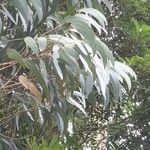
Eucalyptus globulus
اکالیپتوس نیلی · درخت ویکس · Tasmanian bluegum · Blue gum · Victorian blue gum
Description
Source: leafsnapEucalyptus is a genus that includes over 700 species of flowering trees and shrubs native to Australia and surrounding islands. The most well-known species is Eucalyptus globulus, commonly known as the Tasmanian blue gum. This tree can grow up to 70 meters tall and has smooth bark that sheds in long strips. Eucalyptus leaves are aromatic and contain oil valued in various industries such as medicine, cosmetics, perfumes, and cleaning products. Eucalyptus trees are fast-growing and possess a deep root system that makes them drought-tolerant. They are also fire-resistant thanks to their thick bark, which protects them from flames. The wood from eucalyptus trees is prized for its durability and is used in construction for purposes such as flooring, furniture making, and paper production. Beyond its commercial uses, eucalyptus has medicinal properties that have been utilized for centuries by indigenous Australians to treat various ailments like coughs and colds. Today, it remains a common ingredient in cough drops and throat lozenges, appreciated for its soothing effects. Overall, eucalyptus trees have become an important part of Australia's economy. Their versatility makes them a valuable resource both locally and globally.
🌳 Tasmanian blue gum has applications that go well beyond timber and paper manufacturing. Its oil is prized for its antiseptic qualities and is used as an ingredient in pharmaceuticals and the fragrance industry. Its fibrous bark can be used in textiles, and its dense foliage offers essential habitat for wildlife. Additionally, the wood of the Tasmanian blue gum is favored in the construction of musical instruments because of its acoustic properties.
Care Guide
💧 Water Every 7 days
The Tasmanian blue gum is a resilient evergreen plant that requires moderate watering and has good drought tolerance. It thrives when watered every two weeks and flourishes in a range of climates. To avoid waterlogging, it prefers well-drained soil, an adaptation that reflects its ability to handle the variable rainfall of its native habitat.
How should I water my Tasmanian blue gum tree?
Your Tasmanian blue gum is not very particular about how you water it. Therefore, you can use any common watering tool, such as watering cans, hoses, or even cups, to moisten the soil of this plant. It is important to water directly on the soil and make sure all areas are equally moistened to provide water to all parts of the root system. Using filtered water is helpful because tap water may contain harmful particles for the plant. Additionally, using water at or slightly above room temperature is beneficial as extremely hot or cold water can be somewhat shocking to the Tasmanian blue gum. However, this plant generally responds well to any type of water you provide.
What should I do if I give too much or too little water to my Tasmanian blue gum?
Outdoor plants, especially newly planted ones or seedlings, can be prone to lack of watering. It's important to remember to water them enough for a few months when they are small or just planted. Once the roots are established, Tasmanian blue gum trees can rely on rain for most of their water. When your Tasmanian blue gum is in a pot, overwatering is more likely. If you accidentally overwater your plant, you should take immediate action to fix the situation. Stop watering your plant right away to minimize the impact of overwatering. Then, remove your Tasmanian blue gum from its pot and check its roots. If you find no signs of root rot, you can put the plant back in its container. But if you do see signs of root rot, trim any affected roots and consider using a fungicide to prevent further damage. Finally, repot your Tasmanian blue gum in well-draining soil. In the case of underwatering, simply water the Tasmanian blue gum more frequently. Underwatering is usually easy to fix. If the plant's leaves are drooping, drying out, and falling off, watering it sufficiently will cause the leaves to return to their fullness quickly. So, adjust your watering frequency as soon as you notice underwatering.
How frequently should I give water to my Tasmanian blue gum?
If your area doesn't get much rain, you'll need to water your outdoor plants about every 2 weeks in the spring and fall, and more often in the summer. In the winter, you can water them less frequently or not at all. However, if you have a young or newly planted Tasmanian blue gum, you should water it more often to help it grow and become more drought tolerant. For potted Tasmanian blue gums, there are two main approaches to watering. One is to follow a set schedule, such as watering once a week or every other week. However, this might not work well because it doesn't account for the specific conditions of your plant's environment. Another approach is to water based on the moisture level of the soil. It's usually best to wait until the top 2 to 4 inches of soil have dried out before watering again. This depth is typically about ⅓ to ½ of the depth of the pot.
How much water does my Tasmanian blue gum tree need?
When watering your Tasmanian blue gum, you don't always need to give it a lot of water. If only a few inches of soil have dried since the last watering, you can support healthy growth by giving it about five to ten ounces of water each time. You can also base the amount of water on the moisture of the soil. Pay attention to how many inches of soil have dried between waterings. To ensure your Tasmanian blue gum gets enough moisture, water enough to moisten all the dry soil layers since the last watering. If more than half of the soil has dried, give more water than usual and continue until you see excess water draining from the pot's holes. If your Tasmanian blue gum is planted in a rainy area, it may not need extra watering. When it is young or establishing, make sure it gets 1-2 inches of rain per week. As it grows, it can survive on rainwater alone, except during hot, rainless periods of 2-3 weeks. In those cases, give it a full watering to prevent stress.
How do I know if I am giving enough water to my Tasmanian blue gum?
The Tasmanian blue gum is often overwatered, and there are clear indicators to watch out for. Typically, an overwatered Tasmanian blue gum will exhibit yellowing leaves and may shed some leaves. Additionally, excessive watering can cause the plant's overall structure to shrink and possibly lead to root rot. Conversely, an underwatered Tasmanian blue gum will also start to wilt and may develop brown or brittle leaves. Regardless of whether you notice signs of overwatering or underwatering, it is important to take action promptly and restore the plant's well-being.
☀️ Light Full sun
The Tasmanian blue gum does best with a large amount of sunlight each day and also copes well with moderate sun. It originates from regions with abundant sunshine. Too much or too little sun exposure can damage its growth, causing it to languish or suffer sunburn.
What are the sunlight requirements for Tasmanian blue gum?
Tasmanian blue gum thrives when exposed to full sun, meaning it requires more than 6 hours of sunlight each day. However, it can also manage well with partial sun, or about 3-6 hours of sunlight. It's important to watch how sunlight moves through your garden to choose spots that provide the perfect balance of light and shade for your plants, ensuring their happiness.
Why is the right amount of sunlight important for Tasmanian blue gum?
The right amount of sunlight is crucial for the growth of Tasmanian blue gum, which hails from environments known for abundant sunshine. Over or under exposure to sun can negatively impact its growth, causing the plant to languish or even suffer from sunburn. Adequate sunlight each day is essential for its optimal growth.
How can artificial lighting be used for Tasmanian blue gum?
Indoor Tasmanian blue gums require adequate lighting for optimal growth, especially when natural sunlight is insufficient. Artificial lights, especially LED lights that can be customized to provide specific wavelengths of light, offer a vital solution. For full sun plants, 30-50W/sq ft of artificial light is needed, for partial sun plants 20-30W/sq ft, and for full shade plants 10-20W/sq ft. The light source should be placed 12-36 inches above the plant and kept on for 8-12 hours per day to mimic natural daylight hours.
What are some symptoms of insufficient or excessive sunlight in Tasmanian blue gum?
Symptoms of insufficient sunlight in Tasmanian blue gum include small and pale new leaves, leggy or sparse growth, faster leaf drop, slower or no new growth, and an overall weakened plant structure. Excessive sunlight can cause chlorosis, sunscald, leaf curling, wilting, and leaf scorching, indicating damage to the plant's leaves or stems and a reduction in its overall health.
What solutions can help Tasmanian blue gum get adequate sunlight?
To ensure Tasmanian blue gum receives adequate sunlight, gradually move plants to a sunnier location, allowing for at least 6 hours of direct sunlight daily. For indoor plants, consider using artificial lighting if the plant is large or not easily movable, keeping a lamp on for at least 8 hours daily. For outdoor plants, move them to areas with better sunlight gradually to avoid sunburn. If necessary, prune trees or other obstructions blocking sunlight, or consider transplanting smaller plants to a location with better sunlight and drainage.
🌡️ Temperature 10–37.8°C
Tasmanian blue gum does best in temperatures of 50 to 100 °F (10 to 38 °C), which corresponds to its native growing conditions. It’s necessary to adjust temperatures as the seasons change to preserve its optimal health.
What is the optimal temperature range for Tasmanian blue gum?
The Tasmanian blue gum, or Eucalyptus globulus, thrives best in temperatures ranging from 50 to 100 °F (10 to 38 °C). This temperature range reflects its native growth environment and is essential for maintaining the plant's optimal health. Adjusting conditions to stay within this range during seasonal changes is crucial.
Does Tasmanian blue gum require frost protection measures during winter?
Tasmanian blue gum has strong cold resistance, and special frost protection measures are usually not necessary during the winter. However, if winter temperatures are expected to drop below -25°C, it's important to provide cold protection. This can be done by wrapping the trunk and branches with non-woven fabric or cloth. It's also advised to water the plant abundantly before the first freeze in autumn to ensure the soil remains moist and enters a frozen state, helping prevent drought and water scarcity for the plant during winter and early spring.
How does low temperature affect Tasmanian blue gum, and what solutions are available?
Tasmanian blue gum is cold-tolerant and functions best above 10°C. During winter, it's vital to keep it above -15°C. If temperatures fall below -25°C, the branches may become brittle and dry by springtime, with no new shoots emerging. The solution in spring is to prune away any dead branches that failed to produce new leaves, addressing the damage and encouraging new growth.
What should be done if Tasmanian blue gum experiences high temperatures?
During the summer, it's crucial to ensure Tasmanian blue gum remains below 38°C. Exceeding 43°C can cause the leaves to lighten in color, dry out at the tips, and increase the plant's susceptibility to sunburn. To mitigate this, trim away sunburned and dried-up parts. Additionally, moving the plant to a shady location during the midday and afternoon sun, or using a shade cloth, can protect it. It's also beneficial to water the plant in the morning and evening to keep the soil moist and cool.
💨 Humidity
🪴 Soil 5-6
🌱 Fertilizer
The timing of fertilizing Tasmanian blue gum is important. Apply fertilizer in early spring and continue once a month until early summer. Fertilizer encourages attractive blooms and supplies energy during both dormant periods and active growth.
Why should I put fertilizer on my Tasmanian blue gum plant?
Fertilizing a Tasmanian blue gum is important for several reasons. One obvious reason is that it helps the tree produce beautiful blooms. It is best to fertilize it in early spring to ensure excellent flowers that season. Additionally, fertilizer provides the tree with energy that it can store during dormant growth phases. By giving it extra nutrients during fall planting or late spring, the tree can store more energy to use when active growth resumes.
When should I fertilize my Tasmanian blue gum tree?
When fertilizing Tasmanian blue gum, timing is crucial. If you apply fertilizer too early, while the tree is still dormant, it will be washed away by rainwater and wasted. To effectively fertilize, the first application should be in early spring, then continue once a month until early summer.
When should I not put fertilizer on my Tasmanian blue gum?
To ensure optimal growth and flowering of Tasmanian blue gum, be mindful of the nitrogen content in the fertilizer. It is advisable to choose a fertilizer with less nitrogen compared to other nutrients. Avoid fertilizing the tree after early autumn, as excessive growth just before winter can be detrimental. Additionally, refrain from fertilizing during hot and dry periods, as the dry soil may not effectively deliver the nutrients and the resulting growth may require more water than is available. It is best to apply fertilizer earlier in the season when temperatures are cooler. Lastly, exercise caution to prevent inadvertently providing the tree with excess fertilizer, as Tasmanian blue gum can absorb nutrients from nearby plants or lawns.
What kind of fertilizer does my Tasmanian blue gum tree need?
To best care for a Tasmanian blue gum, it needs a fertilizer with a balanced mix of nutrients, but slightly higher amounts of phosphorus. Some gardeners prefer to improve the soil by using organic materials like compost, worm castings, and manure. Experienced gardeners may also supplement with water-soluble fertilizers containing phosphorus during the flowering stage to help the flowers grow larger and bloom longer. Fertilizers can come in various forms, but for Tasmanian blue gum, liquid or powdered forms are considered some of the best. Regardless of the form, it's important to dilute the fertilizer and apply it while watering the plant.
How should I feed my Tasmanian blue gum plant?
When using fertilizer for your Tasmanian blue gum, it's important to follow the specific directions for the type of fertilizer you are using. Take the time to do some research on how to properly apply the fertilizer to your tree. One crucial thing to remember is not to over-fertilize your Tasmanian blue gum. To determine the correct amount of fertilizer to use, a general guideline is to consider the age of the tree or the diameter of the trunk. You can estimate using one-tenth of a pound of fertilizer per year or per inch of trunk, but do not exceed one pound. If you are using granular or organic fertilizers such as blood meal, sprinkle the substance around the base of the tree all the way to its drip line (the area below the farthest-reaching branches). It's important to avoid letting the fertilizer come in contact with the trunk. As time goes on, the granules will break down and filter into the soil, where the tree's roots can absorb them. After applying the fertilizer, it's recommended to spread a layer of compost that is about one inch deep around the base of the tree and then water the tree thoroughly.
🪴 Pot & Repot
✂️ Pruning
Pruning plays an essential role in maintaining the shape and health of the Tasmanian blue gum. The best time to prune is from early to late winter. During pruning, concentrate on removing deadwood and branches that cross each other. This process improves airflow, allows more sunlight in, and boosts the tree's vigor. Make sure to use clean and sharp tools to minimize the risk of disease.
🌿 Propagating
🐛 Diseases & pets
☠️ Toxicity
Characteristics
- Plant Type
- Tree
- Life Cycle
- Perennial
- Genus
- Eucalyptus
- Family
- Myrtaceae
- Hardiness Zone
- 6-11
- Mature Height
- 45.11 m
- Mature Spread
- 9.14 m to 24.08 m
- Leaf Color
- Blue, White, Green
- Leaf Type
- Evergreen
- Flower Color
- White
- Flower Size
- 0.51 cm
- Bloom Time
- Early spring, Mid fall, Late fall, Winter
- Planting Time
- Spring, Autumn
- Harvest Time
- Mid spring, Late spring, Early summer