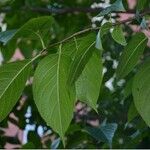
Eucommia ulmoides
Eucommia · Gutta-percha-tree · Gutta-percha Tree · Du Zhong · Woody plant
Description
Source: leafsnapEucommia ulmoides, commonly known as the hardy rubber tree, is a deciduous tree native to China. Belonging to the family Eucommiaceae, it can grow up to 20 meters tall. The tree's bark contains latex, which has been used for centuries in traditional Chinese medicine due to its anti-inflammatory and pain-relieving properties. The leaves of Eucommia ulmoides are unique, being one of only two species in the world that produce latex. They are rich in antioxidants and have been utilized as a natural supplement to support overall health. The hardy rubber tree is also valued for its strong and durable wood, which has applications in furniture manufacturing, construction, and even the crafting of bows. Eucommia ulmoides thrives in well-drained soil with plenty of sunlight but can tolerate some shade. It is hardy in USDA zones 5-8 and can withstand temperatures as low as -20°C (-4°F). The plant requires minimal maintenance once established but may benefit from occasional pruning or shaping. Overall, Eucommia ulmoides is a fascinating plant with numerous medicinal and industrial uses. Its unique properties make it an important species both culturally in China, where it originates, and globally, where it has gained popularity for its various uses over time.
Care Guide
💧 Water Every 7 days
The hardy rubber tree, native to central China, is known for its drought tolerance and efficient water storage. To replicate its natural hydration, water the tree once every two weeks. When grown outdoors, the tree maximizes water absorption during the rainy season, enhancing its growth and resilience in dry conditions.
What's the best way to water my Hardy rubber tree?
For excellent root development, place a garden hose at the base of the plant. Avoid spraying the leaves directly and note that outdoor plants in direct sunlight will require more watering for their leaves. To moisten the roots, you can use bubblers or soaker hoses that cover the entire garden or bed. When adding or removing plants, use soaker hoses to help roots go deeper into the soil. After watering, drain any excess water and wait for the soil to dry before watering again. To prevent diseases, water at ground level. On a sunny day, consider spraying the entire bush with water. Whether potted or in-ground, remember that the Hardy rubber tree prefers deep watering rather than light sprinkling.
What do I do if I give too much or too little water to a Hardy rubber tree?
If a Hardy rubber tree is overwatered, its leaves may turn yellow, drop off, and wilt. The plant may also appear unhealthy with mushy stems. When these signs begin to show, it is best to adjust your watering schedule. Wilting can also indicate under watering, which causes crispy and dry leaves. In this case, check the soil and give the plant a full watering if it is dry. However, even with enough water, the tree may still have dry and yellow leaves for a few days due to a damaged root system. Once the root system recovers, the yellowing of leaves will stop. When having a Hardy rubber tree indoors, always monitor the moisture levels and avoid overwatering. Look out for black spots, and if present, allow the soil to dry by not watering for a few days. Overwatering can lead to root rot, so transfer the plant to a different pot if you notice discolored and slimy roots. Prevent root rot by avoiding overly soggy soil. When planting the Hardy rubber tree outdoors, dig a little deeper. If the soil feels too dry when you check with your fingers, it may be underwatering. Adequate watering is necessary for the plant's recovery.
How frequently should I water my Hardy rubber tree?
To keep the Hardy rubber tree healthy, it is best to water it deeply but infrequently. This is especially important for potted plants since they often have limited water storage and the soil dries out quickly. In colder regions, watering every 3 to 5 days is necessary, preferably in the morning when the soil is dry. You can check if watering is needed by testing the top 2-3 inches of soil for dryness. During hot days, it's advisable to check the soil moisture daily as it can dry out rapidly. If you have a garden, irrigation is also necessary. In hot climates, watering once a week is usually sufficient. Consider the amount of rainfall and avoid overwatering to prevent root rot. Adding mulch around the tree can help conserve water when it's outdoors. Sandy soil tends to drain faster, so more frequent watering is needed, while clay soil requires less watering to avoid root rot. Keeping track of watering dates on a calendar can help ensure timely care for the plant. Drooping leaves may indicate that watering is needed soon.
How much water should I give my Hardy rubber tree?
The Hardy rubber tree usually requires about a gallon of water on a regular schedule. For potted plants, it's best to water them deeply until you see water dripping from the bottom of the pot. Let the soil dry between waterings, and you can use a water calculator or moisture meter to determine how much water you've given your plant in a week. During the flowering period, provide ample water but allow the moisture to evaporate afterwards to avoid root rot. If the Hardy rubber tree is planted outdoors where there is sufficient rainfall, additional watering may not be necessary. However, when the tree is young or newly planted, ensure it receives 1-2 inches of rain per week. As the tree grows, it can rely solely on rainfall. Only in extremely hot weather or if there's no rain for 2-3 weeks should you consider giving the tree a full watering during cooler times of the day to prevent damage from heat. Additional watering will be needed during extended dry periods.
Should I water my Hardy rubber tree more or less depending on the time of year or the weather?
The Hardy rubber tree prefers to be outdoors and generally only needs watering during dry periods. During the spring and fall, the soil should be kept moist but not overly wet, and alternating between dry and moist soil conditions will promote growth. In hot summer weather or when there is little rainfall, the tree may require more frequent watering. However, during the winter, it needs less water as it goes dormant. Use well-draining soil, such as terracotta, during this period. Once the tree starts growing again in the spring, you can water it more to encourage growth and blooming. Good drainage is important at all times, especially in winter. If the tree is in a pot, make sure to water it well, particularly during the summer, while avoiding cold and wet roots. It's best to deep soak the entire root system once or twice a week, rather than sprinkling water on the leaves. Even in fall or winter dormancy, the tree should not be allowed to completely dry out. Avoid overwatering, as this can be detrimental to the tree. Applying mulch can help reduce stress, conserve water, and promote healthy blooms.
☀️ Light Full sun
The hardy rubber tree grows best when given plenty of sunlight, reflecting its native growing environment that receives abundant sunshine throughout the day. It can tolerate conditions with less sun, but reduced light may negatively affect its healthy growth. Both excessive and insufficient sunlight can stress the plant, diminishing its robustness and vitality.
What are the sunlight requirements for a Hardy rubber tree?
The Hardy rubber tree thrives in conditions where it can receive ample sunlight, reflective of its natural growing environment which is accustomed to significant sunshine throughout the day. Its optimal growth is seen with exposure to full sun, which is defined as above 6 hours of sunlight. However, it can also grow under partial sun, about 3-6 hours of sunlight, albeit with possible impacts on its healthy growth. It's essential to watch how sunlight moves through your garden and choose locations that ensure a balance of light and shade, conducive to the plant's happiness.
What essentials should be known for growing Hardy rubber tree?
The Hardy rubber tree is best grown when exposed to ample sunlight, mimicking its native environment's preference for abundant daylight. While it can withstand less sunny conditions, insufficient light may negatively affect its growth. Overexposure or underexposure to sunlight could stress the plant, impacting its robustness. In indoor settings or during less sunny periods, artificial lighting serves as a crucial aid, promoting healthier growth. Indoor plants benefit from LED lights, which can be adjusted to provide necessary wavelengths, with full sun plants requiring 30-50W/sq ft, partial sun plants needing 20-30W/sq ft, and full shade plants 10-20W/sq ft of artificial light. The light source should be 12-36 inches above the plant, imitating natural sunlight, for 8-12 hours per day.
What are the symptoms of insufficient sunlight in Hardy rubber trees?
Hardy rubber trees exhibit several symptoms when they experience light deficiency, including smaller new leaves, leggy or sparse growth, faster leaf drop, slower or no new growth, lighter-colored new leaves, chlorosis (yellowing leaves due to chlorophyll breakdown), sunscald (damaged leaves from intense sunlight), leaf curling as a defense mechanism against extreme sunlight, wilting from increased water loss, and leaf scorching (brown, dry edges on leaves due to excessive sunlight). These symptoms highlight the plant's sensitivity to both insufficient and excessive sunlight exposure.
How can I address sunlight-related issues in my Hardy rubber tree?
To ensure your Hardy rubber tree receives optimal sunlight, gradually acclimate it to sunnier spots, aiming for at least 6 hours of direct sunlight daily. Use south-facing windows for indoor plants, keeping curtains open to maximize light. If moving the plant isn't feasible, consider artificial lighting, such as desk lamps or professional grow lights, keeping them on for at least 8 hours a day. For outdoor plants, transition them slowly to prevent sunburn. Reducing obstructions, like pruning trees, or transplanting to sunnier locations during the plant's dormant period, can also help. It's important to remember that while affected parts may not recover, new growth should be healthy once light exposure improves.
🌡️ Temperature 5–32.2°C
The hardy rubber tree comes from cooler-climate environments and prefers temperatures between 41 and 90 °F (5 to 32 °C). During warmer seasons it may need shade or cooler locations, while in colder seasons it may benefit from some protection from chilling winds.
What is the preferred temperature range for a Hardy rubber tree?
The Hardy rubber tree, also known as Eucommia ulmoides, thrives in cooler climates, favoring a temperature range of 41 to 90°F (5 to 32°C). In warmer seasons, it's important to provide shade or relocate it to cooler locations to protect it from overheating. Conversely, during colder seasons, safeguarding it against chilling winds can be beneficial, although it's notably cold-tolerant and doesn't need extra frost protection in winter. It's advisable to water the plant generously before the first freeze of autumn to help the soil stay moist and prevent drought and water scarcity during the colder months and into early spring.
How does the Hardy rubber tree react to extremely low temperatures?
While the Hardy rubber tree exhibits remarkable cold tolerance, maintaining winter temperatures above -30°C is crucial for its survival. Should temperatures plunge below this level, the tree might not show immediate distress, but by spring, its branches could turn brittle and dry. Moreover, it might fail to produce new shoots. To mitigate these effects, it's recommended to prune any dead branches in spring that have not sprouted new leaves.
What should I do if my Hardy rubber tree experiences high temperatures?
The Hardy rubber tree struggles in high temperatures, particularly when the mercury goes above 32°C. Under such conditions, the tree may lose leaves significantly, and in extreme cases, it could completely wither and die. If your tree suffers from heat stress, trim the sunburned and dried parts. Relocate the plant to a shaded spot away from the intense midday and afternoon sun, or use a shade cloth to protect it. Additionally, water the plant in the morning and evening to ensure the soil remains moist, aiding in its recovery and continued health.
💨 Humidity
🪴 Soil 5-7
🌱 Fertilizer
Fertilize your Hardy rubber tree in early spring to encourage healthy growth. Consistent fertilization boosts overall health, producing vigorous growth, better tolerance of difficult conditions, and increased resistance to pests and diseases. Stick to a regular fertilizing routine for your Hardy rubber tree to preserve vibrant, deep-colored foliage and a lush appearance.
Why is it necessary for me to give fertilizer to my Hardy rubber tree?
No matter which type of Hardy rubber tree you have, regular fertilization is crucial for its overall health. Providing the proper nutrients promotes strong growth and increases resilience to harsh conditions, as well as improved resistance against diseases and pests. Since the foliage is a key feature of your Hardy rubber tree, it's important to maintain its integrity. This involves following a specific fertilization schedule tailored to your particular tree, resulting in vibrant, lush leaves with a deep color.
When should I put fertilizer on my Hardy rubber tree?
To keep your Hardy rubber tree healthy and promote growth, it's best to fertilize it in late winter or early spring. This provides the necessary nutrients for a strong growth spurt when the weather warms up. If you live in a warm climate, it's also beneficial to give your tree an extra fertilization in early fall. This not only provides more nutrients for the coming growing season, but also helps the tree withstand winter by making it more resilient and less prone to foliage damage. Fertilizing earlier in the fall allows the new branches to grow sufficiently to endure the cold winter.
When is it not a good idea to add fertilizer to my Hardy rubber tree?
There are a few specific times throughout the year when you should avoid fertilizing your Hardy rubber tree. The first instance is during the early and mid-winter months when the tree is dormant and does not require any nutrients. It is also not recommended to fertilize the plant during late spring and summer. During this period, the weather tends to be hotter and drier, which can have a negative impact on the tree if it is fertilized. To prevent any potential problems, it is best to stick to a fertilization schedule that only includes feeding in the early spring and early fall.
What kind of plant food does my Hardy rubber tree need?
The most important nutrient for a Hardy rubber tree is usually nitrogen, but that doesn't mean phosphorus and potassium are not important. In fact, the tree typically requires a decent amount of all three main nutrients. That's why a balanced fertilizer like a 10-10-10 can be effective. However, a more specific nutrient ratio may lead to optimal growth. Often, fertilizers with a higher nitrogen content, such as a 10-6-4 ratio, work well. You can choose between granular or liquid-based fertilizers when feeding your tree.
How do I give nutrients to my Hardy rubber tree?
To fertilize your Hardy rubber tree with granular fertilizer, simply sprinkle it on the soil at the correct time. The slow-release granules will slowly release nutrients into the soil. It's best to lightly water your tree before applying fertilizer. Alternatively, you can use liquid fertilizer by mixing it with water and pouring around the base of the tree. It's less common but still effective. Before fertilizing, it may be helpful to perform a soil test to see if any pH adjustments are necessary.
🪴 Pot & Repot
✂️ Pruning
For the hardy rubber tree to thrive, it is important to prune it carefully in early spring. This involves removing dead branches to promote airflow and encourage new growth. Thinning the canopy and shaping the tree help support its structure, while using clean tools prevents the spread of disease. Proper timing and precise cuts are essential for maintaining the tree's vitality and health.
🌿 Propagating
🐛 Diseases & pets
☠️ Toxicity
Characteristics
- Plant Type
- Tree
- Life Cycle
- Perennial
- Genus
- Eucommia
- Family
- Eucommiaceae
- Hardiness Zone
- 4-7
- Mature Height
- 20.12 m
- Mature Spread
- 7.62 m to 10.36 m
- Leaf Color
- Green
- Leaf Type
- Deciduous
- Flower Color
- Green, White, Yellow
- Flower Size
- 2.54 cm
- Bloom Time
- Early spring, Mid spring
- Planting Time
- Spring, Autumn
- Harvest Time
- Late summer, Early fall, Mid fall
- Native Area
- China