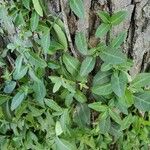
Euonymus fortunei
Climbing euonymus · Wintercreeper · Spreading euonymus · Dwarf euonymus · Creeping Spindle
Description
Source: leafsnapEuonymus fortunei, commonly known as wintercreeper, is a versatile evergreen plant native to East Asia. It is a popular ornamental plant that can be grown as ground cover or trained to climb walls and fences. The plant features glossy green, oval-shaped leaves that grow in opposite pairs along the stem. During the fall, these leaves turn striking shades of red and purple. When trained on a support structure, wintercreeper can reach a height of up to six feet. However, when used as ground cover, it typically grows to about one to two feet tall. This plant prefers well-drained soil and partial shade but can tolerate conditions ranging from full sun to full shade. In late summer, wintercreeper produces small greenish-white flowers, which are followed by pinkish-red fruit capsules in the fall. These capsules split open to reveal bright orange seeds. Euonymus fortunei has also been used in traditional Chinese medicine for its anti-inflammatory properties. However, it is important to note that all parts of this plant are toxic if ingested by humans or animals. Overall, Euonymus fortunei is an attractive evergreen shrub with many applications in landscaping design, thanks to its adaptability and hardiness.
💡 Once upon a time, there was a young boy who dreamed of exploring the sky to discover what lay beyond. To help fulfill his wish, his mother gave him a seed from the fortune’s spindle plant. She explained that by growing this plant, he would be able to learn what was up in the sky. Eager to begin his adventure, the boy found a tall tree, planted the seed next to it, and patiently waited for the fortune's spindle to climb slowly up the tree.
🌳 Wintercreeper serves not only as a common ornamental plant but also acts as an indicator of soil phosphate levels. Its thick, compact foliage provides shelter for wildlife, and its ability to tolerate a variety of conditions makes it a strong candidate for pollution-reducing green walls in urban settings.
🎭 Confronting challenges
Care Guide
💧 Water Every 7 days
Wintercreeper thrives in dense forests with consistent moisture and prefers a moderate level of humidity. To care for it, water the plant every 1-2 weeks, allowing the soil to dry out slightly between waterings. As an evergreen, wintercreeper requires well-draining soil to avoid root rot, which can occur if the soil becomes too wet.
When Should I Water My Wintercreeper?
Proper and timely watering is pivotal for the health and growth of wintercreeper, ensuring vibrant foliage and disease resistance. The key indicators for watering include dry soil top layer (1 to 2 inches deep), wilted or limp leaves, fading or yellowing leaves, and increased water needs during the pre-flowering stage and in warm, sunny conditions. Beware of the risks of watering either too early, which can cause root diseases due to over-watering, or too late, risking wilting and potentially plant death.
How Should I Water My Wintercreeper?
For optimal hydration of wintercreeper, bottom-watering is effective, minimizing foliage moisture and fungal disease risk. Choose a watering can with a narrow spout for precise watering at the base, avoiding foliage. Utilize a moisture meter to accurately assess soil moisture. Ensure your watering frequency keeps the soil's top inch dry before the next watering, and provide good drainage to prevent root rot. In dry environments, occasional misting helps, but overuse could introduce excess humidity.
How Much Water Does Wintercreeper Really Need?
Wintercreeper's water requirement is influenced by pot size, root depth, and plant size, ideally maintained whenever the top 1-2 inches of soil feel dry. Ensuring thorough watering without causing waterlogging is crucial. A well-hydrated wintercreeper showcases healthy foliage; signs of over or underwatering include discolored, wilting leaves or a foul odor from soggy soil. To avoid these issues, ensure appropriate soil drainage and regular soil moisture monitoring.
What Kind of Water is Best for Wintercreeper?
Wintercreeper thrives with rainwater or distilled water due to its sensitivity to chlorine, fluoride, and mineral content in tap water. To minimize these elements' adverse effects, let tap water sit for 24 hours before use or opt for filtered water sans fluoridated supply. Room temperature water is preferred to prevent shocking the plant's system.
How Do Wintercreeper's Watering Needs Change with the Seasons?
In spring, water wintercreeper more as it exits dormancy. Summer's heat requires frequent watering to maintain soil moisture without causing waterlogging. Reduce watering frequency in autumn as growth slows, but avoid letting the soil dry out completely. During winter dormancy, water sparingly, ensuring the soil isn't waterlogged to prevent root chilling or freezing.
☀️ Light Partial sun
Wintercreeper typically performs best with moderate sun exposure, though it can adjust to both intense daily sun and considerably shaded spots. Native to environments that combine sun and shade, its growth may be hampered by either excessive sun or inadequate light. Under these extreme conditions, its health can potentially be harmed.
What are the sunlight requirements for Wintercreeper (Euonymus fortunei)?
Wintercreeper requires partial sun to full sun or full shade to thrive, which translates to about 3-6 hours of sunlight or more daily. However, it's important to observe how sunlight moves through your garden to select the best spots that provide a balance of light and shade for the plants, ensuring their well-being.
Can Wintercreeper adapt to different light conditions?
Yes, Wintercreeper can adapt to various light conditions. It generally thrives under moderate solar exposure but can also grow in intense sun or in considerably shaded areas. Originating from habitats that offer a mix of sun and shade, Wintercreeper's growth may suffer if exposed to too much sunlight or too little light, potentially leading to health issues.
How can artificial lighting benefit indoor Wintercreeper plants?
Artificial lighting is crucial for indoor Wintercreeper plants, especially when natural sunlight is insufficient, such as in winter or less sunny spaces. LED lights are recommended for their ability to provide the specific wavelengths needed by the plants. Full sun plants require 30-50W/sq ft, partial sun plants need 20-30W/sq ft, and full shade plants require 10-20W/sq ft of artificial light. The light source should be placed 12-36 inches above the plant to mimic natural sunlight conditions, and it's essential to ensure the plants receive 8-12 hours of light per day.
What are the symptoms of light deficiency in Wintercreeper?
When Wintercreeper doesn't receive adequate light, it may exhibit several symptoms of light deficiency such as smaller new leaves, leggy or sparse growth, faster leaf drop, slower or no new growth, lighter-colored new leaves, chlorosis, sunscald, leaf curling, wilting, and leaf scorching. Each of these symptoms indicates the plant's struggle with either too much or too little light.
What are the solutions to improve light conditions for Wintercreeper?
To optimize light conditions for Wintercreeper, gradually adapt your plants to changing light conditions by shifting them to sunnier spots each week, aiming for 3-6 hours of direct sunlight daily. For indoor plants that are large or not easily movable, consider using artificial light, such as desk or ceiling lamps, for at least 8 hours daily or invest in professional grow lights. Outdoors, move your plants to sunnier locations gradually to prevent sunburn. If the sunlight is blocked by trees, consider pruning branches and leaves. For smaller plants, transplanting during the dormant period to a location with more sunlight may be beneficial. Note that parts of the plant damaged by insufficient light may not recover, but new growth should be healthy.
🌡️ Temperature 10–35°C
Wintercreeper originates from East Asia and does well in temperate climates. It prefers temperatures from 50 to 95 ℉ (10 to 35 ℃) and can withstand both hot and cold conditions. In summer it needs moderate watering and should be kept in a shaded spot with temperatures between 70 and 80 ℉ (21 to 27 ℃). In winter it can tolerate cooler temperatures below 50 ℉ (10 ℃) and should be stored in a cool, dry place.
What is Wintercreeper and where is it native to?
Wintercreeper, botanically known as Euonymus fortunei, is native to East Asia. It thrives in temperate climates and is well adapted to a range of temperatures, showing a strong tolerance for both hot and cold weather conditions. This resilience makes it a popular choice for various landscaping projects.
What are the ideal temperature conditions for Wintercreeper?
Wintercreeper prefers temperatures between 50 to 95 °F (10 to 35 °C), making it versatile for different climate conditions. During the summer, it is ideally kept within 70 to 80 °F (21 to 27 °C) and positioned in shaded areas to avoid direct sunlight. In contrast, during winter, it can withstand cooler temperatures below 50 °F (10 °C), requiring a cool, dry place to thrive without the need for special frost protection measures.
How should Wintercreeper be taken care of in winter?
During winter, Wintercreeper can tolerate temperatures below 50 °F (10 °C) without special frost protection. However, if temperatures are expected to fall below -25°C, protection from the cold is advised by wrapping the trunk and branches in non-woven fabric or cloth. Additionally, watering the plant abundantly before the first freeze ensures the soil is moist when it enters a frozen state, helping prevent drought and water scarcity during the colder seasons.
What are the important symptoms to look out for in Wintercreeper due to temperature changes?
For Wintercreeper, important symptoms to note include: for low temperatures, although the plant is cold-tolerant, temperatures below -25°C can cause branches to become brittle and prevent new shoots in spring. For high temperatures, if the plant is exposed to temperatures above 41°C, leaves may lighten in color, tips might dry, and the plant becomes susceptible to sunburn. These symptoms help in identifying and remedying stress due to temperature extremes.
How can you manage Wintercreeper when it experiences temperature-related stress?
Managing Wintercreeper in temperature-related stress involves: for cold damage, pruning away any dead branches that show no signs of new growth in spring. For heat stress, trimming sunburned or dried parts, relocating the plant to shaded areas, or using a shade cloth for protection against midday and afternoon sun. Additionally, ensuring the soil remains moist by watering in the morning and evening can greatly help the plant recover and thrive.
💨 Humidity normal (40-60%)
This plant will thrive in moderate humidity, which is probably the level in your home. However, misting it a few times a week can be very beneficial. Make sure the room has good ventilation.
🪴 Soil 6-7
🌱 Fertilizer
Fertilize your Wintercreeper in early spring to encourage healthy growth. Regular feeding improves overall health, producing vigorous growth, greater resilience to difficult conditions, and enhanced resistance to diseases and pests. Keep a specific fertilization schedule for your Wintercreeper to preserve vibrant, deeply colored foliage and a lush appearance.
Why do I have to put plant food on my Wintercreeper?
No matter what type of Wintercreeper you have, regularly fertilizing it will improve its overall health. Providing the right nutrients will promote stronger growth and make the plant more resilient to challenging conditions, diseases, and pests. Since the foliage of the Wintercreeper is one of its most appealing aspects, it is important to maintain it. This can be achieved through a consistent fertilization schedule tailored to your specific Wintercreeper. Following this schedule will result in vibrant and lush leaves with deep color.
When should I fertilize my Wintercreeper?
To ensure healthy growth, fertilize your Wintercreeper for the first time in late winter or early spring. This provides essential nutrients for the plant when the weather starts to warm up. If you live in a warm climate, it is also beneficial to fertilize your Wintercreeper in early fall. This additional feeding adds nutrients to the soil, which the plant will use in the following growing season. It also helps the Wintercreeper become hardier and better able to withstand the winter cold without leaf damage. Fertilizing earlier in the season allows enough time for new branches to grow and prepare for the cold winter.
When is the time I shouldn't add fertilizer to my Wintercreeper plant?
There are specific times of the year when you should avoid fertilizing your Wintercreeper. One of these times is in the early and mid-winter, when the plant is dormant and does not require any nourishment. Another time to avoid fertilization is in late spring and throughout summer. This is because the weather during these periods is usually hotter and drier, which can have a negative impact on your Wintercreeper if it is fertilized. To prevent any issues, it is best to only fertilize your Wintercreeper in early spring and early fall.
What kind of plant food does my Wintercreeper need?
Wintercreeper plants primarily require nitrogen, although phosphorus and potassium are also essential. Therefore, it is important to provide all three nutrients in adequate amounts. An effective approach is to use a balanced fertilizer, such as a 10-10-10 formula. However, for optimal growth, a more specific nutrient ratio may be beneficial. In many cases, a slightly higher nitrogen concentration, such as a 10-6-4 ratio, can be more effective. Both granular and liquid fertilizers can be used for this purpose.
How can I make my Wintercreeper plant grow better with nutrients?
To fertilize your Wintercreeper, you have two options: granular fertilizer or liquid fertilizer. If you choose granular fertilizer, simply sprinkle it on the soil at the right time. The nutrients will be released slowly over time. It's a good idea to lightly water your Wintercreeper before applying the fertilizer. Liquid fertilizer is less common, but still an option. Mix the fertilizer with water and pour it around the base of your Wintercreeper. Consider doing a soil test beforehand to check if you need to adjust the pH.
🪴 Pot & Repot 2-3 years
Transpose the Wintercreeper in the early part of spring, opting for a pot that is just a bit larger than its existing one, ensuring it has suitable drainage. Use a potting mixture that drains well and maintain the root ball at its original level. Carefully untangle roots that are root-bound. Following the repotting, water the plant amply and situate it in a warm location with shade. Periodic pruning assists in controlling its size and encourages fresh growth.
✂️ Pruning
Wintercreeper benefits from pruning in early spring, which helps to remove dead wood, improve air circulation by thinning, and shape the plant. This not only promotes the plant's health but also helps to control its invasiveness. To minimize stress and reduce the risk of disease, it is important to maintain clean tools and avoid heavy pruning in late summer. For additional guidance, consult your local horticultural extension services.
🌿 Propagating
🐛 Diseases & pets
☠️ Toxicity
Characteristics
- Plant Type
- Vine
- Life Cycle
- Perennial
- Genus
- Euonymus
- Family
- Celastraceae
- Hardiness Zone
- 6-10
- Mature Height
- 0.91 m to 20.12 m
- Mature Spread
- 61 cm to 91 cm
- Leaf Color
- Green, White, Yellow, Gray, Variegated, Silver
- Leaf Type
- Evergreen
- Flower Color
- White
- Flower Size
- 0.51 cm to 0.51 cm
- Bloom Time
- Early summer, Mid summer
- Planting Time
- Spring, Autumn
- Harvest Time
- Mid summer, Late summer
- Native Area
- India, Indonesia, Mexico, Vietnam, Myanmar, Japan, Philippines, Laos, South Korea, Thailand, China