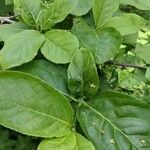
Euonymus sachalinensis
Siberian spindletree
Description
Source: leafsnapEuonymus sachalinensis (syn. Euonymus planipes), the flat-stalked spindle, is a species of flowering plant in the family Celastraceae, native to Japan, China, Korea, and the Island of Sakhalin (whence the specific epithet sachalinensis). Growing to 2.5 m (8.2 ft) tall and broad, it is a deciduous shrub notable for its leaves turning red in autumn, and its red fruit which splits open to reveal orange seeds. Exceptional specimens, such as the one in the Hørsholm Arboretum, Copenhagen University, can become trees up to 4 m (13 ft) in height.This plant is cultivated as an ornamental subject. The cultivar 'Sancho' which is more free-flowering than its parent, is a recipient of the Royal Horticultural Society's Award of Garden Merit.
Care Guide
💧 Water
The Siberian burning bush, which comes from regions with varying moisture levels, is moderately drought-tolerant but thrives in consistently humid conditions. To maintain evenly moist soil, water the plant twice a week. When grown outdoors, the Siberian burning bush is resilient in different climates and effectively adjusts its water uptake throughout the growing season.
☀️ Light Partial sun
The Siberian burning bush is native to habitats like forest understories and rocky areas, where it grows in natural shade. It prefers partial sun but can adapt to full sun or full shade, demonstrating its versatility and hardiness.
What are the sunlight requirements for a Siberian burning bush?
The Siberian burning bush (Euonymus sachalinensis) thrives under specific sunlight conditions. It requires partial sun, meaning about 3-6 hours of sunlight per day. Alternatively, it can grow in full shade, which is defined as receiving less than 3 hours of sunlight each day. It's important to watch how sunlight gracefully moves through your garden, and choose spots that provide the perfect balance of light and shade for your plants, ensuring their happiness.
🌡️ Temperature 5–32.2°C
The Siberian burning bush is highly adaptable to a variety of climates, tolerating both hot summers and cold winters. That said, it has a preferred temperature range for growth. If temperatures become too high, the plant can suffer from heat and humidity stress, which may kill it. In areas where temperatures approach the lower limit of its cold tolerance, insulating the plant is important to protect it.
What is the Siberian burning bush?
The Siberian burning bush, known botanically as Euonymus sachalinensis, is a plant species. Unfortunately, there's no additional information provided on its essentials, such as its care, habitat, or significance, nor any details on its symptoms of illness or conditions for its care.
💨 Humidity
🪴 Soil 6-7
🌱 Fertilizer
Timing is essential when fertilizing the Siberian burning bush. Apply fertilizer in early spring and repeat monthly until early summer. Fertilizer encourages attractive blooms and supplies energy during both dormant and active growth periods.
🪴 Pot & Repot
✂️ Pruning
The Siberian burning bush is known for its vibrant autumn foliage and thrives when pruned in early spring. To enhance its health and appearance, remove any dead wood and thin out branches to improve air circulation. Shaping the plant provides a better structure. Proper pruning encourages healthy growth and creates a striking display. Always use clean tools and avoid over-pruning to minimize stress on the plant.
🌿 Propagating
🐛 Diseases & pets
☠️ Toxicity
Characteristics
- Plant Type
- Shrub
- Life Cycle
- Perennial
- Genus
- Euonymus
- Family
- Celastraceae
- Hardiness Zone
- 4-8
- Mature Height
- 2.44 m
- Mature Spread
- 2.44 m
- Leaf Color
- Red, Green
- Leaf Type
- Semi-evergreen
- Flower Color
- White, Yellow, Green
- Flower Size
- 0.76 cm
- Bloom Time
- Late spring, Early summer
- Planting Time
- Spring, Autumn
- Harvest Time
- Late summer, Early fall, Mid fall
- Native Area
- Russia, Japan, Koppen, South Korea, China