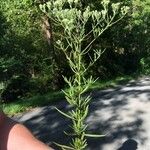
Eupatorium hyssopifolium
Hyssop-leaf thoroughwort · Hyssopleaf Thoroughwort · Hyssop-leaved Boneset · Hyssop-leaf boneset · Late-flowering thoroughwort
Description
Source: leafsnapEupatorium hyssopifolium, also known as hyssopleaf thoroughwort, is a fall-blooming herbaceous plant native to North America. Like other members of the genus Eupatorium it has inflorescences containing a large number of very small flower heads, each with 5 white disc florets but no ray florets. At 0.5 to one meter (20-40 inches) tall, it is towards the shorter end of the range of heights found in Eupatorium species.Plants which are classified as E. hyssopifolium can be either diploid or polyploid, and some of them seem to have been the result of past hybridizations with Eupatorium serotinum. Hybrids with E. album and E. linearifolium also seem to exist. The hybrid E. torreyanum is similar to E. hyssopifolium but is a hybrid of E. serotinum and Eupatorium mohrii.Eupatorium hyssopifolium is found in much of the eastern and south-central United States, from Massachusetts west to Wisconsin, and as far south as Texas and Florida. It grows in moist soils. VarietiesEupatorium hyssopifolium var. hyssopifolium - leaves 2–5 mm wide Eupatorium hyssopifolium var. laciniatum A.Gray - leaves 5–15 mm wide
Care Guide
💧 Water
☀️ Light Full sun
The hyssopleaf thoroughwort does best when it gets abundant sunlight throughout the day. It can also tolerate moderately lit conditions quite well. In its native environment it experienced plentiful sun, which supported healthy growth. However, extremes — either too little or too much sunlight — can endanger its normal development and overall health.
What are the sunlight requirements for Hyssopleaf thoroughwort?
Hyssopleaf thoroughwort requires full sun to partial sun conditions to thrive. Full sun entails more than 6 hours of sunlight per day, while partial sun means the plant should receive about 3-6 hours of sunlight daily. Understanding the movement of sunlight through your garden is crucial for positioning plants in spots that offer the right balance of light and shade, ensuring optimal growth and health of your Hyssopleaf thoroughwort.
What essentials are needed for the growth of Hyssopleaf thoroughwort?
The growth of Hyssopleaf thoroughwort is heavily dependent on the amount of sunlight it receives. Originating from environments abundant in sunlight, this plant thrives under full to moderately sunlit conditions. However, too little or too much sunlight can negatively affect its growth and health. For indoor plants where natural sunlight may be insufficient, especially during winter or in less sunny spaces, artificial lighting can be a beneficial supplement. LEDs are recommended for their ability to be customized to specific plant needs, suggesting a range of 10-50W/sq ft based on the plant's sunlight needs and adjustments to the light's distance and duration to best mimic natural conditions.
What are some common symptoms of inappropriate lighting in Hyssopleaf thoroughwort?
Inappropriately lit Hyssopleaf thoroughwort plants can develop several symptoms indicating either too little or too much light. Symptoms of light deficiency include smaller new leaves, leggy or sparse growth, faster leaf drop, slower or halted new growth, and lighter-colored or yellow leaves (chlorosis). Excessive sunlight exposure can lead to leaf scorching, chlorosis, sunscald, leaf curling, and wilting. These symptoms highlight the plant's struggle to adapt to its lighting conditions, either by conserving energy and resources or attempting to minimize damage and water loss.
How can lighting issues be addressed for Hyssopleaf thoroughwort?
Addressing lighting issues for both indoor and outdoor Hyssopleaf thoroughwort plants involves thoughtful adjustments to their exposure. Indoors, gradually increase sunlight exposure by moving plants closer to south-facing windows or supplement light with artificial sources like LEDs or dedicated plant grow lights for at least 8 hours a day. Outdoors, plants should be moved progressively to sunnier spots to avoid shock and sunburn. It's important to note that parts of the plant already damaged by poor lighting might not recover, but new growth should be healthy with corrected lighting. Additionally, reducing obstructions and, if necessary, transplanting to sunnier locations can significantly improve sunlight access. When transplanting, choose a period of dormancy for the plant, usually late winter or early spring, ensuring the plant has ample sunlight and good drainage in its new spot.
🌡️ Temperature 5–32.2°C
Hyssopleaf thoroughwort is a temperate-zone plant, native to environments with moderate temperature ranges of 41 to 89.6 °F (5 to 32 ℃). It prefers cooler conditions but can withstand heat up to that upper limit. Once situated in an ideal spot, seasonal temperature adjustments are rarely required.
What is hyssopleaf thoroughwort and where is it native to?
Hyssopleaf thoroughwort, botanically known as Eupatorium hyssopifolium, is a plant that thrives in the temperate zones. It is native to environments that feature moderate temperature ranges, specifically between 41 to 89.6 °F (5 to 32 °C). These regions have cooler climates, which the plant prefers, though it can also tolerate heat up to its higher temperature threshold. Given its strong cold resistance, the hyssopleaf thoroughwort rarely needs seasonal temperature adjustments once placed in an optimal spot.
How should hyssopleaf thoroughwort be cared for during winter?
Hyssopleaf thoroughwort possesses a strong resistance to cold, negating the need for special frost protection measures for much of the winter. However, if temperatures are anticipated to drop below -30°C, it's crucial to provide cold protection by covering the plant with soil, straw, or similar materials. To prepare for winter, it is recommended to water the plant generously before the first freeze of autumn, ensuring the soil remains moist and enters a frozen state. This strategy helps prevent drought and water scarcity during the colder months and early spring.
What should be done if the hyssopleaf thoroughwort is exposed to temperatures below -25°C?
Hyssopleaf thoroughwort is capable of tolerating cold temperatures and ideally should be kept in conditions above 5°C to thrive. In the event the temperature dips below -25°C to -30°C, you may not notice immediate changes during winter, but there might be a reduced sprouting or even absence of sprouting in spring. Should this occur, the recommended solution is to remove any parts of the plant that have failed to sprout in the spring, allowing for healthier growth.
How does hyssopleaf thoroughwort react to high temperatures, and what are the solutions?
During the summer months, it's essential to keep hyssopleaf thoroughwort's temperature below 32°C. Exceeding this threshold, especially reaching temperatures above 35°C, can cause the plant's leaves to lighten in color, curl, and become susceptible to sunburn. In severe cases, the entire plant may wilt and dry out. To combat these issues, you should trim away the sunburned and dried parts of the plant. Moving the plant to a shaded area during intense midday and afternoon sun or utilizing a shade cloth can protect it. Additionally, watering the plant in the morning and evening will help maintain soil moisture and support the plant's health.
💨 Humidity
🪴 Soil 5-7
🌱 Fertilizer
The best time to fertilize a Hyssopleaf thoroughwort is in early spring, as it comes out of dormancy and starts active growth. Fertilization supplies essential nutrients for healthy development. While Hyssopleaf thoroughwort has relatively low fertilizer requirements, feeding it annually can boost its survival and encourage better, longer-lasting flowers.
🪴 Pot & Repot
✂️ Pruning
Pruning hyssopleaf thoroughwort from early to late spring encourages healthy growth and helps maintain its shape. Start by removing any dead stems and then cut back about one-third of the plant to promote bushiness. This practice improves air circulation and reduces the risk of disease. Always sterilize your pruning tools to prevent infections and ensure that your hyssopleaf thoroughwort remains healthy and robust.
🌿 Propagating
🐛 Diseases & pets
☠️ Toxicity
Characteristics
- Plant Type
- Herb
- Life Cycle
- Perennial
- Genus
- Eupatorium
- Family
- Asteraceae
- Hardiness Zone
- 4-8
- Mature Height
- 1.22 m
- Mature Spread
- 61 cm
- Leaf Color
- Green, Blue
- Leaf Type
- Deciduous
- Flower Color
- White
- Flower Size
- 2.54 cm
- Bloom Time
- Mid summer, Late summer, Early fall
- Planting Time
- Spring, Summer
- Harvest Time
- Early fall, Mid fall