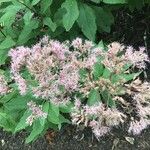
Eupatorium maculatum
Spotted Trumpetweed · Spotted joe pye weed · Joe Pye Weed
Description
Source: leafsnapEutrochium maculatum, the spotted joe-pyeweed, is a North American species of flowering plant in the family Asteraceae. It is widespread through much of the United States and Canada. It is the only species of the genus Eutrochium found west of the Great Plains.This herbaceous perennial sometimes grows as high as 2 m (6 ft 7 in). Stems are sometimes completely purple, sometimes green with purple spots. One plant can produce numerous rose-purple flower heads in late summer, each head with 8-22 disc flowers but no ray flowers. The specific name maculatum, meaning spotted, refers to the purple spots on the stem.Spotted joe-pyeweed thrives in marshes, rich fens and swamps. It also does well in man-made moist expanses such as ditches, seepage areas and wet fields. Above all else the plant flourishes in the non-shaded environments that are also abundant in wetlands.It is a larval host to the Clymene moth, the eupatorium borer moth, the ruby tiger moth, and the three-lined flower moth. The plant also attracts butterflies and honeybees.
🌳 Spotted Joe-Pye weed might not be widely recognized for commonly traded items like furniture or beverages, but it stands out in a different way. It provides essential nectar for a variety of bees and butterflies—especially honeybees and swallowtails—and plays a key role in honey production for local beekeepers. It illustrates that sweetness doesn't only come from obvious sweet sources, as shown by Spotted Joe-Pye weed's indirect sweetening of our honey supplies.
🎭 Postponement, Striking mauve flowers with rose-purple tones
Care Guide
💧 Water
☀️ Light Full sun
Spotted Joe-Pye weed grows best in places with abundant sunlight, though it can tolerate somewhat shaded locations. Its growth may be hindered by too much shade or by excessively intense sun, since it comes from habitats where sunlight penetrates sufficiently.
🌡️ Temperature 5–32.2°C
Spotted Joe-Pye weed prefers temperatures between 41 and 90 ℉ (5 and 32 ℃) and is native to regions with moderate temperatures. In cooler seasons, adjust temperatures to keep them within the preferred range. In hotter seasons, provide adequate shade and water to prevent heat damage.
💨 Humidity
🪴 Soil 5-7
🌱 Fertilizer
Usually a single fertilizer application in spring suffices for Spotted Joe-Pye weed, though multiple feedings can boost growth. Apply fertilizer roughly every month to every month and a half. Fertilization improves the leaves' appearance and function, maintaining even color and a healthy texture. It also promotes root development and nutrient uptake for the plant's long-term health.
🪴 Pot & Repot 2-3 years
When repotting Spotted Joe-Pye weed, select a pot 1-2 inches (2.5–5.1 cm) larger with good drainage. Use a well-draining potting mix. Repot in spring or fall, making sure the root ball sits slightly lower than the rim of the pot. Water thoroughly after repotting and place in a warm spot with indirect sunlight.
✂️ Pruning
🌿 Propagating
🐛 Diseases & pets
☠️ Toxicity
Characteristics
- Plant Type
- Herb
- Life Cycle
- Perennial
- Genus
- Eupatorium
- Family
- Compositae
- Hardiness Zone
- 4-8
- Mature Height
- 2.13 m
- Mature Spread
- 1.22 m to 1.52 m
- Leaf Color
- Green
- Leaf Type
- Deciduous
- Flower Color
- Pink
- Flower Size
- 2.54 cm
- Bloom Time
- Mid summer
- Planting Time
- Spring
- Harvest Time
- Mid summer