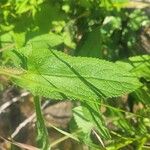
Eupatorium perfoliatum
Boneset · Common boneset · Thoroughwax · Thoroughwort · Chapman's Thoroughwort
Description
Source: leafsnapEupatorium perfoliatum, known as common boneset or just boneset, is a North American perennial plant in the family Asteraceae. It is a common native to the Eastern United States and Canada, widespread from Nova Scotia to Florida, west as far as Texas, Nebraska, the Dakotas, and Manitoba. It is also called agueweed, feverwort, or sweating-plant. It was introduced to American colonists by natives who used the plant for breaking fevers by means of heavy sweating. It is nearly always found in low, wet areas.
🌳 Boneset is not just a relic of past medical use; it also serves an important role in today's ecosystem by acting as a strong attractant for pollinators such as butterflies and bees. Its ecological importance also includes the ability to help restore and re-naturalize disturbed habitats, thereby supporting ecosystem recovery and resilience. Aside from its medicinal reputation, boneset also functions as a key contributor to maintaining biodiversity and ecological balance.
🎭 Repairing, Healing Renewal, Reinforcing.
Care Guide
💧 Water Every week
Boneset is a North American herbaceous perennial that thrives in moist environments. To mimic its natural habitat, it should be watered once a week. When grown outdoors, it benefits from natural rainfall, which boosts its resilience and promotes lush growth during the growing season.
How should I water my Boneset plant to take care of it the best?
To properly water the Boneset, it is recommended to use filtered water at room temperature. Tap water may have harmful particles, so filtered water is preferable. Since the Boneset is accustomed to warm environments, using cold water can be a shock to its system. Therefore, it is best to avoid overhead watering to prevent foliage issues. Instead, generously water the soil with filtered room temperature water until it is thoroughly soaked. This will help moisturize the roots and support their nutrient absorption.
What do I do if I give my Boneset too much or too little water?
Overwatering is a common issue that can harm your Boneset plant. It causes the stems and leaves to wilt and turn yellow, and can even lead to diseases like root rot, mold, and mildew. Underwatering is less common, but still possible. When underwatered, the leaves will become brittle and brown. It's important to notice the signs of overwatering early on, as some diseases may not be fixable if left too long. Reduce watering immediately if you see signs of overwatering. Check the soil drainage and replace with a well-draining mix if needed. If underwatering is the issue, simply water more regularly until the signs subside.
How frequently should I add water to my Boneset plant?
If your Boneset plant is in a pot, the most accurate way to determine if it needs water is by checking the moisture of the soil. Stick your finger into the soil and if you find that the top two to three inches are dry, it's time to water it. If your Boneset is growing outdoors in the ground, you can use the same method to test the soil. Once the first few inches of soil have dried out, it's time to give it some water. Typically, during spring and early fall, watering once a week should be sufficient. However, during extremely hot weather, you may need to water it two or more times per week. It's worth noting that mature and well-established Boneset plants have a good ability to withstand drought.
How much water does my Boneset plant need?
When it's time to water your Boneset, don't hold back on how much water you give. Make sure the first two to three inches of soil are dry before giving it a good, deep watering. You want to soak the soil completely, so add enough water that it drains out of the bottom of the pot. If you don't see any water draining, you may not have given enough water. On the other hand, be careful not to let water accumulate in the soil, as that can harm the plant. If you're watering the plant outdoors, 1 inch of rain per week should be enough.
How do I water my Boneset when it is growing at different stages?
The water needs of the Boneset can vary depending on its growth stages. When the Boneset is in the early years of its life or has been recently transplanted, it will require more water than usual. During these stages, the Boneset focuses its energy on developing new roots that will support future growth. These new roots perform best when they have slightly more moisture. As the plant matures, it will require less water. Additionally, during the bloom period, the Boneset may need more water due to the significant moisture used for flower development.
☀️ Light Partial sun
Boneset does best in sites where sunlight is dappled through the canopy, so it prefers gentle, moderate light. The plant can also tolerate very strong sun as well as deep shade. However, too much or too little light can result in weaker growth and possible health problems.
What are the sunlight requirements for Boneset (Eupatorium perfoliatum)?
Boneset requires varying amounts of sunlight depending on its growth stage and location. It thrives in partial sun, which entails about 3-6 hours of sunlight per day. This plant can also adapt to full sun or full shade conditions, which means it can handle more than 6 hours of sunlight daily. It's essential to observe how sunlight moves through your garden to ensure your plant gets the right balance of light and shade, as this can significantly affect its health and growth.
How does Boneset handle light exposure?
Boneset is highly adaptable to different light conditions. It can grow well when the sunlight filters through overhead foliage, which simulates understated light exposure. This resilience extends to both extremes of sunlight exposure, allowing Boneset to survive under intense solar conditions and in deeply shaded areas. However, it's important to note that too much or too little light can lead to stunted growth and health issues for the plant.
What should I do if natural light is insufficient for my Boneset?
For indoor Boneset plants struggling with low natural light, artificial lighting can be a boon. Optimal growth is supported by adequate lighting, especially during winter or in less sunny locales. LED lights are recommended because they can be customized to provide the wavelengths needed by your plants. The intensity of artificial light should be adjusted based on the plant's needs: 30-50W/sq ft for full sun plants, 20-30W/sq ft for partial sun plants, and 10-20W/sq ft for full shade plants. Set up your artificial light source 12-36 inches above the plant and keep it on for 8-12 hours per day to mimic natural daylight hours.
What are the signs of insufficient light for indoor Boneset plants?
Indoor Boneset plants can show several symptoms when they're not receiving enough light. Watch out for smaller new leaves, leggy or sparse growth, faster leaf drop, stunted or halted growth, and lighter-colored or yellowing leaves (chlorosis). These signs indicate that your plant is struggling with light deficiency and needs either repositioning to a brighter spot or the support of artificial lighting to improve its light intake.
What are common issues caused by incorrect light exposure in Boneset?
Boneset can face various problems due to incorrect light exposure, such as chlorosis, sunscald, leaf curling, wilting, and leaf scorching. These issues arise from both underexposure and overexposure to sunlight. For example, insufficient sunlight can lead to pale or yellowing leaves, while too much sunlight might cause leaf damage, curling to minimize water loss, or even scorching. Managing the light exposure correctly is crucial to avoid these health issues.
🌡️ Temperature 0–32.2°C
Boneset is a temperate herbaceous plant that does well in temperatures from 32 to 90 ℉ (0 to 32 ℃). It naturally occurs in moist open fields, wooded areas, and along streams and rivers, and prefers a sunny spot with adequate moisture. In warmer months, occasional watering helps maintain moisture levels. In colder months it tolerates freezing temperatures and may drop its leaves, regrowing them in spring.
What are the optimal growing conditions for Boneset?
Boneset, scientifically known as Eupatorium perfoliatum, thrives in a temperature range from 32°F (0°C) to 90°F (32°C). Its preferred habitat includes moist, open fields, wooded areas, and the banks of streams and rivers. It favors a sunny spot but requires adequate moisture to prosper. In warmer months, occasional watering is beneficial to maintain moisture levels, while in colder months, it can tolerate freezing temperatures and may lose its leaves, which regrow in spring. Although Boneset has strong cold resistance and usually doesn't need special frost protection, in winters with temperatures dropping below its tolerance limit, cold protection with soil or straw cover is advisable. For winter preparation, watering the plant abundantly before the first freeze is recommended to ensure the soil remains moist and enters a frozen state, safeguarding against drought and water scarcity during the colder season.
How does Boneset react to extreme temperatures?
Boneset shows resilience to cold temperatures, optimally growing above a certain minimum temperature and needing protection when winter temperatures fall below its cold tolerance limit. Without noticeable winter changes, temperatures below this limit could lead to reduced or even absent sprouting in spring. For such cases, removing unsprouted parts in spring is suggested. In hot climates, keeping Boneset below a maximum temperature is crucial as exceeding this limit can cause leaf discoloration, curling, susceptibility to sunburn, and in severe cases, complete wilting and drying of the plant. To combat heat stress, trim away affected parts, relocate the plant for shade during intense sun, or use a shade cloth. Morning and evening waterings are advisable to maintain soil moisture.
💨 Humidity
🪴 Soil 5-7
🌱 Fertilizer
Usually one fertilizer application in spring is enough for Boneset, but multiple feedings can maximize its growth. Apply fertilizer about every month to six weeks. Fertilization improves leaf appearance and function, helping maintain even color and a healthy texture. It also promotes root development and nutrient uptake, supporting long-term plant health.
🪴 Pot & Repot 2-3 years
When repotting Boneset, choose a pot 1-2 inches (2.5–5.1 cm) larger with ample drainage. Use a well-draining potting mix. Repot in spring or fall, ensuring that the root ball is slightly lower than the rim of the flower pot. Water thoroughly after repotting and place it in a warm spot with indirect sunlight.
✂️ Pruning
To improve the health and appearance of your boneset plants, prune them from early to late spring. This process removes dead stems, encourages healthy growth, and enhances air circulation. Be sure to cut back just above healthy buds to promote vigorous blooming. Use clean, sharp tools to minimize the risk of disease and to help maintain the plant's shape, preventing overcrowding.
🌿 Propagating
🐛 Diseases & pets
☠️ Toxicity
Characteristics
- Plant Type
- Herb
- Life Cycle
- Perennial
- Genus
- Eupatorium
- Family
- Asteraceae
- Hardiness Zone
- 3-8
- Mature Height
- 1.22 m to 1.83 m
- Mature Spread
- 0.91 m to 1.22 m
- Leaf Color
- Green
- Leaf Type
- Deciduous
- Flower Color
- White
- Flower Size
- 2.54 cm
- Bloom Time
- Mid summer
- Planting Time
- Spring, Autumn
- Harvest Time
- Mid summer
- Native Area
- North America