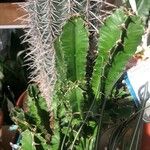
Euphorbia abyssinica
Abyssinian spurge · Desert-candle
Description
Source: leafsnapEuphorbia abyssinica is a succulent plant species belonging to the Euphorbia family. Native to Ethiopia, Somalia, and Kenya, it can grow up to 2 meters tall. The plant features a thick stem with numerous branches, all adorned with small, oval-shaped, bluish-green leaves. The flowers of Euphorbia abyssinica are small and yellow-green, appearing in clusters at the ends of the branches. They typically bloom during the spring season. Local communities in Africa commonly use this plant for medicinal purposes, treating ailments such as stomach problems, skin infections, and respiratory issues. Euphorbia abyssinica thrives in well-draining soil with moderate watering during its growing season, which spans from spring to fall. While the plant prefers full sun exposure, it can also tolerate partial shade. However, it's important to note that this plant contains toxic sap, which can cause skin irritation or even blindness if it comes into contact with eyes or open wounds. Therefore, it should be handled with care during pruning or propagation.
Care Guide
💧 Water Every 7 days
Euphorbia abyssinica is a drought-tolerant plant native to arid regions, renowned for its efficient water storage capabilities. It thrives in low humidity environments and requires infrequent watering, about once every three weeks. Often cultivated indoors, Euphorbia abyssinica effectively regulates water loss through its leaves, making it an excellent choice for container gardening indoors.
☀️ Light Full sun
Originating in arid areas, the desert candle performs best in full sun, its native habitat having intense sunlight and very little shade. It can also tolerate partial sun, giving it some flexibility in growth.
🌡️ Temperature 20–37.8°C
The desert candle flourishes in warm conditions and requires higher temperatures during the growing season to support its growth and metabolic processes. It prefers plenty of sunlight, suitable moisture levels, and good airflow. However, it can be harmed by very low temperatures and by overwatering. It is also important to avoid excessively high temperatures and excessively dry conditions.
💨 Humidity
🪴 Soil 6-7
🌱 Fertilizer
For desert candle, small amounts of fertilizer applied one to two times a year during the growing season are enough. Avoid fertilizing in winter and in summer when the plant is dormant. Cut back on fertilizer for repotted plants and wait a couple of months after repotting before you fertilize. Fertilizing helps maintain healthy growth and encourages flowering.
🪴 Pot & Repot Every 2 years
✂️ Pruning
This is a low-maintenance shrub that does not need extensive pruning unless absolutely essential, such as to eradicate dieback. This plant is not extremely appealing to deer, so they will often avoid it in favor of more appetizing vegetation.
🌿 Propagating
🐛 Diseases & pets
☠️ Toxicity
It produces a poisonous milky sap containing euphorbon. When the sap is applied to the skin, it produces a rash, irritating dermatitis, blistering, blindness, nausea, and vomiting. The Food and Drug Administration of the United States of America classifies it as a toxic plant.
Characteristics
- Plant Type
- Succulent
- Life Cycle
- Perennial
- Genus
- Euphorbia
- Family
- Euphorbiaceae
- Hardiness Zone
- 9-11
- Mature Height
- 3.05 m
- Mature Spread
- 49 cm
- Leaf Color
- Dark Green
- Leaf Type
- Deciduous
- Flower Color
- Yellow, Green
- Flower Size
- 0.51 cm to 0.76 cm
- Bloom Time
- Late spring, Summer
- Planting Time
- Spring, Summer, Autumn
- Harvest Time
- Late summer, Fall
- Native Area
- Africa, Asia, North America, South America