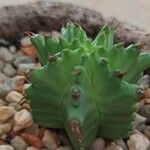
Euphorbia anoplia
Tanzania Zipper Plant · Tanzanian Zipper Plant
Description
Source: leafsnapEuphorbia is a very large and diverse genus of flowering plants, commonly called spurge, in the spurge family (Euphorbiaceae). "Euphorbia" is sometimes used in ordinary English to collectively refer to all members of Euphorbiaceae (in deference to the type genus), not just to members of the genus. Some euphorbias are commercially widely available, such as poinsettias at Christmas. Some are commonly cultivated as ornamentals, or collected and highly valued for the aesthetic appearance of their unique floral structures, such as the crown of thorns plant (Euphorbia milii). Euphorbias from the deserts of Southern Africa and Madagascar have evolved physical characteristics and forms similar to cacti of North and South America, so they (along with various other kinds of plants) are often incorrectly referred to as cacti. Some are used as ornamentals in landscaping, because of beautiful or striking overall forms, and drought and heat tolerance.Euphorbias range from tiny annual plants to large and long-lived trees. The genus has over or about 2,000 members, making it one of the largest genera of flowering plants. It also has one of the largest ranges of chromosome counts, along with Rumex and Senecio. Euphorbia antiquorum is the type species for the genus Euphorbia. It was first described by Carl Linnaeus in 1753 in Species Plantarum. The plants share the feature of having a poisonous, milky, white, latex-like sap, and unusual and unique floral structures. The genus may be described by properties of its members' gene sequences, or by the shape and form (morphology) of its heads of flowers. When viewed as a whole, the head of flowers looks like a single flower (a pseudanthium). It has a unique kind of pseudanthium, called a cyathium, where each flower in the head is reduced to its barest essential part needed for sexual reproduction. The individual flowers are either male or female, with the male flowers reduced to only the stamen, and the females to the pistil. These flowers have no sepals, petals, or other parts that are typical of flowers in other kinds of plants. Structures supporting the flower head and other structures underneath have evolved to attract pollinators with nectar, and with shapes and colors that function in a way petals and other flower parts do in other flowers. It is the only genus of plants that has all three kinds of photosynthesis, CAM, C3 and C4.
Care Guide
💧 Water Every 2-3 weeks
While the plant is known for its high drought tolerance, providing some water during the summer growing season is still necessary. While minimal, water is needed to support the plant's growth and maintain its overall health during this period. It is essential to balance by providing enough water to meet the plant's needs without overwatering. This helps prevent excessive moisture and potential issues like root rot.
☀️ Light
🌡️ Temperature
Dry settings are preferred for Tanzania Zipper Plant. If you shower your plant or add more humidity, water will remain on the leaves longer, which might foster the growth of dangerous fungi. Instead of milder temperatures, Euphorbia Anoplia prefers significantly warmer ones. It's important to keep your Euphorbia Anoplia away from colder climates and freezing conditions because doing so could hurt your succulent.
💨 Humidity
🪴 Soil
🌱 Fertilizer
The majority of potting soils are rich in nutrients that plants can use to create new growth. Your plant will probably have sufficiently grown by the time the nutrients in its soil have been used up to require a larger pot anyhow. Repot your Tanzania Zipper Plant once a year, or when it doubles in size, whichever comes first, to replace its nutrients.
🪴 Pot & Repot
✂️ Pruning
Although zipper plants are simple to grow, they do need to be pruned frequently. Keep your zipper plant healthy and beautiful by following these recommendations: 1. After the new growth has appeared in the spring, prune zipper plants. Reduce the branch tips to about one-third of their original height. 2. Trim any branches that are damaged or dead. 3. After the leaves have changed color in the fall, prune zipper plants.
🌿 Propagating
🐛 Diseases & pets
☠️ Toxicity
The milky sap (latex) running throughout Euphorbia plants is toxic to people and animals both via skin contact and ingestion. The plants actually use the sap as a defense mechanism to prevent animals from feeding on it, and the sap has some antifungal and antibacterial properties.
Characteristics
- Plant Type
- Succulent
- Genus
- Euphorbia
- Family
- Euphorbiaceae
- Native Area
- South Africa