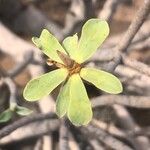
Euphorbia balsamifera
Balsam spurge
Description
Source: leafsnapEuphorbia balsamifera is a succulent plant belonging to the Euphorbiaceae family. Native to the Arabian Peninsula, it thrives in dry, rocky areas. This plant features thick, fleshy stems that can grow up to 1 meter in height, adorned with small, green leaves arranged in pairs along the stem. These leaves release a distinctive scent when crushed. From late winter through early spring, Euphorbia balsamifera produces small yellow-green flowers that bloom at the tips of its stems. Each flower cluster is made up of five petals. For centuries, various cultures have used Euphorbia balsamifera for medicinal purposes. It is believed to possess anti-inflammatory properties and has been employed to treat skin conditions such as eczema, psoriasis, and acne. However, it is important to note that Euphorbia balsamifera contains toxic compounds. These toxins can cause skin irritation and, if ingested or if the sap comes into contact with eyes or mucous membranes, may lead to severe issues such as blindness. In summary, Euphorbia balsamifera is a fascinating succulent with unique characteristics. Nevertheless, it should be handled with care due to its toxic properties.
Care Guide
💧 Water Every 7 days
Balsam spurge is an evergreen plant that thrives in arid regions and is exceptionally tolerant to drought. It requires minimal watering, usually just once every 2 to 3 weeks. The plant retains its leaves all year round, which helps it efficiently store water and makes it well-suited to survive in environments with limited water availability.
What is the right way to water my Balsam spurge plant?
Watering your Balsam spurge isn't too complicated. You can use any common watering tool like a watering can or hose, or even a cup. When watering, make sure to apply the water directly to the soil to evenly moisten all areas. Using filtered water is recommended to protect the plant from harmful particles in tap water. Also, try to use water at or slightly above room temperature, as very cold or hot water can be a bit shocking for the Balsam spurge. However, this plant generally responds well to any kind of water you give it.
What should I do if I give too much or too little water to my Balsam spurge?
For outdoor plants, especially newly planted ones or seedlings, lack of watering can be a problem. Keep in mind that when the tree is small or newly planted, you need to water it regularly for a few months. Once the roots are established, the Balsam spurge can rely on rain most of the time. When your Balsam spurge is planted in pots, overwatering is more likely to happen. If you accidentally overwater your Balsam spurge, take immediate action to fix the situation. Stop watering the plant immediately to minimize the effect of overwatering. Then, remove the plant from its pot to check its roots. If you see no signs of root rot, you can return the plant to its container. However, if you find root rot, trim away the affected roots and consider applying a fungicide to prevent further damage. Finally, repot the Balsam spurge in well-draining soil. In the case of underwatering, it is usually a simple fix. If you underwater, the plant's leaves will droop, dry out, and may fall off. However, after sufficient watering, the leaves will quickly regain their fullness. Make sure to correct your watering frequency as soon as you notice signs of underwatering.
How frequently do I need to water my Balsam spurge plant?
If your area gets enough rainfall, most outdoor plants can grow normally without any additional watering. However, in areas with limited rainfall, it is important to provide your plants with adequate watering. During the spring and fall, watering every two weeks should suffice. In the summer, when plants require more water, you will need to water more frequently. In the winter, when plant growth slows down and water needs decrease, you can reduce watering. In fact, during the winter, you may not need to water your plants at all. If your Balsam spurge is young or newly planted, it will require more frequent watering to help establish itself and grow into more adaptable and drought tolerant plants. For potted plants, there are two main ways to determine how often to water your Balsam spurge. The first is to set a predetermined watering schedule, such as once a week or once every two weeks. However, this approach may not always be accurate as it doesn't consider the specific growing conditions for your Balsam spurge. Watering frequency can also vary depending on the season. For example, a predetermined schedule may not be sufficient during the water-demanding summer months. An alternative method is to monitor the moisture levels in the soil. It is generally recommended to wait until the top two to four inches of soil, about one-third to half the depth of the pot, have completely dried out before watering again.
How much water does my Balsam spurge require?
When watering your Balsam spurge, you may be surprised to learn that it doesn't always require a large amount of water. Instead, if only a few inches of soil have dried since your last watering, you can promote healthy growth by giving it about five to ten ounces of water each time. You can also determine the amount of water based on the soil's moisture level. Take note of how many inches of soil have dried out between waterings. To ensure the Balsam spurge receives sufficient moisture, water enough to dampen all the soil layers that have dried since the last watering. If more than half of the soil has dried out, you may need to provide more water than usual. In such cases, continue watering until you see excess water draining from the pot's drainage holes. If your Balsam spurge is planted outdoors in an area with abundant rain, it may not require additional watering. When the plant is young or still establishing itself, it should receive 1-2 inches of rain per week. As the Balsam spurge grows and becomes established, it can rely solely on rainwater. Only if the weather is hot and there has been no rainfall for 2-3 weeks should you consider giving your Balsam spurge a thorough watering to prevent stress.
How do I know if I am watering my Balsam spurge enough?
When it comes to the Balsam spurge, overwatering is a more common issue that can be identified through certain signs. If the plant is overwatered, you will notice the leaves turning yellow and potentially falling off. Overwatering can also cause the plant's overall structure to shrink and lead to root rot. On the other hand, an underwatered Balsam spurge will start to sag and its leaves may become brown or brittle. Whether you see signs of overwatering or underwatering, it is important to take action and restore the plant's health.
☀️ Light Full sun
Balsam spurge is native to open habitats, such as sunlit meadows and forest margins, which offer abundant light. It does best in Full Sun but can also tolerate Partial Sun, adapting well to a range of sunlight conditions.
What are the sunlight requirements for Balsam spurge?
Balsam spurge, also known as Euphorbia balsamifera, thrives best in full sun, requiring more than 6 hours of sunlight daily, but it can also tolerate partial sun, which is about 3-6 hours of sunlight. It's essential to observe how sunlight moves through your garden to select spots that offer the ideal balance of light and shade, ensuring your plants are happy and healthy.
How does Balsam spurge adapt to different lighting conditions?
Originating from open environments such as sunny meadows and forest edges, Balsam spurge is well adapted to various sunlight conditions. It thrives in full sun but can also tolerate partial sun. For indoor plants, where natural sunlight might be insufficient, especially in winter or less sunny spaces, artificial lighting becomes crucial. Using the right type of artificial light, such as LED lights which can be customized to provide specific wavelengths, ensures optimal growth. Full sun plants require 30-50W per square foot, partial sun plants need 20-30W per square foot, and full shade plants benefit from 10-20W per square foot of artificial light.
What are the common symptoms of light deficiency in Balsam spurge?
Balsam spurge may show several symptoms when exposed to suboptimal lighting conditions, including smaller new leaves, leggy or sparse growth due to long spaces between leaves or stems, faster leaf drop to conserve resources, slower or no new growth as the plant enters survival mode, and paler new leaves indicating a lack of chlorophyll. In contrast, excessive sunlight can lead to chlorosis (leaves turning yellow), sunscald (damage from intense sun exposure), leaf curling (to minimize water loss), wilting (due to water loss through transpiration), and leaf scorching (brown, dry edges on leaves due to excessive light).
What solutions can alleviate the symptoms of light deficiency or damage in Balsam spurge?
To counteract light deficiency or damage in Balsam spurge, gradually move plants to sunnier locations to ensure they receive at least 6 hours of direct sunlight daily. For indoor plants that are large or not easily movable, use artificial lighting like desk or ceiling lamps, or invest in grow lights, keeping them on for at least 8 hours daily. Outdoor plants should be moved gradually to avoid sunburn. If sunlight is blocked by trees, consider pruning. For smaller plants, transplanting during their dormant period (late winter or early spring) to a sunnier location with good drainage may be beneficial. Note that parts of the plant affected by insufficient sunlight might not recover, but new growth should be healthy.
🌡️ Temperature 20–37.8°C
Balsam spurge comes from tropical areas, where the climate is generally warm and humid. As a result, it is well adapted to high temperatures and humidity. It does not tolerate sudden temperature changes and prefers a stable thermal environment, so indoor temperature fluctuations should be avoided. It typically cannot withstand cold and needs higher temperatures to grow. If the ambient temperature falls too low, the plant may stop growing or even die.
💨 Humidity
🪴 Soil 6-7
🌱 Fertilizer
Fertilizing is essential for caring for Balsam spurge. Consistent feeding throughout the growing season helps maintain vigor for its showy leaves and supports overall growth. Failing to fertilize can cause unhealthy foliage, reduced ornamental value, and stunted or weak growth that is prone to breaking.
🪴 Pot & Repot Every 12 months
✂️ Pruning
The balsam spurge, known for its succulent stems and drought resistance, benefits from regular pruning. It's best to prune in early to late winter, targeting dead or weak growth to encourage new shoots. This practice reduces stress during the plant's dormancy and boosts its growth in spring. Additionally, regular pruning enhances air circulation and promotes overall plant health.
🌿 Propagating
🐛 Diseases & pets
☠️ Toxicity
Characteristics
- Plant Type
- Tree, Shrub
- Life Cycle
- Perennial
- Genus
- Euphorbia
- Family
- Euphorbiaceae
- Hardiness Zone
- 9-11
- Mature Height
- 2.13 m to 4.88 m
- Mature Spread
- 0.91 m to 2.13 m
- Leaf Color
- Green
- Leaf Type
- Evergreen
- Flower Color
- Yellow, Green
- Flower Size
- 0.51 cm to 1.02 cm
- Bloom Time
- Spring
- Planting Time
- Summer, Autumn
- Harvest Time
- Late spring, Early summer, Mid summer