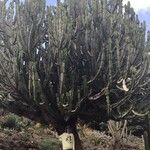
Euphorbia candelabrum
Candelabra tree · Giant euphorbia · Sudanese tree-euphorbia · Tree cactus · Naboom
Description
Source: leafsnapEuphorbia candelabrum, also known as the candelabra tree or milk tree, is a succulent plant species belonging to the Euphorbia family. It is native to tropical and subtropical regions of Africa and Madagascar. This plant can grow up to 10 meters tall, with a thick trunk that branches out into several arms resembling a candelabrum. The leaves of Euphorbia candelabrum are small and deciduous, falling off during dry seasons. The stems are green and contain white latex sap, which can cause skin irritation or allergic reactions in some individuals. During spring and summer, the plant produces small yellow-green flowers in clusters at the tips of its branches. These flowers attract pollinators like bees, butterflies, and birds. Euphorbia candelabrum is commonly used in traditional African medicine to treat various ailments such as skin infections, respiratory problems, and fever. Additionally, due to its unique shape, it is often used ornamentally in gardens or landscapes, especially in arid regions where it thrives due to its drought-resistant nature. However, caution should be exercised when handling this plant, as its toxic sap can cause severe irritation if it comes into direct contact with human skin or eyes.
Care Guide
💧 Water
☀️ Light Full sun
🌡️ Temperature 20–37.8°C
💨 Humidity
🪴 Soil 6-7
🌱 Fertilizer
🪴 Pot & Repot
✂️ Pruning
🌿 Propagating
🐛 Diseases & pets
☠️ Toxicity
Characteristics
- Plant Type
- Herb
- Life Cycle
- Perennial
- Genus
- Euphorbia
- Family
- Euphorbiaceae
- Hardiness Zone
- 9-12
- Mature Height
- 10.06 m
- Mature Spread
- 4.88 m
- Leaf Color
- Green
- Leaf Type
- Evergreen
- Flower Color
- Yellow, Green
- Flower Size
- 0.51 cm to 0.76 cm
- Bloom Time
- All year round
- Planting Time
- Spring
- Harvest Time
- All year round
- Native Area
- Malawi, Somalia, Angola, Burundi, Sudan, Zambia, Rwanda, Ethiopia, Kenya, Congo (DRC), Uganda, Tanzania, Zimbabwe