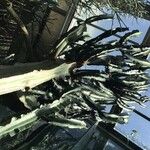
Euphorbia cooperi
Candelabra tree · Transvaal candelabra tree · Bushveld candelabra-tree
Description
Source: leafsnapEuphorbia cooperi is a flowering plant in the Euphorbiaceae family. It is commonly called Transvaal candelabra tree or bushveld candelabra euphorbia, and is found in South Africa.
Care Guide
💧 Water
The candelabra tree originates from semi-arid regions and thrives in dry conditions with minimal irrigation. Ideally, it should be watered once a week. Its succulent nature enhances its drought tolerance, making it an excellent choice for xeriscaping. As a deciduous plant, the candelabra tree conserves moisture by shedding its leaves during dry periods.
☀️ Light Full sun
Originating in arid regions, the Candelabra tree flourishes in full sun; its natural habitat is marked by intense sunlight and little shade. It can also tolerate partial sun, giving it some flexibility in where it grows.
What are the sunlight requirements for a Candelabra tree (Euphorbia cooperi)?
The Candelabra tree (Euphorbia cooperi) thrives in areas that receive full sun, which is defined as above 6 hours of sunlight per day. It can also tolerate partial sun, meaning about 3-6 hours of sunlight per day. It's important to observe how sunlight moves through your garden to find spots that offer the right balance of light and shade, ensuring the plants remain healthy and happy.
🌡️ Temperature 20–37.8°C
The candelabra tree performs best in warm conditions and needs elevated temperatures during the growing season to support growth and metabolic activity. It prefers plenty of sunlight, adequate moisture, and good air circulation. However, it can be damaged by very low temperatures and by overwatering. Likewise, excessively high heat and overly dry conditions should also be avoided.
What is the botanical name of the Candelabra tree?
The botanical name of the Candelabra tree is Euphorbia cooperi. This distinctive name is crucial for identifying and classifying the tree within the vast diversity of the plant kingdom.
💨 Humidity
🪴 Soil 0-0
🌱 Fertilizer
For the Candelabra tree, light applications of fertilizer once or twice a year during the growing season are enough. Do not fertilize in winter or in summer while the tree is dormant. Use less fertilizer for repotted plants and wait a couple of months after repotting before applying fertilizer. Fertilizing helps maintain healthy growth and promotes flowering.
🪴 Pot & Repot
✂️ Pruning
The candelabra tree is known for its distinctive shape and succulent branches. To keep it healthy and looking its best, it's recommended to prune the tree in early spring. This helps remove dead growth and improves airflow. Be sure to wear protective gloves while pruning, as the sap can be irritating. Regular pruning not only preserves the tree's unique form but also promotes vigorous growth.
🌿 Propagating
🐛 Diseases & pets
☠️ Toxicity
Characteristics
- Plant Type
- Tree, Succulent
- Life Cycle
- Perennial
- Genus
- Euphorbia
- Family
- Euphorbiaceae
- Hardiness Zone
- 9-11
- Mature Height
- 3.05 m to 6.1 m
- Mature Spread
- 2.13 m to 3.05 m
- Leaf Color
- Dark Green
- Leaf Type
- Deciduous
- Flower Size
- 1.02 cm to 2.03 cm
- Bloom Time
- All year round
- Planting Time
- Spring, Summer, Autumn
- Harvest Time
- All year round
- Native Area
- Malawi, Mozambique, Tanzania, South Africa, Zambia, Eswatini, Botswana, Zimbabwe