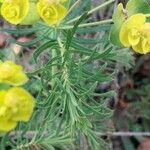
Euphorbia cyparissias
فرفیون · Cypress spurge · Bonaparte's crown · Cemetary plant · Graveyard moss
Description
Source: leafsnapEuphorbia cyparissias, commonly known as Cypress Spurge, is a perennial herbaceous plant belonging to the Euphorbiaceae family. Native to Europe and western Asia, it has also been introduced and naturalized in North America. The plant typically grows up to 30 cm in height and features narrow, dark green leaves that are spirally arranged around the stem. The small, yellow-green flowers of Euphorbia cyparissias bloom from late spring to early summer. The plant produces a milky sap that can cause skin irritation or allergic reactions in some individuals. Cypress Spurge thrives in well-drained soils with full sun exposure but can also tolerate partial shade. Due to its low maintenance requirements and ability to spread rapidly through underground rhizomes, it is often used as a ground cover or border plant. Despite its invasive nature, Euphorbia cyparissias possesses some medicinal properties. For example, it has anti-inflammatory effects on skin conditions like eczema and psoriasis when applied topically. However, caution is advised because its toxic sap can cause severe eye irritation upon contact. In summary, Euphorbia cyparissias is an attractive ornamental plant that is easy to care for. Nevertheless, it should be handled carefully due to its toxic properties.
💡 Cypress spurge may look like a miniature pine or cypress tree, but it's not related to either. This plant produces clusters of small flowers and spreads quickly, making it an excellent ground cover for dry, rocky areas. However, it is considered invasive in some regions. Like other members of the euphorbia family, cypress spurge has a milky sap that is toxic.
🌳 Cypress spurge is mainly valued as an ornamental in gardens because of its attractive, fern-like foliage and yellow-green flowers. However, it has also become notorious for invasive behavior in some regions, where it can outcompete native species. Attempts to control its spread uncovered its allelopathic properties, which could be used in developing natural herbicides. This unexpected ecological effect illustrates the plant's double-edged relationship with the environment.
🎭 Long life, Recovery, Cleanliness, Safeguarding, Insight
Care Guide
💧 Water Every 7 days
Cypress spurge thrives in well-drained soil with moderate moisture and grows best in temperate climates with seasonal rainfall. Once it is established, this plant becomes drought-tolerant, needing only weekly watering for optimal growth. It efficiently stores water to maintain proper hydration.
How much water does my Cypress spurge need?
If your Cypress spurge is planted in a pot, the best way to determine if it needs water is by checking the soil. Stick your finger into the soil and if the top two to three inches are dry, it's time to water it. If you have your Cypress spurge planted directly in the ground outdoors, you can use the same method. Check if the top few inches of soil are dry and if they are, it's time to water. During the spring and early fall, you will typically need to water this plant once a week using this method. However, in extremely hot weather, you may need to increase your watering frequency to twice or more per week. It's worth noting that mature, well-established Cypress spurge plants have a remarkable ability to tolerate dry conditions.
How does watering my Cypress spurge inside compare to watering it outside?
For gardeners who don't reside in temperate or tropical regions, growing Cypress spurge indoors is a common practice. However, it's important to note that soil in containers tends to dry out faster than ground soil. Additionally, if you have drying elements like air conditioning units, your Cypress spurge may require more frequent watering compared to if it were planted outdoors. In such cases, if you choose to plant it outside, you may not need to water it very often, especially if you receive regular rainfall. On the other hand, if you grow the plant indoors, you will need to water it more frequently since relying on rainfall to saturate the soil won't be possible.
How should I water my Cypress spurge?
When watering the Cypress spurge, it is recommended to use filtered water at room temperature. Tap water may have particles that can harm this plant's health. This plant prefers water that is at room temperature or slightly warmer because it comes from a warm environment and cold water can be a bit of a shock to its system. Avoid overhead watering as it can cause problems with the foliage. Instead, water the plant by applying filtered room temperature water to the soil until it is fully soaked. It is beneficial for the plant to have the soil soaked as it helps to moisten the roots and allows them to spread through the soil and absorb the necessary nutrients.
What do I do if I give my Cypress spurge too much or too little water?
Overwatering is a more common issue for the health of your Cypress spurge. It causes wilting and yellowing of the stems and leaves, and can lead to diseases like root rot, mold, and mildew. Underwatering is less common, but can still happen. It causes brittle and brown leaves. It is important to notice the signs of overwatering early, as some of the resulting diseases may not be fixable if left too long. Reduce watering immediately if you see early signs of overwatering. Check the soil drainage and replace it with a well-draining potting mix if necessary. If your Cypress spurge is not getting enough water, simply water more regularly until the signs subside.
How much water does my Cypress spurge require?
When watering your Cypress spurge, it's important to not be conservative with the amount of water you use. Make sure the top couple of inches of soil are dry before watering, then give the plant a deep and thorough watering. You want to fully saturate the soil, allowing excess water to flow out of the drainage holes at the bottom of the pot. If you don't see any excess water draining out, it means you haven't watered enough. However, you also don't want water to accumulate in the soil, as this can harm the plant. It's also important to use well-draining soil, as poor drainage can be detrimental to the plant's health. If the plant is outside, a weekly rainfall of 1 inch should be enough.
☀️ Light Full sun
Cypress spurge does best with plenty of sunlight, though it can also tolerate areas with moderate sun. It originated in environments with strong sunlight, which benefits its health and growth. Both too much and too little light can impede its development.
What are the sunlight requirements for Cypress Spurge?
Cypress Spurge requires full sun, which is defined as receiving above 6 hours of sunlight daily, or partial sun, amounting to about 3-6 hours of sunlight. It's crucial to observe the sunlight's movement in your garden to find locations that offer a balanced exposure for the plants. Adequate sunlight is essential for the plant's happiness and growth.
Can Cypress Spurge adapt to different light conditions?
Yes, Cypress Spurge is capable of adapting to various light conditions. Although it thrives best under abundant sunshine, it can also grow in areas with moderate sun exposure. This adaptability is a result of its origin from habitats accustomed to ample sunlight. Both too much and too little light can negatively affect its growth, highlighting the importance of finding the right balance.
Is artificial lighting beneficial for Cypress Spurge?
Artificial lighting can be beneficial for Cypress Spurge, especially when natural sunlight is lacking, such as during winter or in less sunny spaces. Indoor plants require adequate lighting for optimal growth, and artificial lights, including LEDs, can be tailored to provide the specific wavelengths needed by the plants. The recommended artificial light intensity varies depending on the plant's natural light requirements, spanning from 10-20W/sq ft for full shade plants to 30-50W/sq ft for full sun plants. The appropriate distance is 12-36 inches above the plant, and most plants benefit from 8-12 hours of artificial light daily.
What are the symptoms of inadequate lighting for Cypress Spurge?
Inadequate lighting can lead to several symptoms in Cypress Spurge, including smaller new leaves, leggy or sparse growth, faster leaf drop, slower or halted growth, and discoloration or chlorophyll deficiency in new leaves. Additionally, too much sunlight can result in chlorosis, sunscald, leaf curling, wilting, and leaf scorching. These conditions indicate the plant's struggle with its lighting environment and necessitate adjustments.
How can I address light-related issues for my Cypress Spurge?
Addressing light-related issues for Cypress Spurge involves adjusting the plant's exposure to sunlight. Indoors, you can gradually move the plant to a sunnier location to ensure it receives at least 6 hours of direct sunlight daily. Utilizing a south-facing window or professional grow lights can also help. Outdoors, gradually acclimate plants to brighter spots while avoiding drastic changes to prevent sunburn. Reducing obstructions, like pruning trees, or transplanting to sunnier locations with good drainage, can improve the situation. Note that parts of the plant already affected by poor light may not recover, but new growth will be healthy after increasing light exposure.
🌡️ Temperature 5–32.2°C
The cypress spurge is a temperate woody plant that favors temperatures from 41 to 90 ℉ (5 to 32 ℃). Its native habitat indicates it can tolerate a range of temperatures, though it performs best in cooler conditions. During warmer seasons, providing shade and adding mulch can help the plant cope with higher temperatures.
What are the essential growth conditions for Cypress spurge?
Cypress spurge, known botanically as Euphorbia cyparissias, thrives in a temperature range of 41 to 90°F (5 to 32°C), indicating its preference for cooler climates. This temperate woody plant is quite versatile, handling a variety of temperatures graciously. To aid in its adjustment to warmer temperatures during the hotter seasons, implementing shade and mulching can be beneficial. Furthermore, Cypress spurge possesses a notable resistance to cold, negating the need for specific frost protection measures in winter. In situations where winter temperatures plummet below its tolerance levels, safeguarding the plant with soil or straw coverings can provide needed cold protection. It's also advisable to water the plant thoroughly before the onset of the first freeze in autumn, to maintain soil moisture throughout the cold season, preventing drought stress.
How should you care for Cypress spurge in low temperatures?
Cypress spurge exhibits high tolerance to cold temperatures, performing optimally when the environment is kept above its minimum growth threshold. During winter, the plant should be maintained above its minimum tolerable growing temperature. If temperatures dip below the critical low growth limit, though immediate visible damage may not be apparent, there could be a significant impact on the plant's vitality come spring, potentially resulting in reduced or absent sprouting. To manage this, any parts of the plant that fail to sprout in the spring should be pruned away to encourage new growth and maintain plant health.
What care does Cypress spurge need in high temperatures?
In the summer months, it's crucial to ensure the temperature around Cypress spurge does not exceed its maximum optimal growth temperature. Should temperatures rise above its maximum tolerable limit, you might observe signs of stress on the plant, such as lighter leaf color, leaf curling, susceptibility to sunburn, and in severe cases, wilting or complete drying of the plant. To mitigate these issues, it's recommended to trim away the affected parts of the plant. Relocating the plant to an area with afternoon shade or using a shade cloth can also provide relief from intense sun exposure. Maintaining soil moisture through regular watering sessions during the cooler parts of the day, in the morning and evening, is essential to the plant's well-being during high temperatures.
💨 Humidity
🪴 Soil 6-7
🌱 Fertilizer
Typically, a single fertilizer application in spring suffices for Cypress spurge, though repeated feedings can boost growth. Apply every month to every month and a half. Fertilization improves leaf appearance and function, helping maintain even color and a healthy texture. It also promotes root development and nutrient uptake for long-term plant health.
🪴 Pot & Repot 2-3 years
When repotting Cypress spurge, select a pot 1-2 inches (2.5–5.1 cm) larger with good drainage. Use a well-draining potting mix. Repot in spring or fall, making sure the root ball sits slightly below the rim of the flower pot. Water thoroughly after repotting and place in a warm spot with indirect sunlight.
✂️ Pruning
🌿 Propagating
🐛 Diseases & pets
☠️ Toxicity
Characteristics
- Plant Type
- Herb
- Life Cycle
- Perennial
- Genus
- Euphorbia
- Family
- Euphorbiaceae
- Hardiness Zone
- 4-8
- Mature Height
- 15 cm to 49 cm
- Mature Spread
- 30 cm to 61 cm
- Leaf Color
- Green, Blue, Red, Purple
- Leaf Type
- Deciduous
- Flower Color
- Yellow
- Flower Size
- 0.76 cm to 1.27 cm
- Bloom Time
- Mid spring, Late spring, Early summer
- Planting Time
- Spring, Summer
- Harvest Time
- Early summer, Mid summer
- Native Area
- Austria, Czech Republic, Slovakia, Montenegro, Bulgaria, Poland, Greece, Croatia, Slovenia, Belarus, Ukraine, Serbia, Russia, Lithuania, Hungary, Germany, Italy, Spain, Switzerland, France, Albania, Romania, Latvia, Belgium, Netherlands