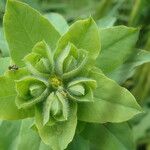
Euphorbia hirsuta
Hairy spurge · Pubescent Spurge
Description
Source: leafsnapEuphorbia hirsuta is a perennial plant belonging to the Euphorbiaceae family. Native to the Mediterranean region, it thrives in various habitats, including rocky slopes, dry meadows, and open woodlands. The plant can grow up to 50 cm tall and features hairy stems that are either green or reddish-brown. The leaves of Euphorbia hirsuta are small, narrow, and hairy, growing alternately along the stem. They exhibit a gray-green hue with reddish margins. The plant's flowers are small but numerous, with yellow-green petals forming clusters at the top of each stem. Known for its medicinal properties, Euphorbia hirsuta contains compounds such as flavonoids, alkaloids, and tannins, which possess anti-inflammatory properties. Traditionally, it has been used to treat various skin ailments, including eczema and psoriasis. In addition to its medicinal benefits, Euphorbia hirsuta also holds ornamental value due to its attractive foliage, making it an excellent addition to gardens or landscapes. It can be used as an ornamental border or ground cover. However, caution is advised when handling this plant, as all parts contain a milky sap that can cause skin irritation upon direct contact. It is recommended to wear gloves when handling Euphorbia hirsuta to avoid any adverse reactions.
Care Guide
💧 Water Every 7 days
To keep pubescent spurge healthy, water it about once a week during the growing season. Check the soil and water when the top 2 inches feel dry. During its resting period indoors, make sure the plant still receives enough moisture. For best results, water from below to avoid excess moisture on the leaves.
☀️ Light Full sun
Hairy spurge is a sun-loving perennial herbaceous plant that comes from open habitats and is often found in meadows and grasslands. It prefers full sun but can also tolerate partial sun.
🌡️ Temperature 5–35°C
Hairy spurge can tolerate a wide variety of temperatures, but its distribution can still be restricted by particular combinations of moisture and heat. It performs best in warm summer climates with sufficient rainfall or irrigation. Extended periods of cloudy, rainy weather or prolonged high temperatures increase the risk of Hairy spurge dying. In winter, adequate protection from cold can raise the plant's survival rate.
💨 Humidity
🪴 Soil 6-8
🌱 Fertilizer
Typically one spring fertilizer treatment is adequate for Hairy spurge, though multiple applications can boost growth to its fullest. Apply fertilizer roughly every month to six weeks. Fertilizing improves the leaves' appearance and function, helping preserve even color and a healthy texture. It also promotes root development and better nutrient uptake for sustained plant health.
🪴 Pot & Repot
✂️ Pruning
🌿 Propagating
🐛 Diseases & pets
☠️ Toxicity
Characteristics
- Plant Type
- Herb
- Life Cycle
- Perennial
- Genus
- Euphorbia
- Family
- Euphorbiaceae
- Hardiness Zone
- 5-9
- Mature Height
- 49 cm to 76 cm
- Mature Spread
- 30 cm to 49 cm
- Leaf Color
- Green, Dark Green
- Leaf Type
- Semi-evergreen
- Flower Color
- Yellow
- Flower Size
- 1.02 cm to 2.03 cm
- Bloom Time
- Late spring, Early summer, Mid summer
- Planting Time
- Spring, Autumn
- Harvest Time
- Mid summer, Late summer, Early fall