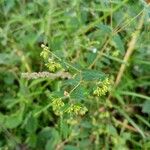
Euphorbia hyssopifolia
فرفیون هرز، · Hyssop-leaf sandmat · Hyssopleaf Sandmat · Hyssop spurge · Leafy spurge
Description
Source: leafsnapEuphorbia hyssopifolia, commonly known as hyssop spurge, is a small herbaceous plant in the Euphorbiaceae family. It is native to tropical and subtropical regions of Africa, Asia, and Australia. The plant typically grows up to 30 cm in height, with slender stems and small leaves arranged in opposite pairs along the stem. The leaves of Euphorbia hyssopifolia are narrow, lance-shaped, and have a smooth surface. Its flowers are small and greenish-yellow, clustered at the tips of the branches. The plant produces fruit capsules, each containing three seeds. Euphorbia hyssopifolia has been used for medicinal purposes for centuries across various cultures. It is believed to have anti-inflammatory properties, making it useful for treating skin conditions like eczema or psoriasis. However, the plant also contains toxic compounds that can cause skin irritation or even blindness if ingested or if its sap comes into contact with the eyes or mucous membranes. Hyssop spurge is often cultivated as an ornamental plant because of its attractive foliage and flowers. It can be grown both indoors and outdoors but requires well-drained soil, moderate watering, and either full sun or partial shade, depending on climate conditions. In summary, Euphorbia hyssopifolia is an intriguing species due to its unique medicinal properties but must be handled with caution because of its toxic nature when ingested by humans or animals.
🎭 Cleansing, Safeguarding
Care Guide
💧 Water Every 7 days
Hyssop-leaf sandmat thrives in consistently moist environments and needs weekly watering to prevent it from drying out. Applying mulch can help retain moisture during hot periods, which directly supports its growth by conserving water effectively.
How should I water my Hyssop-leaf sandmat plant?
To water Hyssop-leaf sandmat, you can use various tools like a garden hose with a spray nozzle or a watering can. The plant is not particular about the type of water it receives, so rainwater, tap water, or filtered water are all fine. However, it is best to avoid watering from overhead as it can harm the leaves and flowers and potentially lead to disease. Setting up a drip irrigation system is often the most effective way to water this plant as it evenly and directly supplies water to the soil. If you have a container-grown Hyssop-leaf sandmat, you can use a cup, watering can, or tap water to directly water the soil.
What do I need to do if I give my Hyssop-leaf sandmat too much water or too little water?
To fix underwatering of your Hyssop-leaf sandmat, simply start watering it more regularly when you notice it lacks moisture. Overwatering can be a serious issue, especially if not caught early. It can cause diseases that lead to the decline and death of your Hyssop-leaf sandmat. To prevent overwatering, choose a suitable location for growth. This means a spot with ample sunlight to dry the soil and good drainage to avoid waterlogging. If your potted Hyssop-leaf sandmat has been overwatered, you may need to change the pot. The previous container might not have had proper drainage or enough drainage holes. When repotting the overwatered plant, use loose soil and a well-draining pot to ensure efficient drainage.
How frequently should I water my Hyssop-leaf sandmat plant?
To keep your Hyssop-leaf sandmat healthy, it is important to water it regularly throughout the growing season. In spring, watering once a week should be sufficient. However, as the weather gets warmer, you may need to increase watering to two or three times a week. It is important not to exceed this frequency as it can harm the plant. Regardless of how often you water, make sure the soil remains moderately moist but not overly wet. When watering a potted Hyssop-leaf sandmat, keep in mind that the soil in a container dries out more quickly than ground soil. Therefore, you will likely need to water the potted plant a few times per week, compared to just once per week for a plant in the ground.
How much water does my Hyssop-leaf sandmat plant need?
When determining how much water to give your Hyssop-leaf sandmat, there are a few options. Some gardeners prefer to check the soil moisture by feeling it and water until the first six inches are moist. Alternatively, you can use a set measurement, such as two gallons per week, depending on the temperature and soil dryness. However, be cautious of overwatering if your plant needs less. For container-grown Hyssop-leaf sandmat, you must use a different method. Water enough to moisten all dry soil layers, which can be checked by sticking your finger in the soil or seeing excess water draining from the pot.
Am I giving enough water to my Hyssop-leaf sandmat?
Avoiding overwatering can be challenging when caring for your Hyssop-leaf sandmat. On one hand, the deep roots of these plants need weekly soil moistening. On the other hand, these plants are highly prone to root rot, which can cause browning. Underwatering is less likely, as these plants can survive without much additional watering. However, if you neglect to water them for too long, they may wilt and have dry leaves.
☀️ Light Full sun
The hyssop-leaf sandmat requires strong light, doing best in locations where sunlight is present throughout the day. It can still grow satisfactorily in partially lit conditions. Native to habitats with high solar exposure, both too little and too much light can lead to poor growth or harm. Its different growth stages also reflect this preference for abundant sun.
What are the sun requirements for Hyssop-leaf sandmat?
Hyssop-leaf sandmat thrives best in full sun conditions, requiring above 6 hours of sunlight daily. It can also grow in partial sun, which means about 3-6 hours of sunlight each day. It is crucial to observe how sunlight moves through your garden throughout the day and choose planting spots that provide an optimum balance of light and shade, ensuring the plants' best growth and health.
Can Hyssop-leaf sandmat grow under artificial lighting?
Yes, Hyssop-leaf sandmat can grow under artificial lighting, especially when natural sunlight is insufficient, such as during winter or in less sunny indoor spaces. The right type of artificial light, like LED, should be chosen to provide the specific wavelengths needed by the plant. Full sun plants require 30-50W/sq ft, partial sun plants need 20-30W/sq ft, and full shade plants should have 10-20W/sq ft of artificial light. The light source should be placed 12-36 inches above the plant to mimic natural sunlight conditions, and the duration should replicate natural daylight hours, typically 8-12 hours per day.
What symptoms indicate insufficient or excessive sunlight in Hyssop-leaf sandmat?
Symptoms of insufficient sunlight in Hyssop-leaf sandmat include smaller new leaves, leggy or sparse growth, faster leaf drop, slower or no new growth, and lighter-colored or irregularly patterned new leaves. Excessive sunlight can cause symptoms such as chlorosis (leaves losing their green color), sunscald (pale, bleached areas on plant tissue), leaf curling or twisting, wilting, and leaf scorching (brown, dry edges on leaves). These symptoms help identify whether the plant is receiving too little or too much sunlight.
How can I address sunlight-related issues in Hyssop-leaf sandmat?
To address sunlight-related issues in Hyssop-leaf sandmat, gradually increase the plant's exposure to sunlight if it has been receiving too little, moving it to a sunnier spot each week. For outdoor plants, it's essential to avoid sudden changes in light intensity to prevent sunburn. Indoors, use artificial lighting to supplement natural light, keeping lights on for at least 8 hours daily for plants that aren't easily movable. If sunlight is blocked by obstacles, consider pruning or transplanting to a better-lit location. Note that parts of the plant damaged by poor light may not recover, but new growth should be healthy with improved light conditions.
🌡️ Temperature 10–41.1°C
Hyssop-leaf sandmat is native to habitats where temperatures range from 68 to 105.8 °F (20 to 41 ℃), flourishing in warmer conditions. For optimal development, keep these temperatures throughout the growth period.
What is the ideal temperature range for growing Hyssop-leaf sandmat?
The Hyssop-leaf sandmat thrives in environments with temperatures ranging between 68 to 105.8°F (20 to 41°C). To ensure optimal development, it's important to maintain these temperatures throughout the plant's growth period. Hyssop-leaf sandmat has strong cold resistance, indicating that special frost protection measures are not usually necessary during winter. However, protections such as covering the plant with soil or straw should be considered if winter temperatures are expected to drop below the growth limit temperature. Additionally, watering the plant abundantly before the first freeze in autumn is recommended to keep the soil moist and protect the plant against drought and water scarcity during winter and early spring.
How does Hyssop-leaf sandmat react to low temperatures?
Hyssop-leaf sandmat is cold-tolerant and thrives best when temperatures are kept above a certain minimum suitable growth temperature. Throughout the winter, it's important to ensure temperatures remain above the tolerable growing temperature minimum. When temperatures drop below the growth limit temperature, there might not be noticeable changes during winter, but a decrease in sprouting or even a lack of sprouting could occur come springtime. If this happens, it's suggested to remove any parts of the plant that have failed to sprout in the spring.
What should I do if the Hyssop-leaf sandmat experiences high temperatures?
During summer, it's essential to ensure that the Hyssop-leaf sandmat's surrounding temperature is kept below a certain maximum suitable growth temperature. If temperatures exceed the tolerable growing temperature maximum, the plant's leaves may become lighter in color, curl, and become prone to sunburn. In severe cases, the plant may wilt and dry up entirely. To mitigate these issues, trim away sunburned and dried-up parts of the plant. Moving the plant to a shaded location or using a shade cloth to protect it from midday and afternoon sun is advisable. Additionally, watering the plant in the morning and evening can help keep the soil moist and prevent further stress.
💨 Humidity
🪴 Soil 6-7
🌱 Fertilizer
Hyssop-leaf sandmat responds well to regular, dilute applications of fertilizer to encourage healthy leaf development. You should fertilize Hyssop-leaf sandmat about once a month during the summer. Nitrogen is important for foliage, and adding nitrogen-rich sources helps Hyssop-leaf sandmat thrive.
🪴 Pot & Repot
✂️ Pruning
🌿 Propagating
🐛 Diseases & pets
☠️ Toxicity
Characteristics
- Plant Type
- Herb
- Life Cycle
- Annual
- Genus
- Euphorbia
- Family
- Euphorbiaceae
- Hardiness Zone
- 6-13
- Mature Height
- 91 cm
- Mature Spread
- 0.2 m to 3.96 m
- Leaf Color
- Green
- Leaf Type
- Evergreen
- Flower Color
- White
- Flower Size
- 0.05 cm
- Bloom Time
- Late spring, Early summer, Mid summer
- Planting Time
- Spring, Summer, Autumn, Winter
- Harvest Time
- Summer
- Native Area
- Colombia, Bahamas, Belize, Cuba, Honduras, Mexico, Guatemala, Bolivia, Venezuela, Peru, Brazil, Guyana, El Salvador, Nicaragua, Ecuador, Costa Rica, Panama, Jamaica